



Initialising ...
Initialising ...
Initialising ...
Initialising ...
Initialising ...
Initialising ...
Initialising ...
Catumba, G.*; Hiraguchi, Atsuki; Hou, G. W.-S.*; Jansen, K.*; Kao, Y.-J.*; David Lin, C.-J.*; Ramos, A.*; Sarkar, M.*
Proceedings of Science (Internet), 466, p.145_1 - 145_10, 2025/12
The custodial Two-Higgs-Doublet-Model with SU(2) gauge fields is studied on the lattice. This model has the same global symmetry structure as the Standard Model but the additional Higgs field enlarges the scalar spectrum and opens the possibility for the occurrence of spontaneous symmetry breaking of the global symmetries. Both the spectrum and the running of the gauge coupling of the custodial 2HDM are studied on a line of constant Standard Model physics with cutoff ranging from 300 to 600 GeV. The lower bounds of the realizable masses for the additional BSM scalar states are found to be well bellow the W boson mass. In fact, for the choice of quartic couplings in this work the estimated lower mass for one of the BSM states is found to be about  0.2
0.2 
 and independent of the cutoff.
Catumba, G.*; Hiraguchi, Atsuki; Hou, W.-S.*; Jansen, K.*; Kao, Y.-J.*; David Lin, C.-J.*; Ramos, A.*; Sarkar, M.*
Physical Review Research (Internet), 6(4), p.043172_1 - 043172_12, 2024/11
Gauge theories with matter fields in various representations play an important role in different branches of physics. Recently, it was proposed that several aspects of the interesting pseudogap phase of cuprate superconductors near optimal doping may be explained by an emergent SU(2) gauge symmetry. Around the transition with positive hole-doping, one can construct a (2+1)-dimensional SU(2) gauge theory coupled to four adjoint scalar fields which gives rise to a rich phase diagram with a myriad of phases having different broken symmetries. We study the phase diagram of this model on the Euclidean lattice using the Hybrid Monte Carlo algorithm. We find the existence of multiple broken phases as predicted by previous mean field studies. Depending on the quartic couplings, the SU(2) gauge symmetry is broken down either to U(1) or  in the perturbative description of the model. We further study the confinement-deconfinement transition in this theory, and find that both the broken phases are deconfining in the range of volumes that we studied. However, there exists a marked difference in the behavior of the Polyakov loop between the two phases.
 gauge fields
Catumba, G.*; Hiraguchi, Atsuki; W.-S. Hou, G.*; Jansen, K.*; Kao, Y.-J.*; David Lin, C.-J.*; Ramos, A.*; Sarkar, M.*
Proceedings of Science (Internet), 453, p.87_1 - 87_9, 2024/11
We study the most general Two Higgs Doublet Model with gauge fields on the lattice. The phase space is probed through the computation of gauge-invariant global observables serving as proxies for order parameters. In each phase, the spectrum of the theory is analysed for different combinations of bare couplings and different symmetry breaking patterns. The scale setting and determination of the running gauge coupling are performed through the Wilson flow computation of the action density.
Catumba, G.*; Hiraguchi, Atsuki; W.-S. Hou, G.*; Jansen, K.*; Kao, Y.-J.*; David Lin, C.-J.*; Ramos, A.*; Sarkar, M.*
Proceedings of Science (Internet), 453, p.362_1 - 362_7, 2024/11
We study a 3-dimensional SU(2) gauge theory with 4 Higgs fields which transform under the adjoint representation of the gauge group, that has been recently proposed by Sachdev et al. to explain the physics of cuprate superconductors near optimal doping. The symmetric confining phase of the theory corresponds to the usual Fermi-liquid phase while the broken (Higgs) phase is associated with the interesting pseudogap phase of cuprates. We employ the Hybrid Monte-Carlo algorithm to study the phase diagram of the theory. We find the existence of a variety of broken phases in qualitative accordance with earlier mean-field predictions and discuss their role in cuprates. In addition, we investigate the behavior of Polyakov loop to probe the confinement/deconfinement phase transition, and find that the Higgs phase hosts a stable deconfining phase consistent with previous studies.

Linh, B. D.*; Corsi, A.*; Gillibert, A.*; Obertelli, A.*; Doornenbal, P.*; Barbieri, C.*; Duguet, T.*; G mez-Ramos, M.*; Holt, J. D.*; Hu, B. S.*; et al.
Physical Review C, 109(3), p.034312_1 - 034312_15, 2024/03
Times Cited Count:3 Percentile:64.72(Physics, Nuclear)no abstracts in English
Meer, H.*; Wust, S.*; Schmitt, C.*; Herrgen, P.*; Fuhrmann, F.*; Hirtle, S.*; Bednarz, B.*; Rajan, A.*; Ramos, R.*; Ni o, M. A.*; et al.
Advanced Functional Materials, 33(21), p.2213536_1 - 2213536_6, 2023/05
Times Cited Count:7 Percentile:55.34(Chemistry, Multidisciplinary)100 MeV/nucleonPohl, T.*; Sun, Y. L.*; Obertelli, A.*; Lee, J.*; Gmez-Ramos, M.*; Ogata, Kazuyuki*; Yoshida, Kazuki; Cai, B. S.*; Yuan, C. X.*; Brown, B. A.*; et al.
Physical Review Letters, 130(17), p.172501_1 - 172501_8, 2023/04
Times Cited Count:17 Percentile:85.36(Physics, Multidisciplinary)We report on the first proton-induced single proton- and neutron-removal reactions from the neutron deficient  O nucleus with large Fermi-surface asymmetry at 100 MeV/nucleon. Our results provide the first quantitative contributions of multiple reaction mechanisms including the quasifree knockout, inelastic scattering, and nucleon transfer processes. It is shown that the inelastic scattering and nucleon transfer, usually neglected at such energy regime, contribute about 50% and 30% to the loosely bound proton and deeply bound neutron removal, respectively.
 Cl isotopes
Linh, B. D.*; Corsi, A.*; Gillibert, A.*; Obertelli, A.*; Doornenbal, P.*; Barbieri, C.*; Chen, S.*; Chung, L. X.*; Duguet, T.*; Gmez-Ramos, M.*; et al.
Physical Review C, 104(4), p.044331_1 - 044331_16, 2021/10
Times Cited Count:11 Percentile:72.73(Physics, Nuclear)no abstracts in English
Schmitt, C.*; Lemasson, A.*; Schmidt, K.-H.*; Jhingan, A.*; Biswas, S.*; Kim, Y. H.*; Ramos, D.*; Andreyev, A. N.; Curien, D.*; Ciemala, M.*; et al.
Physical Review Letters, 126(13), p.132502_1 - 132502_6, 2021/04
Times Cited Count:27 Percentile:83.35(Physics, Multidisciplinary)P rez S
rez S nchez, R.*; Jurado, B.*; Mot, V.*; Roig, O.*; Dupuis, M.*; Bouland, O.*; Denis-Petit, D.*; Marini, P.*; Mathieu, L.*; Tsekhanovich, I.*; et al.
Physical Review Letters, 125(12), p.122502_1 - 122502_5, 2020/09
Times Cited Count:24 Percentile:75.98(Physics, Multidisciplinary) ) two-proton knockout from neutron-rich nuclei
Frotscher, A.*; Gmez-Ramos, M.*; Obertelli, A.*; Doornenbal, P.*; Authelet, G.*; Baba, Hidetada*; Orlandi, R.; 86 of others*
Physical Review Letters, 125(1), p.012501_1 - 012501_7, 2020/07
Times Cited Count:10 Percentile:54.10(Physics, Multidisciplinary)Chrysalidis, K.*; Barzakh, A. E.*; Ahmed, R.*; Andreyev, A. N.; Ballof, J.*; Cubiss, J. G.*; Fedorov, D. V.*; Fedosseev, V. N.*; Fraile, L. M.*; Harding, R. D.*; et al.
Nuclear Instruments and Methods in Physics Research B, 463, p.472 - 475, 2020/01
Times Cited Count:3 Percentile:26.88(Instruments & Instrumentation)A number of radiogenically produced dysprosium isotopes have been studied by in-source laser spectroscopy at ISOLDE using the Resonance Ionization Laser Ion Source (RILIS). Isotope shifts were measured relative to  Dy in the
  (gs)
(gs) 
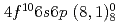 (418.8 nm
  )resonance transition. The electronic factor,
  , and mass shift factor, M, were extracted and used for determining the changes in mean-squared charge radii for
  Dy and
  Dy for the first time.

 He
He
 reaction for the
  bound-state search in the J-PARC E15 experiment
Sekihara, Takayasu; Oset, E.*; Ramos, A.*
JPS Conference Proceedings (Internet), 26, p.023009_1 - 023009_4, 2019/11
Ramos, R.*; Hioki, Tomosato*; Hashimoto, Yusuke*; Kikkawa, Takashi*; Frey, P.*; Kreil, A. J. E.*; Vasyuchka, V. I.*; Serga, A. A.*; Hillebrands, B.*; Saito, Eiji
Nature Communications (Internet), 10, p.5162_1 - 5162_8, 2019/11
Times Cited Count:29 Percentile:74.61(Multidisciplinary Sciences) O
O /Pt/FeO epitaxial trilayers
Kikkawa, Takashi*; Suzuki, Motohiro*; Ramos, R.*; Aguirre, M. H.*; Okabayashi, Jun*; Uchida, Kenichi*; Lucas, I.*; Anadn, A.*; Kikuchi, Daisuke*; Algarabel, P. A.*; et al.
Journal of Applied Physics, 126(14), p.143903_1 - 143903_11, 2019/10
Times Cited Count:13 Percentile:48.32(Physics, Applied)el order switching in antiferromagnetic thin films revealed by magnetotransport and direct imagingBaldrati, L.*; Gomonay, O.*; Ross, A.*; Filianina, M.*; Lebrun, R.*; Ramos, R.*; Leveille, C.*; Fuhrmann, F.*; Forrest, T. R.*; Maccherozzi, F.*; et al.
Physical Review Letters, 123(17), p.177201_1 - 177201_6, 2019/10
Times Cited Count:141 Percentile:97.75(Physics, Multidisciplinary) Hg,
Hg,  Hg,
Hg,  Hg and
  Hg
HgWrzosek-Lipska, K.*; Rezynkina, K.*; Bree, N.*; Zieli ska, M.*; Gaffney, L. P.*; Petts, A.*; Andreyev, A. N.; Bastin, B.*; Bender, M.*; Blazhev, A.*; et al.
European Physical Journal A, 55(8), p.130_1 - 130_23, 2019/08
Times Cited Count:18 Percentile:79.63(Physics, Nuclear) -Fe
-Fe O/NiO/Pt epitaxial stacks
Dong, B.-W.*; Baldrati, L.*; Schneider, C.*; Niizeki, Tomohiko*; Ramos, R.*; Ross, A.*; Cramer, J.*; Saito, Eiji; Kl ui, M.*
Applied Physics Letters, 114(10), p.102405_1 - 102405_5, 2019/03
Times Cited Count:12 Percentile:45.51(Physics, Applied) He
He  reaction for the bound-state search in the J-PARC E15 experiment
Sekihara, Takayasu; Oset, E.*; Ramos, A.*
Proceedings of Science (Internet), 310, p.199_1 - 199_5, 2018/03
 invariant-mass spectrum in the
  reaction?
Sekihara, Takayasu; Oset, E.*; Ramos, A.*
Acta Physica Polonica B, 48(10), p.1869 - 1874, 2017/10
Times Cited Count:1 Percentile:10.58(Physics, Multidisciplinary)
