



Initialising ...
Initialising ...
Initialising ...
Initialising ...
Initialising ...
Initialising ...
Initialising ...
 in
in  decays at Belle
Chilikin, K.*; 谷田 聖; Belle Collaboration*; 他194名*
Journal of High Energy Physics (Internet), 2020(5), p.34_1 - 34_22, 2020/05
被引用回数:2 パーセンタイル:16.06(Physics, Particles & Fields)The first dedicated search for the is carried out using the decays  ,
,  ,
,  , and
, and  with
with 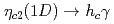 . No significant signal is found. For the mass range between
  and
and 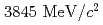 , the branching-fraction upper limits are determined to be
  ,
,  ,
,  , and
, and  at 90% C. L. The analysis is based on the 711
  data sample collected on the
  resonance by the Belle detector, which operated at the KEKB asymmetric-energy
  collider.
 baryon at Belle
Li, Y. B.*; 谷田 聖; Belle Collaboration*; 他194名*
Physical Review D, 100(3), p.031101_1 - 031101_8, 2019/08
被引用回数:23 パーセンタイル:78.29(Astronomy & Astrophysics)We present the first measurements of the absolute branching fractions of decays into  and
and  final states. Our analysis is based on a data set of
 pairs collected at the resonance with the Belle detector at the KEKB
  collider. We measure the absolute branching fraction of
  with the recoiling against
  in
in  decays resulting in
 ![$${cal B}(bar{B}^{0} to bar{Lambda}_{c}^{-} Xi_{c}^{+}) = [1.16 pm 0.42(rm stat.) pm 0.15(rm syst.)] times 10^{-3}$$](/search/images/ER3VYY1BNQQEE5JILRRGC2T1IJ4V24ZQPUQFY3DPEBOGEYLSPNOEYYLNMJSGC5K5PNRX0XT1FV4SAXCYNFPXWY13LZ3SW5JJEA4SAWZRFYYTMIC2OBWSAMBOGQZCQXDSNUQHG3DBOQXCSIC2OBWSAMBOGE0SQXDSNUQHG4LTOQXCSXJALR0GS1LFOMQDCMC4PMWTG5JE.gif) . We then measure the product branching fractions
. We then measure the product branching fractions  and
and  . Dividing these product branching fractions by yields:
 ![$${cal B}(Xi_c^+ to Xi^- pi^+ pi^+) = [2.86 pm 1.21(rm stat.) pm 0.38(rm syst.)]%$$](/search/images/ER3VYY1BNQQEE5JILRMGSX1DLYVSAXDUN2QFYWDJLYWSAXDQNFPCWIC2OBUV2KZJEA4SAWZSFY2DMIC2OBWSAMJOGIYSQXDSNUQHG3DBOQXCSIC2OBWSAMBOGM2CQXDSNUQHG4LTOQXCSXK2EUSA.gif) and
and ![$${cal B}(Xi_c^+ to p K^- pi^+)=[0.45 pm 0.21(rm stat.) pm 0.07(rm syst.)]%$$](/search/images/ER3VYY1BNQQEE5JILRMGSX1DLYVSAXDUN2QHAICLLYWSAXDQNFPCWKJ3LMYC2NBVEBOHA1JAGAXDEMJILRZG0IDTORQXILRJEBOHA1JAGAXDANZILRZG0IDTPFZXILRJLVOCKJA.gif) . Our result for
. Our result for  can be combined with branching fractions measured relative to
 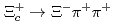 to set the absolute scale for many branching fractions.
