



Initialising ...
Initialising ...
Initialising ...
Initialising ...
Initialising ...
Initialising ...
Initialising ...
 identification method by the
  reaction for a
  scattering experiment at J-PARC
坂尾 珠和*; 藤田 真奈美; 長谷川 勝一; 細見 健二; 市川 真也; 市川 裕大; 今井 憲一*; 七村 拓野; 成木 恵; 佐甲 博之; et al.
JPS Conference Proceedings (Internet), 33, p.011133_1 - 011133_6, 2021/03
The reaction is an important elementary process to produce from a proton target and is a key for a scattering experiment where the momentum of should be tagged from the missing momentum of the  reaction. However, the spectroscopy method has not been established yet due to the difficulty of the
  detection. Therefore, we have proposed a new detection method where
  and
and  from the decay are measured by a forward magnetic spectrometer and a detector cluster surrounding the target, respectively. The feasibility of the detection method was confirmed by analyzing the J-PARC E40 data taken with such a detector system. In the analysis, 's were successfully identified in the missing mass spectrum of the
  reaction.
 scattering experiment at J-PARC and the analysis status
中田 祥之*; 長谷川 勝一; 早川 修平*; 細見 健二; 市川 裕大; 今井 憲一; 七村 拓野*; 成木 恵*; 佐甲 博之; 佐藤 進; et al.
JPS Conference Proceedings (Internet), 26, p.023024_1 - 023024_5, 2019/11
J-PARC E40 aims to measure the differential cross sections of the  elastic scatterings and the
  conversion. A clear peak of
  was observed in a missing mass spectrum of the
 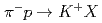 reaction and recoil protons from the
  elastic scattering were successfully observed in the data taken in the summer 2018. The rest of data taking is coming in the spring 2019.
 meson production in the forward/backward rapidity region in Cu + Au collisions at
  = 200 GeV
Adare, A.*; 長谷川 勝一; 今井 憲一; 永宮 正治; 佐甲 博之; 佐藤 進; 谷田 聖; PHENIX Collaboration*; 他505名*
Physical Review C, 93(2), p.024904_1 - 024904_13, 2016/02
被引用回数:12 パーセンタイル:60.30(Physics, Nuclear)The PHENIX experiment at the Relativistic Heavy Ion Collider has measured meson production and its nuclear modification in asymmetric Cu + Au heavy-ion collisions at = 200 GeV at both forward Cu-going direction (1.2  y 2.2) backward Au-going direction (-2.2 y -1.2) rapidities. The measurements are performed via the dimuon decay channel and reported as a function of the number of participating nucleons, rapidity, and transverse momentum. In the most central events, 0% - 20% centrality, the meson yield integrated over 1
  5 GeV/
 prefers a smaller value, which means a larger nuclear modification, in the Cu-going direction compared to the Au-going direction. Additionally, the nuclear-modification factor in Cu + Au collisions averaged over all centrality is measured to be similar to the previous PHENIX result in
  + Au collisions for these rapidities.
= 7.7-200 GeVAdare, A.*; 今井 憲一; 永宮 正治; 佐甲 博之; 佐藤 進; 谷田 聖; PHENIX Collaboration*; 他506名*
Physical Review C, 93(1), p.011901_1 - 011901_8, 2016/01
被引用回数:76 パーセンタイル:97.45(Physics, Nuclear)We report the measurement of cumulants ( ,
,  ) of the net-charge distributions measured within pseudorapidity (
 ) in Au + Au collisions at = 7.7-200 GeV with the PHENIX experiment at the Relativistic Heavy Ion Collider. The ratios of cumulants (e.g.,
  ,
,  ) of the net-charge distributions, which can be related to volume independent susceptibility ratios, are studied as a function of centrality and energy. These quantities are important to understand the quantum-chromodynamics phase diagram and possible existence of a critical end point. The measured values are very well described by expectation from negative binomial distributions. We do not observe any nonmonotonic behavior in the ratios of the cumulants as a function of collision energy. The measured values of and can be directly compared to lattice quantum-chromodynamics calculations and thus allow extraction of both the chemical freeze-out temperature and the baryon chemical potential at each center-of-mass energy. The extracted baryon chemical potentials are in excellent agreement with a thermal-statistical analysis model.
 production in
  and Au+Au collisions at = 200 GeV
Adare, A.*; 今井 憲一; 谷田 聖; PHENIX Collaboration*; 他504名*
Physical Review C, 91(2), p.024913_1 - 024913_16, 2015/02
被引用回数:38 パーセンタイル:89.71(Physics, Nuclear)Measurements of bottomonium production in heavy-ion and collisions at the Relativistic Heavy Ion Collider (RHIC) are presented. The inclusive yield of the three  states, , was measured in the PHENIX experiment via electron-positron decay pairs at midrapidity for Au+Au and collisions at
  GeV. The
  differential cross section at midrapidity was found to be
  pb in collisions. The nuclear modification factor in the 30% most central Au+Au collisions indicates a suppression of the total state yield relative to the extrapolation from collision data. The suppression is consistent with measurements made by STAR at RHIC and at higher energies by the CMS experiment at the Large Hadron Collider.

