



Initialising ...
Initialising ...
Initialising ...
Initialising ...
Initialising ...
Initialising ...
Initialising ...
Toyoda, Shin*; Inoue, Kazuhiko*; Yamaguchi, Ichiro*; Hoshi, Masaharu*; Hirota, Seiko*; Oka, Toshitaka; Shimazaki, Tatsuya*; Mizuno, Hideyuki*; Tani, Atsushi*; Yasuda, Hiroshi*; et al.
Radiation Protection Dosimetry, 199(14), p.1557 - 1564, 2023/09
Times Cited Count:0 Percentile:0.01(Environmental Sciences)Interlaboratory comparison studies are important for radiation dosimetry in order to demonstrate how the technique is universally available. The set of standard samples are examined in each participating laboratory in the present study. After a set of standard samples together with the samples with unknown doses, which were prepared in the same laboratory as the standard samples, are measured at a participating laboratory, those samples are sent to another participating laboratory for next measurement. There is some small difference observed in the sensitivity (the slope of the dose response line) of the standard samples while the differences in the obtained doses for the samples with unknown doses are rather systematic, implying that the difference is mostly due to the samples but not to measurements.
Hirota, Yuki*; Tominaga, Taiki*; Kawabata, Takashi*; Kawakita, Yukinobu; Matsuo, Yasumitsu*
Bioengineering (Internet), 10(5), p.622_1 - 622_17, 2023/05
Times Cited Count:0 Percentile:0.01(Biotechnology & Applied Microbiology) rays from a neutron-induced
  -wave resonance of
  Xe
XeOkudaira, Takuya*; Tani, Yuika*; Endo, Shunsuke; Doskow, J.*; Fujioka, Hiroyuki*; Hirota, Katsuya*; Kameda, Kento*; Kimura, Atsushi; Kitaguchi, Masaaki*; Luxnat, M.*; et al.
Physical Review C, 107(5), p.054602_1 - 054602_7, 2023/05
Times Cited Count:2 Percentile:83.53(Physics, Nuclear)no abstracts in English
Nakajima, Junya; Hirota, Seiko*; Tsuji, Tomoya; Watanabe, Yuki; Sakoda, Akihiro; Kobayashi, Noriko*
Hoken Butsuri (Internet), 58(1), p.13 - 20, 2023/04
no abstracts in English
Hirota, Noriaki; Funamoto, Kodai*; Tachibana, Yukio
Zairyo, 72(3), p.255 - 261, 2023/03
For the purpose of developing metallic materials with excellent corrosion resistance under boiling sulfuric acid environment, the coated materials were evaluated for their corrosion resistance and the differences in surface morphology were investigated. As a result, the corrosion resistance of SUS304 coated and sintered eight times by chemical densified coating method (S-ZAC) was maintained at the point after 12h corrosion test, but the corrosion rate rapidly increased after 100h corrosion test. The cross-sectional microstructural analysis of the specimens showed that only a small amount of SiO remained on the surface, while CrO
 completely disappeared. The mechanism of film delamination in S-ZAC is assumed to be due to the thermal expansion caused by heating, which resulted in curvature of the thick film and cracks at the CrO and SiO interfaces. On the other hand, SUS304 coated with higher density of CrO by repeating the coating and sintering eleven times (MS-ZAC) showed excellent corrosion resistance as well as SiC even after 100h corrosion test. The results of cross-sectional microstructuCrO particle layer, in addition to the thinning of the entire film.
Yasuoka, Yumi*; Fujita, Hiroki; Tsuji, Tomoya; Tsujiguchi, Takakiyo*; Sasaki, Michiya*; Miyazaki, Tomoyuki*; Hashima, Shun*; Yasuda, Hiroshi*; Shimada, Kazumasa; Hirota, Seiko*
Hoken Butsuri (Internet), 57(3), p.146 - 155, 2022/12
no abstracts in English
rays in the  Sn(
Sn( )
) Sn reaction
Endo, Shunsuke; Okudaira, Takuya*; Abe, Ryota*; Fujioka, Hiroyuki*; Hirota, Katsuya*; Kimura, Atsushi; Kitaguchi, Masaaki*; Oku, Takayuki; Sakai, Kenji; Shima, Tatsushi*; et al.
Physical Review C, 106(6), p.064601_1 - 064601_7, 2022/12
Times Cited Count:3 Percentile:49.92(Physics, Nuclear)no abstracts in English
Hirota, Yuki*; Tominaga, Taiki*; Kawabata, Takashi*; Kawakita, Yukinobu; Matsuo, Yasumitsu*
Bioengineering (Internet), 9(10), p.599_1 - 599_17, 2022/10
Times Cited Count:2 Percentile:32.07(Biotechnology & Applied Microbiology)Sakoda, Akihiro; Tsuji, Tomoya; Hirota, Seiko*; Watanabe, Yuki
Hoken Butsuri (Internet), 57(2), p.108 - 114, 2022/06
no abstracts in English
rays from the -wave resonance of SnKoga, Jun*; Takada, Shusuke*; Endo, Shunsuke; Fujioka, Hiroyuki*; Hirota, Katsuya*; Ishizaki, Kohei*; Kimura, Atsushi; Kitaguchi, Masaaki*; Niinomi, Yudai*; Okudaira, Takuya*; et al.
Physical Review C, 105(5), p.054615_1 - 054615_5, 2022/05
Times Cited Count:4 Percentile:64.25(Physics, Nuclear)no abstracts in English
Watanabe, Yuki; Tsuji, Tomoya; Hirota, Seiko*; Hokama, Tomonori; Nakajima, Junya; Tsujiguchi, Takakiyo*; Kimura, Tatsuki*; Koike, Hiromi*; Nakamura, Kaori*; Kuwata, Haruka*; et al.
Hoken Butsuri (Internet), 57(1), p.54 - 64, 2022/03
no abstracts in English
rays in the  La(
La( )
) La
La reaction
Okudaira, Takuya*; Endo, Shunsuke; Fujioka, Hiroyuki*; Hirota, Katsuya*; Ishizaki, Kohei*; Kimura, Atsushi; Kitaguchi, Masaaki*; Koga, Jun*; Niinomi, Yudai*; Sakai, Kenji; et al.
Physical Review C, 104(1), p.014601_1 - 014601_6, 2021/07
Times Cited Count:4 Percentile:55.56(Physics, Nuclear)Hirota, Takatoshi*; Nagoshi, Yasuto*; Hojo, Kiminobu*; Okada, Hiroshi*; Takahashi, Akiyuki*; Katsuyama, Jinya; Ueda, Takashi*; Ogawa, Takuya*; Yashirodai, Kenji*; Ohata, Mitsuru*; et al.
Proceedings of ASME 2021 Pressure Vessels and Piping Conference (PVP 2021) (Internet), 9 Pages, 2021/07
Sakai, Kenji; Oku, Takayuki; Okudaira, Takuya; Kai, Tetsuya; Harada, Masahide; Hiroi, Kosuke; Hayashida, Hirotoshi*; Kakurai, Kazuhisa*; Shimizu, Hirohiko*; Hirota, Katsuya*; et al.
JPS Conference Proceedings (Internet), 33, p.011116_1 - 011116_6, 2021/03
In neutron fundamental physics, study of correlation term  of a neutron spin
  and a target nuclear spin
  is important because term interferes to parity non-conserving (PNC) and time reversal non-conserving terms. For this study, a xenon (Xe) is an interesting nucleus because it has been observed an enhancement of PNC effect around neutron resonance peaks, and polarizes up to
  by using a spin exchange optical pumping (SEOP) method. We would plan to develop a polarized Xe gas target with a compact in-situ SEOP system, and to study term by utilizing epithermal neutron beams supplied from a high intense pulsed spallation neutron source. As the first step, we attempted to measure neutron polarizing ability caused by term at a 9.6 eV s-wave resonance peak of
  Xe at BL10 in MLF, by detecting change
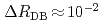
  of ratio between neutron transmissions with the polarized and unpolarized Xe target. After demonstrating that our apparatus could detect small change (
 ) of neutron transmissions caused by Doppler broadening effect, a signified value of has been obtained as preliminary results. For analyzing the obtained in detail, we are improving our nuclear magnetic resonance and electron paramagnetic resonance systems for evaluating Xe polarization independently of neutron beams.
Hirota, Noriaki; Takeda, Kiyoko*; Tachibana, Yukio; Masaki, Yasuhiro*
Zairyo To Kankyo, 70(3), p.68 - 76, 2021/03
Corrosion resistance of stainless steels and Ni-based alloys were evaluated in a sulfuric acid decomposition gas at high temperature. The evaluation were carried out in an environment simulated in the sulfuric acid decomposition reaction vessel for thermochemical hydrogen production process (IS process). Their corrosion films were also analyzed for better understanding of the corrosion behavior. As a result, after 100 hour corrosion test, Ni-based alloy containing 2.4% Si showed good corrosion resistance. Ferritic stainless steel containing 3% Al (3Al-Ferrite) showed better corrosion resistance. Its corrosion rate was lower than that of SiC (0.1mm/year), which is a candidate material for the sulfuric acid decomposition reaction vessel. On the other hand, Ni-based alloy pre-filmed with AlO is prepared as the relative corrosion film of 3Al-Ferrite. Its corrosion rate was significantly higher than that of 3Al-Ferrite. As the result of EPMA analysis of these oxide films, Ni-based alloy containing 2.4% Si formed Si oxide film which had some cracks after the long term corrosion test. Therefore S penetrated into grain boundaries of the matrix through the oxide film. 3Al-Ferrite formed a thin and uniform AlO film, and the penetration of S into the grain boundaries was not observed. AlO pre-film of Ni-based alloy also showed S penetration in the matrix because the AlO pre-film had many small defects originally. The corrosion oxide film of 3Al-Ferrite consisted of only  -AlO, while the AlO pre-film consist of -AlO and -AlO. Those results suggest that the better corrosion resistance of 3Al-Ferrite is due to the uniform formation of dense -AlO film at the early stage of the corrosion.
 He neutron spin filter at J-PARC
Okudaira, Takuya; Oku, Takayuki; Ino, Takashi*; Hayashida, Hirotoshi*; Kira, Hiroshi*; Sakai, Kenji; Hiroi, Kosuke; Takahashi, Shingo*; Aizawa, Kazuya; Endo, Hitoshi*; et al.
Nuclear Instruments and Methods in Physics Research A, 977, p.164301_1 - 164301_8, 2020/10
Times Cited Count:11 Percentile:78.21(Instruments & Instrumentation) rays from neutron-induced compound states of LaYamamoto, Tomoki*; Okudaira, Takuya; Endo, Shunsuke; Fujioka, Hiroyuki*; Hirota, Katsuya*; Ino, Takashi*; Ishizaki, Kohei*; Kimura, Atsushi; Kitaguchi, Masaaki*; Koga, Jun*; et al.
Physical Review C, 101(6), p.064624_1 - 064624_8, 2020/06
Times Cited Count:9 Percentile:72.89(Physics, Nuclear) He excimer cluster tracers in superfluid helium-4 via neutron-
 He absorption reaction
Sonnenschein, V.*; Tsuji, Yoshiyuki*; Kokuryu, Shoma*; Kubo, Wataru*; Suzuki, So*; Tomita, Hideki*; Kiyanagi, Yoshiaki*; Iguchi, Tetsuo*; Matsushita, Taku*; Wada, Nobuo*; et al.
Review of Scientific Instruments, 91(3), p.033318_1 - 033318_12, 2020/03
Times Cited Count:0 Percentile:0(Instruments & Instrumentation)-rays after neutron capture by La for a T-violation searchOkudaira, Takuya; Shimizu, Hirohiko*; Kitaguchi, Masaaki*; Hirota, Katsuya*; Haddock, C. C.*; Ito, Ikuya*; Yamamoto, Tomoki*; Endo, Shunsuke*; Ishizaki, Kohei*; Sato, Takumi*; et al.
EPJ Web of Conferences, 219, p.09001_1 - 09001_6, 2019/12
Parity violating effects enhanced by up to 10 times have been observed in several neutron induced compound nuclei. There is a theoretical prediction that time reversal (T) violating effects can also be enhanced in these nuclei implying that T-violation can be searched for by making very sensitive measurements. However, the enhancement factor has not yet been measured in all nuclei. The angular distribution of the (n,) reaction was measured with La by using a germanium detector assembly at J-PARC, and the enhancement factor was obtained. From the result, the measurement time to achieve the most sensitive T-violation search was estimated as 1.4 days, and a 40% polarized La target and a 70% polarized He spin filter whose thickness is 70 atm
 cm are needed. Therefore high quality He spin filter is developed in JAEA. The measurement result of the (n,) reaction at J-PARC and the development status of the He spin filter will be presented.
 O(He,
O(He, )F reaction; Identification of the low-energy "super" -Gamow-Teller state
Fujita, Hirohiko*; Fujita, Yoshitaka*; Utsuno, Yutaka; Yoshida, Kenichi*; Adachi, Tatsuya*; Algora, A.*; Csatl s, M.*; Deaven, J. M.*; Estevez-Aguado, E.*; Guess, C. J.*; et al.
Physical Review C, 100(3), p.034618_1 - 034618_13, 2019/09
Times Cited Count:12 Percentile:76.6(Physics, Nuclear)no abstracts in English

