



Initialising ...
Initialising ...
Initialising ...
Initialising ...
Initialising ...
Initialising ...
Initialising ...

Yamauchi, Hiroki; Metoki, Naoto; Watanuki, Ryuta*; Hong, T.*; Fernandez-Baca, J. A.*; Hagihara, Masato; Masuda, Takatsugu*; Yoshizawa, Hideki*; Ito, Shinichi*
Journal of the Physical Society of Japan, 94(5), p.054705_1 - 054705_8, 2025/04
Ito, Kengo*; Morita, Misaki*; Araki, Yuta*; Kato, Chizu*; Fukutani, Satoshi*; Matsumura, Tatsuro; Fujii, Toshiyuki*
Solvent Extraction Research and Development, Japan, 32(1), p.53 - 62, 2025/00
Rhodium (Rh) and Palladium (Pd) in high-level radioactive waste are primarily fission products. This Study focused on understanding the extraction behavior of these platinum group elements (PGEs) using the novel extractants  -hexaoctylnitriloacetamide (HONTA) and alkyl diamideamine (ADAAM). Both extractants showed affinity for Pd, with distribution coefficients significantly exceeding 1, demonstrating their effectiveness in Pd separation. In contrast, the distribution coefficients for Rh were consistently below 10
  , indicating low extraction efficiency from nitric acid. However, by leveraging the salting-out effect with calcium nitrate hydrate, a distribution coefficient of
  570 for Rh was achieved using HONTA. To overcome the difficult back-extraction of PGEs with HONTA, experiments were conducted using HEDTA and thiourea. Back-extraction with HEDTA in high-concentration nitric acid (
 2M) resulted in 90% extraction of Pd, while thiourea-based back-extraction with nitric acid yielded over 40% extraction for Rh, with the maximum of 62.7% achieved using hydrochloric acid.
Shimomura, Koichiro*; Koda, Akihiro*; Pant, A. D.*; Sunagawa, Hikaru*; Fujimori, Hiroshi*; Umegaki, Izumi*; Nakamura, Jumpei*; Fujihara, Masayoshi; Tampo, Motonobu*; Kawamura, Naritoshi*; et al.
Interactions (Internet), 245(1), p.31_1 - 31_6, 2024/12
Moon, J. Y.*; Ito, Yuta; 13 of others*
Journal of the Korean Physical Society, 9 Pages, 2024/12
Times Cited Count:0 Percentile:0.00(Physics, Multidisciplinary) Cf fission fragments with MRTOF-MS and detailed study of masses of neutron-rich Ce isotopes
Kimura, Sota*; Ito, Yuta; 8 of others*
Physical Review C, 110(4), p.045810_1 - 045810_9, 2024/10
Times Cited Count:2 Percentile:58.81(Physics, Nuclear) C to 1000C
Imagawa, Yuya; Hashidate, Ryuta; Miyazawa, Takeshi; Onizawa, Takashi; Otsuka, Satoshi; Yano, Yasuhide; Tanno, Takashi; Kaito, Takeji; Onuma, Masato*; Mitsuhara, Masatoshi*; et al.
Journal of Nuclear Science and Technology, 61(6), p.762 - 777, 2024/06
Times Cited Count:4 Percentile:62.75(Nuclear Science & Technology)The Japan Atomic Energy Agency has been developing 9Cr-oxide dispersion strengthened (ODS) steel as a fuel cladding material for sodium-cooled fast reactors (SFRs). Previous studies have formulated the creep rupture equation for 650C to 850C. However, little data have been obtained above 850C, and no equation has been formulated. This study conducted creep tests to evaluate creep strength at 700C to 1000C. Two creep test methods, the internal pressure and ring creep tests under development, were used, and the validation of the ring creep test method was conducted. The results showed that 9Cr-ODS steel undergoes almost no strength change due to the matrix's phase transformation, and a single equation can express a creep rupture strength from 700C to 1000C. In validating the ring creep test method, analysis clarified the effect of stress concentration on the specimen. Plastic deformation occurs at high initial stress and may lead to early rupture. The results will be essential for future creep testing and evaluation of neutron-irradiated 9Cr-ODS steel.
Ichikawa, Tsubasa*; Hakoshima, Hideaki*; Inui, Koji*; Ito, Kosuke*; Matsuda, Ryo*; Mitarai, Kosuke*; Miyamoto, Koichi*; Mizukami, Wataru*; Mizuta, Kaoru*; Mori, Toshio*; et al.
Nature Reviews Physics (Internet), 6(6), p.345 - 347, 2024/06
Times Cited Count:7 Percentile:99.15(Physics, Applied)Miyazawa, Takeshi; Tanno, Takashi; Imagawa, Yuya; Hashidate, Ryuta; Yano, Yasuhide; Kaito, Takeji; Otsuka, Satoshi; Mitsuhara, Masatoshi*; Toyama, Takeshi*; Onuma, Masato*; et al.
Journal of Nuclear Materials, 593, p.155008_1 - 155008_16, 2024/05
Times Cited Count:1 Percentile:57.00(Materials Science, Multidisciplinary) nuclei constrain element abundances
Xian, W.*; Ito, Yuta; 30 of others*
Physical Review C, 109(3), p.035804_1 - 035804_10, 2024/03
Times Cited Count:0 Percentile:0.00(Physics, Nuclear)Soler, J. M.*; Kek linen, P.*; Pulkkanen, V.-M.*; Moreno, L.*; Iraola, A.*; Trinchero, P.*; Hokr, M.*;
 ha, J.*; Havlov
 , V.*; Trpko
 ov, D.*; et al.
Nuclear Technology, 209(11), p.1765 - 1784, 2023/11
Times Cited Count:4 Percentile:73.39(Nuclear Science & Technology)Schury, P.*; Ito, Yuta; Niwase, Toshitaka*; Wada, Michiharu*
Atoms (Internet), 11(10), p.11100134_1 - 11100134_13, 2023/10
 O
OKondo, Yosuke*; Achouri, N. L.*; Al Falou, H.*; Atar, L.*; Aumann, T.*; Baba, Hidetada*; Boretzky, K.*; Caesar, C.*; Calvet, D.*; Chae, H.*; et al.
Nature, 620(7976), p.965 - 970, 2023/08
Times Cited Count:27 Percentile:94.86(Multidisciplinary Sciences)no abstracts in English
Saito, Shingo*; Haraga, Tomoko; Marumo, Kazuki*; Sato, Yoshiyuki; Nakano, Yuta*; Tasaki-Handa, Yuiko*; Shibukawa, Masami*
Bulletin of the Chemical Society of Japan, 96(3), p.223 - 225, 2023/03
Times Cited Count:3 Percentile:34.10(Chemistry, Multidisciplinary)Highly efficient and effective separation between americium (Am ) and curium ion (Cm) was achieved by two simple electrophoresis-based techniques. Am and Cm ions were complexed with fluorophore-modified acyclic hexadentate and octadentate polyaminocarboxylates and then were electrophoretically separated and fluorescently detected in free solution with ternary complexation or in gel medium.
Otsuka, Satoshi; Shizukawa, Yuta; Tanno, Takashi; Imagawa, Yuya; Hashidate, Ryuta; Yano, Yasuhide; Onizawa, Takashi; Kaito, Takeji; Onuma, Masato*; Mitsuhara, Masatoshi*; et al.
Journal of Nuclear Science and Technology, 60(3), p.288 - 298, 2023/03
Times Cited Count:4 Percentile:53.26(Nuclear Science & Technology)JAEA has been developing 9Cr-oxide dispersion strengthened (ODS) tempered martensitic steel(TMS) as a candidate material for the fuel cladding tubes of sodium-cooled fast reactors(SFRs). The reliable prediction of in-reactor creep-rupture strength is critical for implementing the 9Cr-ODS TMS cladding tube in the SFR. This study investigated the quantitative correlation between the creep properties of 9Cr-ODS TMS at 700 C and the dispersions of nanosized oxides by analyzing the creep data and the material's nanostructure. The possibility of deriving a formula for estimating the in-reactor creep properties of 9Cr-ODS TMSs based on an analysis of the nanostructure of neutron-irradiated 9Cr-ODS TMSs was also discussed. The creep properties of 9Cr-ODS TMS at 700 C closely correlated with the dispersion of nanosized oxide particles. The correlation between creep-rupture lives and nanosized oxide particle dispersion was determined using existing creep models. The elucidation of correlation between the stress exponent of secondary creep rate and the nanostructure is essential to enhance future modeling reliability and formulation.
 Zn
Zn probed by muon spin relaxation
Higemoto, Wataru; Sato, Kazuhiko*; Ito, Takashi; Oishi, Kazuki*; Saiga, Yuta*; Kosaka, Masashi*; Matsubayashi, Kazuyuki*; Uwatoko, Yoshiya*
Journal of Physics; Conference Series, 2462, p.012039_1 - 012039_5, 2023/03
Times Cited Count:0 Percentile:0.00(Physics, Applied)The cubic compound YbCoZn has huge electronic specific heat coefficient and its ground state could be located in the vicinity of the quantum critical point. Indeed, a magnetic long-range order was observed under pressure above 1-2 GPa. To investigate magnetic ground state, we have carried out muon spin relaxation measurements and confirm non-magnetic ground state with fluctuating tiny magnetic moment.
Shimomura, Koichiro*; Koda, Akihiro*; Pant, A. D.*; Natori, Hiroaki*; Fujimori, Hiroshi*; Umegaki, Izumi*; Nakamura, Jumpei*; Tampo, Motonobu*; Kawamura, Naritoshi*; Teshima, Natsuki*; et al.
Journal of Physics; Conference Series, 2462, p.012033_1 - 012033_5, 2023/03
Times Cited Count:0 Percentile:0.00(Physics, Applied) U and systematic high-precision atomic mass measurements of neutron-rich Pa-Pu nuclei produced via multinucleon transfer reactions
Niwase, Toshitaka*; Ito, Yuta; 18 of others*
Physical Review Letters, 130(13), p.132502_1 - 132502_6, 2023/03
Times Cited Count:38 Percentile:98.23(Physics, Multidisciplinary)The new isotope U was synthesized and systematic atomic mass measurements of nineteen neutron-rich Pa-Pu isotopes were performed in the multinucleon transfer reactions of the  U+
U+ Pt system at the KISS facility. The present experimental results demonstrate the crucial role of the multinucleon transfer reactions for accessing unexplored neutron-rich actinide isotopes toward the
  shell gap in this region of nuclides.
 and
and  shell gap for Ti and V by the first high-precision multireflection time-of-flight mass measurements at BigRIPS-SLOWRI
Iimura, Shun*; Rosenbusch, M.*; Takamine, Aiko*; Tsunoda, Yusuke*; Wada, Michiharu*; Chen, S.*; Hou, D. S.*; Xian, W.*; Ishiyama, Hironobu*; Yan, S.*; et al.
Physical Review Letters, 130(1), p.012501_1 - 012501_6, 2023/01
Times Cited Count:13 Percentile:88.25(Physics, Multidisciplinary) Sr,
Sr,  Ba and
  Nd ions in a He-gas target at collision energies 50 eV/u - 10 GeV/u
Tolstikhina, I. Yu.*; Ito, Yuta; Shevelko, V. P.*
Nuclear Instruments and Methods in Physics Research B, 532, p.27 - 37, 2022/12
Times Cited Count:4 Percentile:53.47(Instruments & Instrumentation)Electron-loss (EL) and electron-capture (EC) cross sections of neutral and low-charged heavy Sr , Ba and Nd ions with charges
  , 1 and 2 in collisions with He atoms are predicted in the energy range
  eV/u - 10 GeV/u. Experimental data on EL and EC cross sections of these particles colliding with He atoms are practically absent. At relatively low energies
  - 30 keV, EL cross sections
  of Sr
of Sr , Ba and Nd ions are predicted from new experimental equilibrium charge-state fractions
  and
and  and calculated EC cross sections. Predicted value for Ba ions,
  cm
cm , is in a good agreement with the one available experimental point
 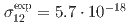 cm at
cm at  keV (Fedorenko, 1954). Calculations of EL and EC cross sections are performed by available computer codes shortly described in the paper. Theoretically estimated neutral-atom fractions
  are found much smaller than the measured , , and
  charge-state fractions.
 isomers in
  Cf
CfOrlandi, R.; Makii, Hiroyuki; Nishio, Katsuhisa; Hirose, Kentaro; Asai, Masato; Tsukada, Kazuaki; Sato, Tetsuya; Ito, Yuta; Suzaki, Fumi; Nagame, Yuichiro*; et al.
Physical Review C, 106(6), p.064301_1 - 064301_11, 2022/12
Times Cited Count:4 Percentile:53.47(Physics, Nuclear)