



Initialising ...
Initialising ...
Initialising ...
Initialising ...
Initialising ...
Initialising ...
Initialising ...
 CoSi
CoSi山内 宏樹; Sari, D. P.*; 安井 幸夫*; 坂倉 輝俊*; 木村 宏之*; 中尾 朗子*; 大原 高志; 本田 孝志*; 樹神 克明; 井川 直樹; et al.
Physical Review Research (Internet), 6(1), p.013144_1 - 013144_9, 2024/02
 -Mn-type family alloys Mn
 have three-dimensional antiferromagnetic (AFM) corner-shared triangular network. The antiferromagnet MnRhSi shows magnetic short-range order (SRO) over a wide temperature range of approximately 500 K above the N
 el temperature
  = 190 K. MnCoSi has the smallest lattice parameter and the lowest in the family compounds. The quantum critical point (QCP) from AFM to the quantum paramagnetic state is expected near a cubic lattice parameter of 6.15
 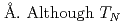 of MnCoSi is only 140 K, quantum critical behavior is observed in MnCoSi as the enhancement of the electronic specific heat coefficient
  . We study how the magnetic SRO appears in MnCoSi by using neutron scattering,
  SR, and physical property measurements. The experimental results show that the neutron scattering intensity of the magnetic SRO does not change much regardless of the suppressed magnetic moment in the long-range magnetic ordered state compared to those of MnRhSi. The initial asymmetry drop ratio of SR above becomes small, and the magnetic SRO temperature
  is suppressed to 240 K. The results suggest that the MnCoSi is close to the QCP in the Mn system.
 TaS
TaS
Park, P.*; Cho, W.*; Kim, C.*; An, Y.*; Kang, Y.-G.*; Avdeev, M.*; Sibille, R.*; 飯田 一樹*; 梶本 亮一; Lee, K. H.*; et al.
Nature Communications (Internet), 14, p.8346_1 - 8346_9, 2023/12
被引用回数:0 パーセンタイル:0(Multidisciplinary Sciences)The triangular lattice antiferromagnet (TLAF) has been the standard paradigm of frustrated magnetism for several decades. The most common magnetic ordering in insulating TLAFs is the 120 structure. However, a new triple-
 chiral ordering can emerge in metallic TLAFs, representing the short wavelength limit of magnetic skyrmion crystals. We report the metallic TLAF CoTaS as the first example of tetrahedral triple- magnetic ordering with the associated topological Hall effect (non-zero
  ). We also present a theoretical framework that describes the emergence of this magnetic ground state, which is further supported by the electronic structure measured by angle-resolved photoemission spectroscopy. Additionally, our measurements of the inelastic neutron scattering cross section are consistent with the calculated dynamical structure factor of the tetrahedral triple- state.
Lee, J.; 児玉 有; Rossi, F.; 弘中 浩太; 小泉 光生; 堀 順一*; 佐野 忠史*
第44回日本核物質管理学会年次大会会議論文集(インターネット), 4 Pages, 2023/11
核不拡散・核セキュリティ総合支援センターでは、試料中に含まれる少量の核分裂性物質を特定し定量する能力を向上させるための技術として、中性子飛行時間法を用いた中性子共鳴核分裂中性子分析(Neutron Resonance Fission Neutron Analysis: NRFNA)の技術開発を進めている。本発表会では、核分裂性物質の非破壊分析のために進めているNRFNA技術の紹介及びその基礎実験の結果について報告する。
Domal, S. J.*; Correa-Alfonso, C. M.*; Paulbeck, C. J.*; Griffin, K. T.*; 佐藤 達彦; 船本 幸代*; Cullings, H. M.*; Egbert, S. D.*; 遠藤 章; Hertel, N. E.*; et al.
Health Physics, 125(4), p.245 - 259, 2023/10
被引用回数:0 パーセンタイル:0.01(Environmental Sciences)原爆被爆者に対する線量評価は、大人・小児・幼児の3体の単純な数学ファントムに基づいて構築されたDS02システムが利用されており、妊婦や胎児に対する詳細な線量評価は行われていかなった。そこで、放射線影響研究所を中心とする日米共同研究チームは、最新の計算科学に基づいて1945年の日本人体型を再現した様々な人体模型(J45シリーズ)を開発し、より精度の高い線量評価を実施してきた。本研究では、様々な週齢の胎児・妊婦人体模型を用いて、その姿勢が被ばく線量に与える影響を検討した。その結果、妊婦の姿勢は、特に胎児の被ばく線量に大きな影響を与えることが分かった。
 RhSi
RhSi社本 真一; 山内 宏樹; 飯田 一樹*; 池内 和彦*; Hall, A. E.*; Chen, Y.-S.*; Lee, M. K.*; Balakrishnan, G.*; Chang, L.-J.*
Communications Physics (Internet), 6, p.248_1 - 248_6, 2023/09
被引用回数:1 パーセンタイル:0(Physics, Multidisciplinary)MnRhSi単結晶の中性子散乱測定により、局所スピン相関秩序がらせん構造を持つことがわかった。磁気クラスター形成の起源の可能性を、リフシッツ不変量とグリフィス相の観点から議論し、Co ZnMn
ZnMn の室温スキルミオン相とMnの非フェルミ液体挙動と比較した。
Esser, S. P.*; Rahlff, J.*; Zhao, W.*; Predl, M.*; Plewka, J.*; Sures, K.*; Wimmer, F.*; Lee, J.*; Adam, P. S.*; McGonigle, J.*; et al.
Nature Microbiology (Internet), 8(9), p.1619 - 1633, 2023/09
被引用回数:2 パーセンタイル:79.73(Microbiology)CRISPR-Cas systems defend prokaryotic cells from viruses, plasmids, and other mobile genetic elements. Capitalizing on multi-omics approaches, we show here that the CRISPR-Cas systems of uncultivated archaea also play an integral role in mitigating potentially detrimental interactions with episymbionts. A comprehensive analysis of CRISPR-Cas-based infection histories revealed that uncultivated deep-subsurface archaeal primary-producers defend themselves from archaeal episymbionts of the DPANN superphylum of archaea, some of which are known to fuse their membranes with their host. We show that host cells counter these attacks by deploying one of two CRISPR-Cas systems (type I-B and type III-A) to target and disrupt essential genes in the episymbiont. However, genome-scale modeling of metabolic interactions between two deep subsurface host-symbiont systems revealed that host cells also benefit from the symbionts via metabolic complementation. We speculate that populations of these uncultivated archaeal episymbionts are currently transitioning from a parasitic lifestyle to one of mutualism, as must have occurred in countless mutualistic systems known today. By expanding our analysis to thousands of archaeal genomes, we conclude that CRISPR-Cas mediated resistance to archaeal episymbiosis evolved independently in various archaeal lineages and may be a wide-spread evolutionary phenomenon.
弘中 浩太; Lee, J.; 小泉 光生; 伊藤 史哲*; 堀 順一*; 寺田 和司*; 佐野 忠史*
Nuclear Instruments and Methods in Physics Research A, 1054, p.168467_1 - 168467_5, 2023/09
被引用回数:0 パーセンタイル:0.02(Instruments & Instrumentation)We propose neutron resonance fission neutron analysis (NRFNA), an active nondestructive assay (NDA) technique, to improve the capability to identify and quantify a small amount of fissile material in a sample. NRFNA uses pulsed neutrons to induce fission reactions in the sample. Fission neutrons are detected by a neutron-gamma pulse shape discrimination (PSD) scintillation detector with time-of-flight (TOF) technique. The obtained nuclide-specific resonance peaks in the neutron energy spectrum provide information to identify and quantify a fissile material in the sample. The possibility of using PSD for NRFNA was confirmed through a test experiment using a natural uranium sample. We successfully observed the resonance peaks from  U(n,f) reaction and showed that NRFNA would be useful for measuring a small amount of fissile material in a sample.
 Ca cast doubt on a doubly magic
  Ca
CaChen, S.*; Browne, F.*; Doornenbal, P.*; Lee, J.*; Obertelli, A.*; 角田 佑介*; 大塚 孝治*; 茶園 亮樹*; Hagen, G.*; Holt, J. D.*; et al.
Physics Letters B, 843, p.138025_1 - 138025_7, 2023/08
被引用回数:1 パーセンタイル:0.02(Astronomy & Astrophysics) Scからの1陽子ノックアウト反応を用いて、
 Caと
Caと Caのガンマ崩壊を観測した。Caでは1456(12)keVの線遷移が、Caでは1115(34)keVの遷移が観測された。どちらの遷移も暫定的に
 と割り当てられた。有効核子間相互作用をわずかに修正した広い模型空間での殻模型計算では、
 準位エネルギー、2中性子分離エネルギー、反応断面積が実験とよく一致し、N=34閉殻の上に新しい殻が形成されていることを裏付けた。その構成要素である
 と
と 軌道はほぼ縮退しており、これはCaが二重魔法核である可能性を排除し、Ca同位体のドリップラインを
 Caあるいはそれ以上にまで広げる可能性がある。
Lind, T.*; Kalilainen, J.*; Marchetto, C.*; Beck, S.*; 中村 康一*; 木野 千晶*; 丸山 結; 城戸 健太朗; Kim, S. I.*; Lee, Y.*; et al.
Proceedings of 20th International Topical Meeting on Nuclear Reactor Thermal Hydraulics (NURETH-20) (Internet), p.4796 - 4809, 2023/08
The OECD/NEA ARC-F project was established to investigate the accidents at Fukushima Daiichi nuclear power station with the aim of consolidating the observations for deeper understanding of the severe accident progression and the status of reactors and containment vessels. Additionally, the project formed an information sharing framework in reactor safety between Japan and international experts. In order to achieve these objectives, the project focused on three tasks: i) to refine analysis for accident scenarios and associated fission-product transport and dispersion, ii) to compile and manage data on the Fukushima Daiichi NPS accident, and iii) to discuss future long-term projects relevant to the Fukushima Daiichi NPS accident. The work was carried out by 22 partners from 12 countries. In the fission product group, ten organizations worked on five topics which were ranked with a high significance as open issues based on the BSAF project and were thereby selected for further investigations. The five fission product related topics were: i) fission product speciation, ii) iodine chemistry, iii) pool scrubbing, iv) fission product transport and behavior in the buildings, and v) uncertainty analysis and variant calculations. In this paper, the work carried out to investigate these five fission product release and transport topics of special interest in the ARC-F project will be described and summarized.
Paulbeck, C. J.*; 佐藤 達彦; 船本 幸代*; Lee, C.*; Griffin, K. T.*; Cullings, H. M.*; Egbert, S. D.*; 遠藤 章; Hertel, N. E.*; Bolch, W. E.*
Radiation and Environmental Biophysics, 62(3), p.317 - 329, 2023/08
被引用回数:0 パーセンタイル:0.01(Biology)胎児被ばくした原爆生存者に対する線量評価は、放射線被ばくリスクを評価する上で極めて重要となる。原子力機構、放射線影響研究所、フロリダ大学、米国がんセンターらで構成する研究チームは、これまで、1945年の日本人体型を反映した成人、小児及び胎児を含む妊婦の人体模型を作成し、前方照射や等方照射など理想的な照射条件に対してその被ばく線量を評価してきた。本研究では、原爆線量評価システムDS02に含まれる現実的な照射条件に対して、胎児及び母体の被ばく線量を評価した。その結果、現実的な照射条件においては、胎児の臓器線量は、胎児内での臓器の位置や週齢に大きく依存することが分かった。このような胎児に対する詳細被ばく線量解析結果は、将来の胎児被ばくリスク評価モデルの改訂に役立つと考えられる。
山野 秀将; Chenaud, M.-S.*; Tsige-Tamirat, H.*; Sumner, T.*; Lee, J.*; Liu, S.*; Peregudova, O.*
Proceedings of 30th International Conference on Nuclear Engineering (ICONE30) (Internet), 9 Pages, 2023/05
第4世代炉に関する国際フォーラムは、次世代の原子力エネルギーシステムのための研究開発における国際協力を行うための組織である。第4世代ナトリウム冷却高速炉(SFR)の取り決めの中で、SFRの安全と運転(SO)に関するプロジェクトは、安全技術開発と原子炉運転技術開発の分野を取り扱う。SOプロジェクトの目的には、(1)安全アプローチの構築と具体的な安全設備の性能確認を裏付ける解析及び実験、(2)安全評価と施設の認可に使用される計算ツールの開発と検証及びモデルの妥当性確認、(3)運転中のSFRプラントでの経験と試験から広く得られる原子炉運転技術の取得を含む。SOのテーマに含まれるタスクは、以下の3つのワークパッケージ(WP)、すなわち、WP-SO-1「手法,モデル及びコード」、WP-SO-2「実験計画と運転経験」、及びWP-SO-3「革新的な設計と安全システムの研究」に分類される。本論文では、SOプロジェクトにおける最近の活動を報告する。
Kwon, H.*; Sathiyamoorthi, P.*; Gangaraju, M. K.*; Zargaran, A.*; Wang, J.*; Heo, Y.-U.*; Harjo, S.; Gong, W.; Lee, B.-J.*; Kim, H. S.*
Acta Materialia, 248, p.118810_1 - 118810_12, 2023/04
被引用回数:13 パーセンタイル:99.28(Materials Science, Multidisciplinary)Maraging steels, known for ultrahigh strength and good fracture toughness, derive their superior properties from lath martensite structure with high-density nanoprecipitates. In this work, we designed a novel Fe-based medium-entropy alloy with a chemical composition of Fe Co
Co Ni
Ni Mo
Mo in atomic% by utilizing the characteristics of the maraging steels. By a single-step aging of only 10 min at 650 C, the alloy showed microstructures consisting of a very high number density of (Fe, Co, Ni)
 Mo
Mo -type nanoprecipitates in lath martensite structure and reverted FCC phase, which led to ultrahigh yield strength higher than 2 GPa. This work demonstrates a novel direction to produce strong and ductile materials by expanding the horizons of material design with the aid of high-entropy concept and overcoming the limits of conventional materials.
 Fe
Fe intermetallic compound
Cao, Y.*; Zhou, H.*; Khmelevskyi, S.*; Lin, K.*; Avdeev, M.*; Wang, C.-W.*; Wang, B.*; Hu, F.*; 加藤 健一*; 服部 高典; et al.
Chemistry of Materials, 35(8), p.3249 - 3255, 2023/04
被引用回数:1 パーセンタイル:0(Chemistry, Physical)静水圧や化学圧力は、結晶構造を変化させる効率的な刺激であり、材料科学において電気的、磁気的特性のチューニングによく利用されている。しかし、化学圧力は定量化が困難であり、これら両者の定量的な対応関係はまだよくわかっていない。本研究では、負の熱膨張(NTE)を持つ永久磁石の候補である金属間化合物を調べた。放射光X線その場観察により、AlをドープしたHoFeに負の化学圧力があることを明らかにし、単位セル体積の温度・圧力依存性を用いそれを定量的に評価した。また、磁化測定と中性子回折測定を組み合わせることで、磁気秩序に対する化学圧力と静水圧の違いを比較した。興味深いことに、圧力はNTEの抑制と増強を制御するために使用することができた。電子状態計算から、圧力がFermiレベル(EF)に対する主要バンドの上部に影響を与えたことを示しており、これは磁気安定性に影響を与え、それが磁気とNTEを調節する上で重要な役割を果たしていることがわかった。本研究は、圧力の影響を理解し、それを利用して機能性材料の特性を制御する良い例を示している。
 100 MeV/nucleon
Pohl, T.*; Sun, Y. L.*; Obertelli, A.*; Lee, J.*; G mez-Ramos, M.*; 緒方 一介*; 吉田 数貴; Cai, B. S.*; Yuan, C. X.*; Brown, B. A.*; et al.
Physical Review Letters, 130(17), p.172501_1 - 172501_8, 2023/04
被引用回数:5 パーセンタイル:92.42(Physics, Multidisciplinary)大きなフェルミ面非対称性を持つ陽子過剰な O原子核からの100MeV/nucleonでの陽子による陽子・中性子除去反応について報告した。この結果は、quasi-freeノックアウト反応、非弾性散乱、核子移行反応を含む複数の反応機構の定量的寄与を初めて示すものである。このようなエネルギー領域では通常無視される非弾性散乱と核子移行の寄与が、弱束縛陽子と強束縛中性子の除去反応断面積にそれぞれ約50%と30%寄与していることが示された。
Woo, W.*; Kim, Y. S.*; Chae, H. B.*; Lee, S. Y.*; Jeong, J. S.*; Lee, C. M.*; Won, J. W.*; Na, Y. S.*; 川崎 卓郎; Harjo, S.; et al.
Acta Materialia, 246, p.118699_1 - 118699_13, 2023/03
被引用回数:11 パーセンタイル:98.19(Materials Science, Multidisciplinary)In situ neutron diffraction experiments have been performed under loading in cast-wrought (CW) and additively manufactured (AM) equiatomic CoCrNi medium-entropy alloys. The diffraction line profile analysis correlated the faulting-embedded crystal structure to the dislocation density, stacking/twin fault probability, and stacking fault energy as a function of strain. The results showed the initial dislocation density of 1.8 10
10 m
m in CW and 1.310 m in AM. It significantly increased up to 1.310
 m- in CW and 1.710 m in AM near fracture. The dislocation density contributed to the flow stress of 470 MPa in CW and 600 MPa in AM, respectively. Meanwhile, the twin fault probability of CW (2.7%) was about two times higher than AM (1.3%) and the stacking fault probability showed the similar tendency. The twinning provided strengthening of 360 MPa in CW and 180 MPa in AM. Such a favorable strengthening via deformation twinning in CW and dislocation slip in AM was attributed to the stacking fault energy. It was estimated as 18.6 mJ/m
 in CW and 37.5 mJ/m in AM by the strain field of dislocations incorporated model. Dense dislocations, deformation twinning, and atomic-scale stacking structure were examined by using electron backscatter diffraction (EBSD) and transmission electron microscopy (TEM).
 and
and  shell gap for Ti and V by the first high-precision multireflection time-of-flight mass measurements at BigRIPS-SLOWRI
飯村 俊*; Rosenbusch, M.*; 高峰 愛子*; 角田 佑介*; 和田 道治*; Chen, S.*; Hou, D. S.*; Xian, W.*; 石山 博恒*; Yan, S.*; et al.
Physical Review Letters, 130(1), p.012501_1 - 012501_6, 2023/01
被引用回数:5 パーセンタイル:94.66(Physics, Multidisciplinary)The atomic masses of  Sc, Ti, and
  V have been determined using the high-precision multireflection time-of-flight technique. The radioisotopes have been produced at RIKEN's Radioactive Isotope Beam Factory (RIBF) and delivered to the novel designed gas cell and multireflection system, which has been recently commissioned downstream of the ZeroDegree spectrometer following the BigRIPS separator. For Ti and V, the mass uncertainties have been reduced down to the order of 10 keV, shedding new light on the shell effect in Ti and V isotopes by the first high-precision mass measurements of the critical species Ti and
  V. With the new precision achieved, we reveal the nonexistence of the empirical two-neutron shell gaps for Ti and V, and the enhanced energy gap above the occupied
  p
p orbit is identified as a feature unique to Ca. We perform new Monte Carlo shell model calculations including the d
 and g
and g orbits and compare the results with conventional shell model calculations, which exclude the g and the d orbits. The comparison indicates that the shell gap reduction in Ti is related to a partial occupation of the higher orbitals for the outer two valence neutrons at
  .
.
余語 覚文*; Lan, Z.*; 有川 安信*; 安部 勇輝*; Mirfayzi, S. R.*; Wei, T.*; 森 隆人*; Golovin, D.*; 早川 岳人*; 岩田 夏弥*; et al.
Physical Review X, 13(1), p.011011_1 - 011011_12, 2023/01
被引用回数:3 パーセンタイル:88.42(Physics, Multidisciplinary)Neutrons are powerful tools for investigating the structure and properties of materials used in science and technology. Recently, laser-driven neutron sources (LDNS) have attracted the attention of different communities, from science to industry, in a variety of applications, including radiography, spectroscopy, security, and medicine. However, the laser-driven ion acceleration mechanism for neutron generation and for establishing the scaling law on the neutron yield is essential to improve the feasibility of LDNS. In this paper, we report the mechanism that accelerates ions with spectra suitable for neutron generation. We show that the neutron yield increases with the fourth power of the laser intensity, resulting in the neutron generation of  in
in  at a maximum, with
  Wcm, 900 J, 1.5 ps lasers. By installing a "hand-size" moderator, which is specially designed for the LDNS, it is demonstrated that the efficient generation of epithermal (0.1-100 eV) neutrons enables the single-shot analysis of composite materials by neutron resonance transmission analysis (NRTA). We achieve the energy resolution of 2.3% for 5.19-eV neutrons 1.8 m downstream of the LDNS. This leads to the analysis of elements and isotopes within sub-s times and allows for high-speed nondestructive inspection.
伊藤 史哲*; Lee, J.; 弘中 浩太; 小泉 光生; 余語 覚文*
Proceedings of 19th Annual Meeting of Particle Accelerator Society of Japan (インターネット), p.137 - 140, 2023/01
中性子共鳴透過分析(NRTA)は、パルス中性子を計量したい核物質に照射し、飛行時間(TOF)法を用いて測定核物質を非破壊測定する手法であるが、小型・高精度化には短パルスな小型中性子源が必要となる。近年発展著しいレーザー技術を用いたレー ザー駆動中性子源(LDNS)は、そのような中性子源として将来を期待されている。そこで我々はLDNSを用いたNRTAの技術開発を行い、実証実験を行った。その結果について報告する。
Lee, J.; 弘中 浩太; 伊藤 史哲*; 小泉 光生; 堀 順一*; 佐野 忠史*
Journal of Nuclear Science and Technology, 8 Pages, 2023/00
被引用回数:0 パーセンタイル:0.01(Nuclear Science & Technology)In the short-distance time-of-flight (TOF) measurements, the background events increase exponentially with decreasing the distance, and the high background increases the uncertainty of the measurement data. The moderated neutron beam includes the time-dependent background originating from the neutron moderator, such as 2.2 MeV gamma rays emitted by  H(n,) reaction in the moderator. In this paper, to achieve a compact neutron resonance transmission analysis system with high accuracy, we studied the relationship between the moderator and time-dependent background due to gamma rays. Monte Carlo simulations were carried out with the PHITS and the JENDL-4.0 to investigate the time distributions of neutrons and gamma rays emitted from the moderator. Ratios of the gamma-ray intensity to neutron intensity (S/S
 ratio) were calculated for various moderators and flight distances. From the obtained results, moderator designs for maintaining low S/S ratio were discussed.
Wei, D.*; Gong, W.; 都留 智仁; Lobzenko, I.; Li, X.*; Harjo, S.; 川崎 卓郎; Do, H.-S.*; Bae, J. W.*; Wagner, C.*; et al.
International Journal of Plasticity, 159, p.103443_1 - 103443_18, 2022/12
被引用回数:27 パーセンタイル:98.49(Engineering, Mechanical)Face-centered cubic single-phase high-entropy alloys (HEAs) containing multi-principal transition metals have attracted significant attention, exhibiting an unprecedented combination of strength and ductility owing to their low stacking fault energy (SFE) and large misfit parameter that creates severe local lattice distortion. Increasing both strength and ductility further is challenging. In the present study, we demonstrate via meticulous experiments that the CoCrFeNi HEA with the addition of the substitutional metalloid Si can retain a single-phase FCC structure while its yield strength (up to 65%), ultimate strength (up to 34%), and ductility (up to 15%) are simultaneously increased, owing to a synthetical effect of the enhanced solid solution strengthening and a reduced SFE. The dislocation behaviors and plastic deformation mechanisms were tuned by the addition of Si, which improves the strain hardening and tensile ductility. The present study provides new strategies for enhancing HEA performance by targeted metalloid additions.
