



Initialising ...
Initialising ...
Initialising ...
Initialising ...
Initialising ...
Initialising ...
Initialising ...
Al-Shayeb, B.*; Sachdeva, R.*; Chen, L.-X.*; Ward, F.*; Munk, P.*; Devoto, A.*; Castelle, C. J.*; Olm, M. R.*; Bouma-Gregson, K.*; Amano, Yuki; et al.
Nature, 578(7795), p.425 - 431, 2020/02
Times Cited Count:220 Percentile:99.5(Multidisciplinary Sciences) Pd
PdZhou, H. B.*; Zhou, X. H.*; Zhang, Y. H.*; Zheng, Y.*; Liu, M. L.*; Zhang, N. T.*; Chen, L.*; Wang, S. T.*; Li, G. S.*; Wang, H. X.*; et al.
European Physical Journal A, 47(9), p.107_1 - 107_7, 2011/09
Times Cited Count:4 Percentile:32.8(Physics, Nuclear)High-spin states in Pd have been investigated by means of in-beam  -ray spectroscopic techniques. The previously known
 and 1/2
 [550] bands were extended to higher spins. The band crossings observed experimentally are explained by the alignment of
 protons. The band properties in Pd are compared with those in the neighboring nuclei and are discussed within the framework of the cranked shell model.
[503] band of  Pt
PtLi, G. S.*; Zhou, X. H.*; Zhang, Y. H.*; Zheng, Y.*; Liu, M. L.*; Hua, W.*; Zhou, H. B.*; Ding, B.*; Wang, H. X.*; Lei, X. G.*; et al.
Journal of Physics G; Nuclear and Particle Physics, 38(9), p.095105_1 - 095105_9, 2011/09
Times Cited Count:1 Percentile:11.77(Physics, Nuclear)High-spin states in Pt have been investigated by means of in beam -ray spectroscopic method at the JAEA tandem facility. Low-spin signature inversion is revealed in the 7/2[503] band. The inversion can be interpreted as a configuration change from the 7/2[503] orbital to the 7/2[514] orbital with increasing spin, which is supported by a theoretical calculation of the semi-classical Donau and Frauendorf approach.
 Pt
PtZhou, X. H.*; Xing, Y. B.*; Liu, M. L.*; Zhang, Y. H.*; Guo, Y. X.*; Ma, L.*; Lei, X. G.*; Guo, W. T.*; Oshima, Masumi; Toh, Yosuke; et al.
Physical Review C, 75(3), p.034314_1 - 034314_17, 2007/03
Times Cited Count:18 Percentile:73.87(Physics, Nuclear)High-spin states in Pt has been studied experimentally by in-beam -ray spectroscopy. The previously known bands based on the ![$$nu i_{13/2}, nu 7/2^{-}[503] $$](/search/images/EROG23JANFPXWMJTF2ZH0LBALRXHKIBXF2ZF24ZNPVNTKMBTLUQCI.gif) and
and  configurations have been extended to high-spin states, and new rotational bands associated with the
 ![$$nu 3/2^{-}[512]$$](/search/images/EROG23JAGMXTEXT1FV4VWNJRGJOSI.gif) and
and ![$$nu 1/2^{-}[521]$$](/search/images/EROG23JAGEXTEXT1FV4VWNJSGFOSI.gif) Nilsson orbits have been identified. The total Routhian surface calculations indicate that the transitional nucleus Pt is very soft with respect to
Nilsson orbits have been identified. The total Routhian surface calculations indicate that the transitional nucleus Pt is very soft with respect to  and deformations. The band properties have been compared with the systematics observed in neiboring nuclei and have been interpreted within the framework of the cranked shell model.
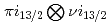 bands in
  Au
AuZhang, Y. H.*; Zhou, X. H.*; He, J. J.*; Liu, Z.*; Fang, Y. D.*; Guo, W. T.*; Lei, X. G.*; Guo, Y. X.*; Ndontchueng, M. M.*; Ma, L.*; et al.
International Journal of Modern Physics E, 15(7), p.1437 - 1445, 2006/10
Times Cited Count:3 Percentile:28.19(Physics, Nuclear)Search for low-spin signature inversion in the bands in odd-odd Au have been made through in-beam -ray spectroscopy techniques. The bands in the three nuclei have been identified and extended up to high-spin states. In particlular, the interband connection between the band and the ground-state band in  Au have been established, leading to a firm spin-and-parity assignment for the band. The low-spin signature inversion is found in the bands in Au.
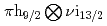 oblate band in
  Tl
TlZhou, X. H.*; Ma, L.*; Xing, Y. B.*; Zhang, Y. H.*; Guo, Y. X.*; Lei, X. G.*; Xie, C. Y.*; Oshima, Masumi; Toh, Yosuke; Koizumi, Mitsuo; et al.
European Physical Journal A, 28(3), p.271 - 275, 2006/06
Times Cited Count:2 Percentile:21.09(Physics, Nuclear)Excited states in Tl have been studied experimentally by in-beam -ray spectroscopy. A rotational band built on the configuration with oblate deformation has been established for Tl. Based on the structure systematics of the oblate bands in heavier odd-odd Tl nuclei, we have tentatively proposed spin values for the new band in Tl. The new oblate band shows low-spin signature inversion, and it can be interpreted qualitatively by the two-quasiparticle plus rotor model including a  -dependent
  -
- residual interaction.
Umeda, Naotaka; Grisham, L. R.*; Yamamoto, Takumi; Kuriyama, Masaaki; Kawai, Mikito; Oga, Tokumichi; Mogaki, Kazuhiko; Akino, Noboru; Yamazaki, Haruyuki*; Usui, Katsutomi; et al.
Nuclear Fusion, 43(7), p.522 - 526, 2003/07
Times Cited Count:39 Percentile:74.23(Physics, Fluids & Plasmas)The Negative-ion based Neutral Beam Injection System (N-NBI) for JT-60U has been operating for plasma heating and non-inductive current drive since 1996. The target is inject of neutral beam into plasma with beam energy 500 keV, injection power 10 MW, for 10 seconds. Until now pulse duration time was restricted up to 5.3 seconds because of larger heat load of port limiter. Recently from the measurement of beam profile at 3.5m downstream from the ion source, it was found that the outermost beamlets in each segment were deflected outward. It was caused by non-uniform electric field by grooves. By improving this, outermost beamlet deflection angle was decreased from 14 mrad to 4 mrad. In this result, 10 seconds injection, which is target parameter, has achieved at 355 keV, 2.6MW, while pulse length was restricted up to 5.3 seconds by larger heat load of port limiter.
Yamamoto, Takumi; Umeda, Naotaka; Kuriyama, Masaaki; Lei, G.*; Grisham, L. R.*; Kawai, Mikito; Oga, Tokumichi; JT-60 NBI-Team
Journal of Plasma and Fusion Research SERIES, Vol.5, p.474 - 477, 2002/00
The performance of a 500keV negative-ion based neutral beam injection system for the JT-60U has been enhanced significantly. By improving the beam divergence, 10-second operation of beam injection has been attained. Small peaks were observed in the beam profile measured at the near field. These peaks are clearly resulted from the deflection of the beamlets due to an unwanted electric field. Correction of the deflection reduced the heat load on the limiter at the injection port by more than 50%. The Doppler shifted spectrum from the negative ion beam was measured, and then indicated that electron stripping of the negative ion beam occurs primarily inside the extraction grid, as expected from theoretical consideration. The electron stripping contributed to half of the heat load on the grounded grid.
