



Initialising ...
Initialising ...
Initialising ...
Initialising ...
Initialising ...
Initialising ...
Initialising ...
Yamaguchi, Yuji; Kondo, Yasuhiro; Meigo, Shinichiro; Oguri, Hidetomo; Oi, Motoki; Saha, P. K.; Shinozaki, Shinichi; Takayanagi, Tomohiro; Yamamoto, Kazami
JPS Conference Proceedings (Internet), 45, p.011162_1 - 011162_7, 2026/06
A high-power 3-GeV proton beam from a rapid cycling synchrotron (RCS) is transported to a neutron production target at Materials and Life Science Experimental Facility (MLF) by a 3-GeV RCS to Neutron facility Beam Transport (3NBT) line in J-PARC. Recently, the design beam power of 1 MW has been achieved. By this achievement, a future plan of MLF second target station (TS2) is motivated for enhancing brightness of the secondary beams and requires a new beam transport line for the 3-GeV proton beam. The design study of the new transport line has been started based on the previous work and is being performed regarding the optics and shielding of the beamline incorporating latest beam commissioning results. In this presentation, we report a brief concept of the new transport line and current status of the design study.
Iwamoto, Hiroki; Meigo, Shinichiro; Sugihara, Kenta*
JPS Conference Proceedings (Internet), 45, p.011179_1 - 011179_7, 2026/06
The nuclide production cross sections are crucial for evaluating the radioactivity of activation products in accelerators and nuclear facilities. Although the production of radionuclides in spallation reactions can be explained using physics models like the nuclear cascade plus evaporation model, accurately and comprehensively reproducing experimental values remains challenging. To address this problem, we have developed a machine learning (ML) model to comprehensively estimate nuclide production cross sections for target materials. The model is trained on experimental data from the nuclear reaction database EXFOR and can estimate nuclide production cross sections even in data-poor regions by utilizing transfer learning. In a previous study, we demonstrated that our model can comprehensively estimate  Be (
Be ( d) and
  H (
H ( y) production cross sections for a wide range of targets. In this study, we apply the ML model to nuclides important for accelerator facility design and astrophysics, such as He,
  Be (
Be (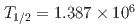 y),
y),  Na (
Na ( y), and
  Na (
Na (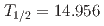 h), showing that it can comprehensively estimate their production cross sections.
Yee-Rendon, B.; Kondo, Yasuhiro; Tamura, Jun; Meigo, Shinichiro; Maekawa, Fujio
JPS Conference Proceedings (Internet), 45, p.011173_1 - 011173_7, 2026/06
The Japan Atomic Energy Agency (JAEA) is carrying out research and development on an Accelerator Driven Subcritical System (ADS) for nuclear transmutation. The JAEA-ADS consists of a CW superconducting proton linac of 30 MW coupling with a subcritical core reactor. The linac will accelerate a 20-mA proton beam to a final energy of 1.5 GeV, starting with a Normal Conducting section up to 2.5 MeV, and followed by a Superconducting part. More than 300 LLRF systems will control longitudinal parameters of the RF structures that compose the linac. In addition to ensuring stability on RF settings for efficient linac performance, the JAEA-ADS LLRF system will also enable fault-tolerance compensations to increase the availability of the linac, which is a major challenge for ADS operation. In this work, we will discuss the necessity of the ADS LLRF and present a proposed model that satisfies these demands.
Yee-Rendon, B.; Kondo, Yasuhiro; Tamura, Jun; Meigo, Shinichiro; Maekawa, Fujio
JPS Conference Proceedings (Internet), 45, p.011174_1 - 011174_10, 2026/06
A 30 MW continuous wave proton linac is devised by the Japan Atomic Energy Agency (JAEA) for the use of Accelerator Driven Subcritical System (ADS) technology. The efficiency of the accelerator is crucial for the realization of ADS in terms of minor actinides management. Therefore, it is necessary to assess the overall efficiency of the different components to ensure the accelerator's feasibility. This study estimated the power required to operate RF cavities, considering effects such as beam loading and microphonics. Additionally, the contribution of cryogenics was considered by calculating the heat load generated by the cryomodules, as well as the power consumption of auxiliary systems such as magnets. In this analysis, we will present the efficiency estimations of the JAEA-ADS linac, as well as the methodology used to obtain the results.
 Ag(p,X) reaction at J-PARC
Sugihara, Kenta*; Meigo, Shinichiro; Iwamoto, Hiroki; Maekawa, Fujio
JPS Conference Proceedings (Internet), 45, p.011181_1 - 011181_10, 2026/06
It is essential to estimate the residual gamma-ray dose rate at accelerator facilities, such as accelerator-driven system. Even though improvements of computer performance enabled us to predict nuclide production cross sections by physics models, the prediction accuracy of the models should be confirmed more. Thus, we have been measuring the nuclide production cross sections by the proton bombardment on various targets with activation technique at J-PARC. In this study, we measured nuclide production cross section of the Ag(p,X) reaction.
Tamura, Jun; Kondo, Yasuhiro; Yee-Rendon, B.; Meigo, Shinichiro; Maekawa, Fujio; Kako, Eiji*; Umemori, Kensei*; Sakai, Hiroshi*; Domae, Takeshi*
JPS Conference Proceedings (Internet), 45, p.011171_1 - 011171_7, 2026/06
Saito, Shigeru; Meigo, Shinichiro; Makimura, Shunsuke*; Hirano, Yukinori*; Tsutsumi, Kazuyoshi*; Maekawa, Fujio
JPS Conference Proceedings (Internet), 45, p.011177_1 - 011177_9, 2026/06
A proton irradiation facility is under consideration at J-PARC to study the irradiation effects of candidate structural materials for accelerator-driven systems (ADS) and high-power target materials. In the facility, irradiation tests in liquid lead-bismuth eutectic (LBE) alloys will be performed for the candidate structural materials. Post irradiation examination (PIE) of irradiated samples will be carried out in the PIE facility to be constructed near the proton irradiation facility. In the PIE facility, PIE of the samples irradiated in the other facilities in J-PARC and in overseas accelerator facilities will also be performed. In this presentation, first, the conceptual study of the PIE facility, including the items to be tested and the test flow will be described. And then, the specifications and quantities of the facilities and the test equipment required to perform these test items will be shown. Finally, the layout of the PIE facility will be proposed.
Yee-Rendon, B.; Kondo, Yasuhiro; Tamura, Jun; Meigo, Shinichiro; Maekawa, Fujio; Pla ais, A.*; Bouly, F.*
Proceedings of 22nd International Conference on RF Superconductivity (SRF2025) (Internet), p.316 - 320, 2026/04
High-intensity accelerators, particularly Accelerator-Driven Systems (ADS), require high availability and reliability for proper operation. For superconducting linear accelerators, the ability to continue operating even when one of the RF cavities fails is key to achieving the required availability, known as cavity compensation. Beam dynamics studies of the JAEA-ADS linear accelerator have demonstrated the possibility of operating with multiple RF cavities disabled with acceptable beam quality. Several other superconducting linear accelerator laboratories have adopted similar methods and developed their procedures. Among these efforts, the LightWin tool has proven to be an effective tool for automatically and systematically identifying compensation settings for each cavity failure in any linear accelerator. This software has been successfully utilized on the MINERVA linac, as well as on the high-energy part of the JAEA-ADS linac. It has currently been tested and improved to ease SPIRAL2 operation. This work presents an analysis of cavity compensation in the JAEA-ADS superconducting linear accelerator using the LightWin tool and compares the results with previous studies.
Tamura, Jun; Kondo, Yasuhiro; Yee-Rendon, B.; Meigo, Shinichiro; Maekawa, Fujio; Kako, Eiji*; Umemori, Kensei*; Sakai, Hiroshi*; Domae, Takeshi*
Proceedings of 22nd International Conference on RF Superconductivity (SRF2025) (Internet), p.691 - 694, 2026/04
Japan Atomic Energy Agency (JAEA) has been proposing an accelerator-driven nuclear transmutation system (ADS) as a future nuclear system to efficiently reduce high-level radioactive waste generated in nuclear power plants. As the first step toward the full-scale CW proton linac for the JAEA-ADS, we are currently prototyping a low-beta (around 0.2) single-spoke cavity. Since there is no experience in manufacturing superconducting spoke cavities in Japan, prototyping and performance evaluation of the cavity are essential to ensure the feasibility of the JAEA-ADS. The actual cavity fabrication started in 2020, and the cavity assembly by electron beam welding was finally completed in fiscal year 2024. In this assembly, the target resonance frequency of 324 MHz was achieved by trimming the ends of the cavity parts several times before the final welding. In the final welding, smooth weld beads were obtained by combining circular-correction and end-thinning for the cavity parts to be welded. The fabrication of the prototype spoke cavity is presented.
Yee-Rendon, B.; Kondo, Yasuhiro; Tamura, Jun; Meigo, Shinichiro; Maekawa, Fujio; Miyamoto, Ryoichi*; Milas, N.*; Eshraqi, M.*
Proceedings of 22nd International Conference on RF Superconductivity (SRF2025) (Internet), p.58 - 62, 2026/04
The European Spallation Source (ESS) superconducting proton linac is currently undergoing commissioning. During the initial operation phase, the final beam energy will be about 800 MeV, reaching a 2 MW power. High reliability and availability are crucial for the success of the ESS science programs and thus operations will be maintained even with failures of main linac components such as cavities and quadrupoles, as long as ~50 percent of the intended power can be achieved. To this end, we developed beam optics strategies to address failures in the cavities of the superconducting linac. Due to the constraints in the RF cavity amplitudes, we implemented a modified version of standard cavity compensation techniques. The results indicated that this strategy enables beam recovery that meets the beam quality specifications, thereby enhancing the availability of the ESS linac.
Yee-Rendon, B.; Kondo, Yasuhiro; Tamura, Jun; Meigo, Shinichiro; Maekawa, Fujio
Proceedings of 22nd Annual Meeting of Particle Accelerator Society of Japan (Internet), p.130 - 134, 2026/03
Accelerator-Driven Systems (ADS) represent an efficient solution to the challenge of nuclear waste disposal. Therefore, the Japan Atomic Energy Agency (JAEA) is designing a 30-MW proton linac as a key element of its proposal for the use of ADS technology. A key feature of ADS accelerators is their extremely high availability and reliability that is required to avoid thermal stress on reactor structures. To this end, JAEA-ADS adopted a combined strategy of hot standby in the front part of the linac and standby element compensation as a fast and efficient way to reduce the downtime due to an element failure. The JAEA-ADS injector is mainly composed of a normal conducting section and ends with the first section of superconducting cavities (Half Wave Resonator). This paper presents the details of the optics design of the JAEA-ADS injector and the results of beam dynamics simulations.
Yamaguchi, Yuji; Kondo, Yasuhiro; Meigo, Shinichiro; Takayanagi, Tomohiro; Fujimori, Hiroshi*; Shinozaki, Shinichi
Proceedings of 22nd Annual Meeting of Particle Accelerator Society of Japan (Internet), p.655 - 660, 2026/03
Preliminary designs of new bending magnets have been considered for the second target station (TS2) of Materials and Life Science Experimental Facility (MLF), J-PARC. To give a design approach for the bending magnets, several examples of bending magnets, such as a pulse bending magnet and a septum magnet were reviewed. The reviewed magnet specifications compared with requirements for the new bending magnets indicate that the new pulse bending magnet requires a new design idea, while the new septum magnet can be designed based on the previous design of an extraction septum magnet for the 3-GeV synchrotron in J-PARC. The new design idea for the pulse bending magnet and the septum magnet design idea based on the previous one are presented.
Yamaguchi, Yuji; Kondo, Yasuhiro; Meigo, Shinichiro; Shinozaki, Shinichi; Takayanagi, Tomohiro; Fujimori, Hiroshi*; Kawamura, Naritoshi*
Journal of Physics; Conference Series, 3094(1), p.012023_1 - 012023_5, 2025/09
The 3-GeV proton beam from the rapid cycling synchrotron (RCS) of J-PARC is transported to the spallation neutron source at Materials and Life Science Experimental Facility (MLF) by a 3-GeV RCS to Neutron facility Beam Transport (3NBT) line. Recently, the first design idea of a new proton beam transport line has been proposed for a future target station of the MLF (TS2). In the present study, proton beam transport is simulated near the TS2 target where a bending magnet and a solenoid are located for muon beam transport. The purposes are to clarify the magnetic field effects on the proton beam by the magnets and to present a method to correct each effect. Orbit deviation by the bending magnet and vertical size expansion due to profile rotation by the solenoid can be corrected by installing additional bending magnets and a solenoid with reversal magnetic field, respectively. The correction method is expected to be effective and also needs to be studied further for detail design.
Meigo, Shinichiro; Iwamoto, Hiroki; Sugihara, Kenta*; Hirano, Yukinori*; Tsutsumi, Kazuyoshi*; Saito, Shigeru; Maekawa, Fujio
JAEA-Technology 2024-026, 123 Pages, 2025/03
 JAEA-Technology-2024-026.pdf:14.22MB
Based on the design of the ADS Target Test Facility (TEF-T) at the J-PARC Transmutation Experimental Facility, a conceptual study was conducted on the J-PARC proton beam irradiation facility. This research was carried out based on the recommendations of the Nuclear Transmutation Technology Evaluation Task Force of the MEXT. The recommendations state that it is desirable to consider facility specifications that can make the most of the benefits of using the existing J-PARC proton accelerator while also solving the engineering issues of the ADS. We considered facilities that could respond to a variety of needs while reducing the facilities that were not needed in the TEF-T design. In order to clarify these diverse needs, we investigated the usage status of representative accelerator facilities around the world. As a result, it became clear that the main purposes of these facilities were (1) Material irradiation, (2) Soft error testing of semiconductor devices using spallation neutrons, (3) Production of RI for medical use, and (4) Proton beam use, and we investigated the facilities necessary for these purposes. In considering the facility concept, we assumed a user community in 2022 and reflected user opinions in the facility design. This report summarizes the results of the conceptual study of the proton irradiation facility, various needs and responses to them, the roadmap for facility construction, and future issues.
 experiment using a
  Cf calibration source
Lee, D. H.*; Dodo, Taku; Haga, Katsuhiro; Harada, Masahide; Hasegawa, Shoichi; Kasugai, Yoshimi; Kinoshita, Hidetaka; Masuda, Shiho; Meigo, Shinichiro; Sakai, Kenji; et al.
Nuclear Instruments and Methods in Physics Research A, 1072, p.170216_1 - 170216_6, 2025/03
Times Cited Count:2 Percentile:77.30(Instruments & Instrumentation)Marzec, E.*; Dodo, Taku; Haga, Katsuhiro; Harada, Masahide; Hasegawa, Shoichi; Kasugai, Yoshimi; Kinoshita, Hidetaka; Masuda, Shiho; Meigo, Shinichiro; Sakai, Kenji; et al.
Physical Review Letters, 134(8), p.081801_1 - 081801_9, 2025/02
Times Cited Count:6 Percentile:90.81(Physics, Multidisciplinary)Dodo, Taku; Haga, Katsuhiro; Harada, Masahide; Hasegawa, Shoichi; Kasugai, Yoshimi; Kinoshita, Hidetaka; Masuda, Shiho; Meigo, Shinichiro; Sakai, Kenji; Suzuya, Kentaro; et al.
Progress of Theoretical and Experimental Physics (Internet), 2025(2), p.023H02_1 - 023H02_8, 2025/02
Times Cited Count:1 Percentile:44.91(Physics, Multidisciplinary)Meigo, Shinichiro
Kasokuki, 21(4), p.333 - 344, 2025/01
For the study of material damage under the beam irradiation circumstance of accelerator-driven systems (ADS), the JAEA had planned to construct a TEF-T using J-PARC Linac 400-MeV proton beams and the LBE spallation target. The task force for evaluating partitioning and transmutation technology in the MEXT recommended that the facility be considered to maximize the advantages of using Linac to meet users' various needs. The proton irradiation facility, a successor of TEF-T, is planned to be constructed for 1) Material irradiation examinations, 2) Semiconductor soft-error examinations using spallation neutrons, 3) Medical RI production, and 4) Proton beam applications for space use. A user community was established in 2022 to incorporate user input as a more attractive facility. In this paper, the present design status of the facility is described.
Iwamoto, Yosuke; Matsuda, Hiroki*; Meigo, Shinichiro; Yonehara, Katsuya*; Pellemoine, F.*; Liu, Z.*; Lynch, K.*; Yoshida, Makoto*; Yabuuchi, Atsushi*; Yoshiie, Toshimasa*; et al.
Nuclear Instruments and Methods in Physics Research B, 557, p.165543_1 - 165543_8, 2024/12
Times Cited Count:1 Percentile:24.85(Instruments & Instrumentation)The number of displacements per atom is widely used as an indicator of irradiation damage to materials in proton accelerator facilities. Experiments have been carried out on protons below 3 GeV to verify the dpa of metallic materials. However, the dpa for high-energy protons above 3 GeV has not been measured. In order to validate the displacement cross sections of metals in the high-energy region, the electrical resistivity changes of aluminium, copper and tungsten wires at a temperature of 8 K were measured using protons with energy of 120 GeV. The results show that the conventional irradiation damage model of PHITS overestimates the experimental data. On the other hand, the calculation results using the athermal recombination correction model were in agreement with the experimental data.
 from 3-GeV protons and
  Hg with the
  Bi(n,xn) reactions
Sugihara, Kenta*; Meigo, Shinichiro; Iwamoto, Hiroki; Maekawa, Fujio
JAEA-Conf 2024-002, p.162 - 167, 2024/11
A neutron energy spectrum is important for shielding design at an Accelerator-Driven System facility (1.5-GeV p + Lead Bismuth Eutectic). A similar spectrum can be obtained at J-PARC (3-GeV proton + Hg). To check the validity of the unfolding, the unfolding with the Bi(n,xn) reactions and the response functions (JENDL/HE-2007 and TALYS) was applied. In our poster, we present the derivation of the spectrum and comparison with the spectrum with a Time-of-Flight technique.
