



Initialising ...
Initialising ...
Initialising ...
Initialising ...
Initialising ...
Initialising ...
Initialising ...
 electronic states in CeIrSi
 studied by angle-resolved Ce 3
 resonance photoemission spectroscopy
Okochi, Takuo*; Toshimitsu, Takafumi*; Yamagami, Hiroshi; Fujimori, Shinichi; Yasui, Akira; Takeda, Yukiharu; Okane, Tetsuo; Saito, Yuji; Fujimori, Atsushi; Miyauchi, Yuichiro*; et al.
Journal of the Physical Society of Japan, 78(8), p.084802_1 - 084802_6, 2009/08
Times Cited Count:10 Percentile:54.6(Physics, Multidisciplinary)We have applied angle-resolved Ce 3 4 resonance photoemission spectroscopy to the non-centrosymmetric pressure-induced superconductor CeIrSi and obtained the 4 band-structure and Fermi surfaces. We have found that the Ce 4 states are located mainly near the Fermi level and that the photoemission intensity derived from the dispersive conduction bands across the Fermi level shows considerable resonant enhancement. In addition, the band structure and Fermi surfaces of CeIrSi are different from those of the non- reference compound, LaIrSi and the difference is well explained by the band structure calculated within the local density approximation (LDA). These results strongly suggest that the Ce 4 electrons in CeIrSi are well hybridized with conduction bands and form itinerant electronic states.
realized at the quantum critical pointSettai, Rikio*; Kawai, Tomoya*; Miyauchi, Yuichiro*; Okuda, Yusuke*; Onuki, Yoshichika; Takeuchi, Tetsuya*; Tateiwa, Naoyuki; Matsuda, Tatsuma; Haga, Yoshinori; Harima, Hisatomo*
Kotai Butsuri, 43(8), p.459 - 474, 2008/08
The magnetic transition temperature of an antiferromagnet CeIrSi decreases with increasing hydrostatic pressure, and finally superconductivity appears. An exotic superconducting symmetry is expected because of the absence of the inversion center in the crystal structure. One of the prominent features is the anomalously large upper critical field observed around the quantum critical point.
under high pressureTateiwa, Naoyuki; Haga, Yoshinori; Matsuda, Tatsuma; Ikeda, Shugo; Yamamoto, Etsuji; Okuda, Yusuke*; Miyauchi, Yuichiro*; Settai, Rikio*; Onuki, Yoshichika
Journal of Physics; Conference Series, 121(5), p.052001_1 - 052001_5, 2008/07
Times Cited Count:2 Percentile:60.92(Physics, Multidisciplinary)We investigated the pressure-induced superconductor CeIrSi without inversion center under high pressure. The electrical resistivity and ac heat capacity were measured in the same run for the same sample. The critical pressure of the antiferromagnetic state was determined to be  = 2.25 GPa. The co-existence of the antiferromagnetism and superconductivity is discussed. The superconducting region is extended up to about 3.5 GPa. The superconducting transition temperature
  shows a maximum value of 1.6 K around
  GPa. At 2.58 GPa, a large heat capacity anomaly was observed at = 1.59 K. The jump of the heat capacity in the form of
 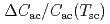 is 5.7
  0.1. This is the largest observed value among all superconductors studied previously, suggesting the strong-coupling superconductivity in CeIrSi.
without inversion centerTateiwa, Naoyuki; Haga, Yoshinori; Ikeda, Shugo; Matsuda, Tatsuma; Yamamoto, Etsuji; Okuda, Yusuke*; Miyauchi, Yuichiro*; Settai, Rikio*; Onuki, Yoshichika*
Physica B; Condensed Matter, 403(5-9), p.1156 - 1158, 2008/04
Times Cited Count:1 Percentile:6.32(Physics, Condensed Matter)We present the result of an antiferromagnet CeIrSi without inversion center by measureing the heat capacity and the electrical resistivity of CeIrSi. Both physical quantities were measured in the same run for the same single crystal sample. A huge heat capacity anomaly was observed at the superconducting transition temperature = 1.6 K where the zero-resistivity was observed. The jump of the heat capacity  is 5.7 0.1 at 2.58 GPa. This value is the largest among previously reported superconducting materials, indicating the strong coupling superconductivity. The electronic specific heat coefficient just above is roughly estimated to be 100 20 mJ/K
 mol at 2.58 GPa, which is the same as
  = 120 20 mJ/Kmol at ambient pressure.
Si and CeIrSi without inversion symmetry in the crystal structureOnuki, Yoshichika; Miyauchi, Yuichiro*; Tsujino, Masahiko*; Ida, Yuki*; Settai, Rikio*; Takeuchi, Tetsuya*; Tateiwa, Naoyuki; Matsuda, Tatsuma; Haga, Yoshinori; Harima, Hisatomo*
Journal of the Physical Society of Japan, 77(Suppl.A), p.37 - 42, 2008/00
Times Cited Count:6 Percentile:43.17(Physics, Multidisciplinary)Superconducting upper critical field of CePtSi and CeIrSi without inversion symmetry was studied in detail. In CePtSi coexisting with antiferromagnetism, rather isotropic critical field was observed. On the other hand, huge anisotropy was detected in CeIrSi. These results are discussed in connection with the formation of the heavy fermion state.
with He non-centrosymmetric crystal structureTateiwa, Naoyuki; Haga, Yoshinori; Matsuda, Tatsuma; Ikeda, Shugo; Yamamoto, Etsuji; Okuda, Yusuke*; Miyauchi, Yuichiro*; Settai, Rikio*; Onuki, Yoshichika
Journal of the Physical Society of Japan, 76(8), p.083706_1 - 083706_4, 2007/08
Times Cited Count:52 Percentile:99.65(Physics, Multidisciplinary)We studied the pressure-induced superconductor CeIrSi with the non-centrosymmetric tetragonal structure under high pressure. The electrical resistivity and ac heat capacity were measured in the same run for the same sample. The critical pressure was determined to be = 2.25 GPa, where the antiferromagnetic state disappears. The superconducting region is extended to high pressures of up to about 3.5 GPa, with the maximum transition temperature = 1.6 K around GPa. At 2.58 GPa, a large heat capacity anomaly was observed at = 1.59 K. The jump of the heat capacity in the form of is 5.7 0.1. This is the largest observed value among previously reported superconductors, indicating the strong-coupling superconductivity.
and CeIrSi with the non-centrosymmetric crystal structureOkuda, Yusuke*; Miyauchi, Yuichiro*; Ida, Yuki*; Takeda, Yuji*; Tonohiro, Chie*; Ozuchi, Yasuhiro*; Yamada, Tsutomu*; Nguyen, D.; Matsuda, Tatsuma; Haga, Yoshinori; et al.
Journal of the Physical Society of Japan, 76(4), p.044708_1 - 044708_11, 2007/04
Times Cited Count:87 Percentile:91.8(Physics, Multidisciplinary)Single crystals of LaIrSi and CeIrSi were grown by the Czochralski pulling method in a tetra-arc furnace and the magnetic and superconducting properties, together with super- conductivity in CeIr Co
Co Si, were clarified by measuring the electrical resistivity, specific heat, magnetic susceptibility, magnetization and de Haas-van Alphen (dHvA) effect. From the results of the dHvA experiment for LaIrSi, the Fermi surface is found to split into two Fermi surfaces due to the spin-orbit interaction arising from the non-centrosymmetric crystal structure. The electronic state of CeIrSi is tuned from the antiferro- magnetic state to the superconducting state by applying pressure. The upper critical field H
 (0) at a pressure of 2.65 GPa is found to be highly anisotropic. Large magnitude and anisotropy of H(0) in CeIrSi are consistent with the theoretical prediction for superconductivity in the non-centrosymmetric crystal structure.
Tateiwa, Naoyuki; Haga, Yoshinori; Matsuda, Tatsuma; Ikeda, Shugo; Yamamoto, Etsuji; Okuda, Yusuke*; Miyauchi, Yuichiro*; Settai, Rikio*; Onuki, Yoshichika
no journal, ,
High pressure experiments were performed on the pressure-induced superconductor CeIrSi without inversion center. The critical pressure of the antiferromagnetic state was determined to be = 2.25 GPa. The co-existence of the antiferromagnetism and superconductivity is discussed. The superconducting region is extended up to about 3.5 GPa. The superconducting transition temperature shows a maximum value of 1.6 K around GPa. At 2.58 GPa, a large heat capacity anomaly was observed at = 1.59 K. The jump of the heat capacity in the form of is 5.7 0.1. This is the largest observed value among all superconductors studied previously, suggesting the strong-coupling superconductivity in CeIrSi.
studied by angle-resolved resonant photoemission spectroscopyToshimitsu, Takafumi; Okochi, Takuo; Yasui, Akira; Kobayashi, Masaki*; Takeda, Yukiharu; Okane, Tetsuo; Saito, Yuji; Fujimori, Atsushi*; Yamagami, Hiroshi*; Miyauchi, Yuichiro*; et al.
no journal, ,
We performed angle-resolved resonant photoemission spectroscopy on CeIrSi. CeIrSi is said to be the superconductor which lacks inversion symmetry and therefore the measurements of electronic conductivity, magnetoresistance, dHvA, and so on, have been made on so far. In this study, we observed extremely clear 4 derived band dispersions and Fermi surfaces. By these obtained profiles and comparison with those predicted by LDA calculation, Ce 4 electrons in CeIrSi have relatively itinerant electronic states.
under high pressureTateiwa, Naoyuki; Haga, Yoshinori; Matsuda, Tatsuma; Ikeda, Shugo; Miyauchi, Yuichiro*; Okuda, Yusuke*; Settai, Rikio*; Onuki, Yoshichika
no journal, ,
Recently, non-centrosymmetric superconductors have attracted much attention from a view point of a mixed parity of a superconducting pair wave function. CeIrSi crystalizes in the tetragonal BaNiSn-type crystal structure. It shows an antiferromagnetic ordering at  = 5.0 K and becomes a superconductor above 2 GPa. In this study, we have investigated CeIrSi by measurements of the heat capacity and electrical resistivity under high pressure. We will discuss the bulk superconducting phase.
 and LaIrSi by angle-resolved photoemission spectroscopy
Toshimitsu, Takafumi; Okochi, Takuo; Yasui, Akira; Kobayashi, Masaki*; Takeda, Yukiharu; Okane, Tetsuo; Saito, Yuji; Fujimori, Atsushi; Yamagami, Hiroshi; Miyauchi, Yuichiro*; et al.
no journal, ,
no abstracts in English
by soft X-ray angle-resolved resonant photoemission spectroscopyOkochi, Takuo; Yasui, Akira; Takeda, Yukiharu; Okane, Tetsuo; Saito, Yuji; Fujimori, Atsushi*; Yamagami, Hiroshi; Miyauchi, Yuichiro*; Okuda, Yusuke*; Settai, Rikio*; et al.
no journal, ,
We have investigated the bulk 4 electronic structure of the non-centrosymmetric superconductor, CeIrSi by soft X-ray angle-resolved photoemission spectroscopy. We have performed the angle-resolved 3 -4 resonant photoemission and the comparison of the angle-resolved photoemission spectra of CeIrSi with those of non- reference compound, LaIrSi and revealed that the 4 states of CeIrSi well hybridized with the non- conduction bands.
Kato, Yoshinari; Hashimoto, Makoto; Miyauchi, Hideaki; Yasumune, Takashi; Ogawa, Ryuichiro; Goto, Shingo; Ochiai, Yukihiro*; Matsui, Junki
no journal, ,
no abstracts in English
