



Initialising ...
Initialising ...
Initialising ...
Initialising ...
Initialising ...
Initialising ...
Initialising ...
 scattering length from
  photoproduction on the proton near the reaction threshold
Ishikawa, Takatsugu*; Fujimura, Hisako*; Fukasawa, Hiroshi*; Hashimoto, Ryo*; He, Q.*; Honda, Yuki*; Hosaka, Atsushi; Iwata, Takahiro*; Kaida, Shun*; Kasagi, Jirota*; et al.
Physical Review C, 101(5), p.052201_1 - 052201_6, 2020/05
Times Cited Count:4 Percentile:45.12(Physics, Nuclear)Hayashi, Nobuhiko; Honda, Mitsuru; Shiraishi, Junya; Miyata, Yoshiaki; Wakatsuki, Takuma; Hoshino, Kazuo; Toma, Mitsunori; Suzuki, Takahiro; Urano, Hajime; Shimizu, Katsuhiro; et al.
Europhysics Conference Abstracts (Internet), 39E, p.P5.145_1 - P5.145_4, 2015/06
 -type giant tetragonal compound Bi
 ZnVO
ZnVO and its stability under pressure
Yu, R.*; Hojo, Hajime*; Oka, Kengo*; Watanuki, Tetsu; Machida, Akihiko; Shimizu, Keisuke*; Nakano, Kiho*; Azuma, Masaki*
Chemistry of Materials, 27(6), p.2012 - 2017, 2015/03
Times Cited Count:26 Percentile:62.59(Chemistry, Physical)no abstracts in English
Ide, Shunsuke; Aiba, Nobuyuki; Bolzonella, T.*; Challis, C. D.*; Fujita, Takaaki; Giruzzi, G.*; Joffrin, E.*; Hamamatsu, Kiyotaka; Hayashi, Nobuhiko; Honda, Mitsuru; et al.
Proceedings of 24th IAEA Fusion Energy Conference (FEC 2012) (CD-ROM), 8 Pages, 2013/03
Fe Mo
Mo O (0
O (0  x 1)
x 1)Yoshida, Koji*; Ikeuchi, Shinya*; Shimizu, Hajime*; Okayasu, Satoru; Suzuki, Takashi*
Journal of the Physical Society of Japan, 80(4), p.044716_1 - 044716_4, 2011/04
Times Cited Count:5 Percentile:38.92(Physics, Multidisciplinary)We studied systematic changes of the structural, electric, and magnetic properties in SrFeMoO with 0 x 1, which bridges between a half-metallic double perovskite SrFeMoO (x = 0) and an antiferromagnetic metal SrFeO (= SrFeO: x = 1). The lattice volume at room temperature linearly decreases with x. The decline steeply enhances around x = 0.5, which is accompanied with a symmetry change from a tetragonal to a cubic crystal structure. In the same composition, we also found changes in the electronic ground state from a metal to an insulator and in the magnetic one from ferromagnetism to paramagnetism. These results indicate the strong correlation among the crystal structure, itinerant electrons and occurrence of ferromagnetic state in the double perovskite. In addition, the value of the critical composition could reflect peculiar physical changes with x.
Shimizu, Futoshi; Ogata, Shigenobu*; Kimizuka, Hajime*; Kano, Takuma; Li, J.*; Kaburaki, Hideo
Journal of the Earth Simulator, 7, p.17 - 21, 2007/06
Kadoyoshi, Tomoko; Kaburaki, Hideo; Shimizu, Futoshi; Kimizuka, Hajime*; Jitsukawa, Shiro; Li, J.*
Acta Materialia, 55(9), p.3073 - 3080, 2007/05
Times Cited Count:61 Percentile:90.89(Materials Science, Multidisciplinary)Critical conditions have been determined for intrinsic transformation of a vacancy Frank loop into a stacking fault tetrahedron in a face centered cubic metal by the molecular dynamics method. We found that a stacking fault tetrahedron can be formed from the scalene hexagonal vacancy Frank loops of wide range of sizes due to the dissociation of dislocations. We have also found atomistically the dynamical process in which vacancy and interstitial faulted Frank loops transform into perfect loops by the application of the external shear stress or by raising the temperature. We have determined numerically the critical shear stress and temperature for the initiation of unfaulting. The simulation results clearly unveiled the important role of temperature in the unfaulting mechanism of an interstitial Frank loop.
 observation from 10
 to 2.0
 using a focusing and polarized neutron small-angle scattering spectrometer, SANS-J-II
Iwase, Hiroki; Koizumi, Satoshi; Suzuki, Junichi; Oku, Takayuki; Sasao, Hajime*; Tanaka, Hirokazu*; Shimizu, Hirohiko*; Hashimoto, Takeji
Journal of Applied Crystallography, 40(s1), p.s414 - s417, 2007/04
Times Cited Count:15 Percentile:80.33(Chemistry, Multidisciplinary)In order to extend an upper q-limit larger, high-angle He sub-detectors were installed on focusing and polarized neutron small-angle scattering spectrometer (SANS-J-II) at JRR-3, Tokai. Consequently, its upper q-limit was improved from 0.2 to 2. To quantitatively discriminate spin incoherent scattering from hydrogen or to perform nuclear spin polarization contrast variation, a remanent supermirror analyser is also available on the high-angle sub detector. By combining a focusing ultra-small angle scattering, realized by compound and/or magnetic lens and high resolution area detector, SANS-J-II is able to cover from 3 10
10 to 2 (four order of magnitude of q), which profits to investigate hierarchically ordered system, found widely in hard, soft and bio-materials.
Kubo, Hirotaka; Nakano, Tomohide; Asakura, Nobuyuki; Takenaga, Hidenobu; Tsuzuki, Kazuhiro; Oyama, Naoyuki; Kawashima, Hisato; Shimizu, Katsuhiro; Urano, Hajime; Fujimoto, Kayoko; et al.
Proceedings of 21st IAEA Fusion Energy Conference (FEC 2006) (CD-ROM), 8 Pages, 2007/03
no abstracts in English
Oku, Takayuki; Yamada, Satoru; Sasao, Hajime*; Suzuki, Junichi; Shinohara, Takenao*; Hirota, Katsuya*; Ikeda, Kazuaki*; Tsuzaki, Tsuyoshi*; Kiyanagi, Yoshiaki*; Furusaka, Michihiro*; et al.
Physica B; Condensed Matter, 385-386(2), p.1225 - 1228, 2006/11
Times Cited Count:10 Percentile:44.47(Physics, Condensed Matter)We have developed a magnetic neutron lens based on an extended Halbach-type permanent sextupole magnet with magnet pieces of NEOMAX-44H, -35EH and high saturation magnetization material, permendule. The aperture size of the magnet is 35 mm in diameter and the magnet length is 2,400 mm. The magnet generates a sextupole magnetic field 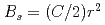 with a gradient coefficient
  =10,600 T/m
 inside the aperture, where
  is a distance from the magnet center axis. To prevent neutrons from hitting and reflecting at the inner surface of the magnet, the surface is covered with cadmium (Cd) sheets and also Cd pinhole slits with size of 30 mm in diameter are positioned in series inside the magnet aperture, resulting in the effective diameter of 30 mm. The neutron focusing property of the magnet is investigated by using pulsed polarized neutrons. The obtained results are discussed with the precise simulation results. Its application to the focusing-geometry small-angle neutron scattering experiments is also discussed.
Koizumi, Satoshi; Iwase, Hiroki; Suzuki, Junichi; Oku, Takayuki; Motokawa, Ryuhei; Sasao, Hajime*; Tanaka, Hirokazu; Yamaguchi, Daisuke; Shimizu, Hirohiko; Hashimoto, Takeji
Physica B; Condensed Matter, 385-386(2), p.1000 - 1006, 2006/11
Times Cited Count:39 Percentile:80.68(Physics, Condensed Matter)no abstracts in English
Oku, Takayuki; Suzuki, Junichi; Sasao, Hajime*; Yamada, Satoru; Furusaka, Michihiro*; Adachi, Tomohiro*; Shinohara, Takenao*; Ikeda, Kazuaki*; Shimizu, Hirohiko
Physica B; Condensed Matter, 356(1-4), p.126 - 130, 2005/02
Times Cited Count:11 Percentile:45.47(Physics, Condensed Matter)We have developed a magnetic neutron lens (MNL) based on a sextupole magnet. A neutron beam, which is incident to the sextupole magnet, either converges or diverges depending on the neutron spin state. Small-angle neutron scattering in focusing geometry (FSANS) was proposed to improve the q-resolution and/or measuring efficiency. The MNL is considered to be the most suitable focusing device for FSANS experiments using a polarized neutron beam, since it focuses the polarized neutron beam free from neutron attenuation and scattering by substances. Recently, we have developed the MNLs with sufficiently large apertures and strong focusing power for FSANS experiments. In this study, we evaluate the focusing property of the MNLs for the polarized neutron beam, and performed FSANS experiments using the MNL. The obtained results are discussed.
Koizumi, Satoshi; Iwase, Hiroki; Tanaka, Hirokazu; Hashimoto, Takeji; Suzuki, Junichi; Oku, Takayuki; Sasao, Hajime*; Shimizu, Hirohiko
Hamon, 14(4), p.266 - 274, 2004/10
no abstracts in English
Oku, Takayuki; Suzuki, Junichi; Sasao, Hajime*; Adachi, Tomohiro*; Shinohara, Takenao*; Ikeda, Kazuaki*; Morishima, Takahiro*; Sakai, Kenji*; Kiyanagi, Yoshiaki*; Furusaka, Michihiro*; et al.
Nuclear Instruments and Methods in Physics Research A, 529(1-3), p.116 - 119, 2004/08
Times Cited Count:21 Percentile:77.78(Instruments & Instrumentation)As a neutron has a magnetic dipole moment, it is accelerated in a magnetic field gradient. Thus, we can control a neutron trajectory free from neutron beam attenuation and scattering using the magnetic field gradient. A sextupole magnetic field functions as a neutron focusing and defocusing lens depending on the neutron spin state. The neutron focusing effect was experimentally verified using a 6-piece permanent sextupole magnet. For the application in practical neutron scattering experiments, a sextupole magnet with a sufficiently large aperture accompanied with strong focusing power is demanded. Recently, a superconducting sextupole magnet, a Halbach-type permanent sextupole magnet and a sextupole pulse electro-magnet have been developed in a project of the development and application of neutron optics. These magnets will be dedicated to practical uses in neutron scattering experiments. In this paper, current status of the development of the magnetic neutron lenses is reported, and their application in the neutron scattering experiments is discussed.
 (
( ,
,
 )
) and (,)
 reactions for
 =1.5-2.4 GeV
Zegers, R. G. T.*; Sumihama, Mizuki*; Ahn, D. S.*; Ahn, J. K.*; Akimune, Hidetoshi*; Asano, Yoshihiro; Chang, W. C.*; Dat , S.*; Ejiri, Hiroyasu*; Fujimura, Hisako*; et al.
Physical Review Letters, 91(9), p.092001_1 - 092001_4, 2003/08
Times Cited Count:128 Percentile:94.9(Physics, Multidisciplinary)no abstracts in English
 = +1 Baryon resonance in photoproduction from the neutron
Nakano, Takashi*; Ahn, D. S.*; Ahn, J. K.*; Akimune, Hidetoshi*; Asano, Yoshihiro; Chang, W. C.*; Date, S.*; Ejiri, Hiroyasu*; Fujimura, Hisako*; Fujiwara, Mamoru; et al.
Physical Review Letters, 91(1), p.012002_1 - 012002_4, 2003/07
Times Cited Count:1006 Percentile:99.86(Physics, Multidisciplinary)no abstracts in English
Kamada, Yutaka; Fujita, Takaaki; Ishida, Shinichi; Kikuchi, Mitsuru; Ide, Shunsuke; Takizuka, Tomonori; Shirai, Hiroshi; Koide, Yoshihiko; Fukuda, Takeshi; Hosogane, Nobuyuki; et al.
Fusion Science and Technology (JT-60 Special Issue), 42(2-3), p.185 - 254, 2002/09
Times Cited Count:34 Percentile:48.48(Nuclear Science & Technology)With the main aim of providing physics basis for ITER and the steady-state tokamak reactors, JT-60/JT-60U has been developing and optimizing the operational concepts, and extending the discharge regimes toward sustainment of high integrated performance in the reactor relevant parameter regime. In addition to achievement of the equivalent break-even condition (QDTeq up to 1.25) and a high fusion triple product = 1.5E21 m-3skeV, JT-60U has demonstrated the integrated performance of high confinement, high beta-N, full non-inductive current drive with a large fraction of bootstrap current in the reversed magnetic shear and in the high-beta-p ELMy H mode plasmas characterized by both internal and edge transport barriers. The key factors in optimizing these plasmas are profile and shape controls. As represented by discovery of various Internal Transport Barriers, JT-60/JT-60U has been emphasizing freedom and restriction of profiles in various confinement modes. JT-60U has demonstrated applicability of these high confinement modes to ITER and also clarified remaining issues.
Shimizu, Futoshi; Kimizuka, Hajime*; Kaburaki, Hideo; Arakawa, Chuichi*
Keisan Kogaku Koenkai Rombunshu, 7(1), p.163 - 166, 2002/05
no abstracts in English
Shimizu, Futoshi; Kimizuka, Hajime*; Kaburaki, Hideo; Arakawa, Chuichi*
Nihon Keisan Kogakkai Rombunshu, 4, p.225 - 230, 2002/04
no abstracts in English
Itakura, Kenichi; Yokokawa, Mitsuo; Shimizu, Futoshi; Kimizuka, Hajime*; Kaburaki, Hideo
Joho Shori Gakkai Kenkyu Hokoku 2001-HPC-88, p.67 - 72, 2001/10
he Earth Simulator which is under development has 640 processor nodes and its peak performance is 40 Tflop/s. In this study, we have evaluated performance of solid molecular dynamics simulation on an SMP node of the Earth Simulator. In molecular dynamics simulation, each particle is influenced by all particles within a cut-off region and the representation of these pairs of particles is made by a matrix. Two matrix representations, compressed row form and jagged diagonal form, are considered for vectorization. The jagged diagonal form is better than the compressed row form in performance on a vector processor for the force calculation of every pairs, because the vector length of the former is longer than that of the latter. However, computational cost for converting the normal matrix form to the jagged diagonal form is quite expensive and the total performance in using the jagged diagonal form is low. Speedup by parallelization with the compressed row form is 2.4 to 2.7 with 8 vector processors.
