



Initialising ...
Initialising ...
Initialising ...
Initialising ...
Initialising ...
Initialising ...
Initialising ...
Takamatsu, Misao; Kawahara, Hirotaka; Ito, Hiromichi; Ushiki, Hiroshi; Suzuki, Nobuhiro; Sasaki, Jun; Ota, Katsu; Okuda, Eiji; Kobayashi, Tetsuhiko; Nagai, Akinori; et al.
Nihon Genshiryoku Gakkai Wabun Rombunshi, 15(1), p.32 - 42, 2016/03
In the experimental fast reactor Joyo, it was confirmed that the top of the irradiation test sub-assembly of "MARICO-2" (material testing rig with temperature control) had been broken and bent onto the in-vessel storage rack as an obstacle and had damaged the upper core structure (UCS). This paper describes the results of the in-vessel repair techniques for UCS replacement, which are developed in Joyo. UCS replacement was successfully completed in 2014. In-vessel repair techniques for sodium cooled fast reactors (SFRs) are important in confirming its safety and integrity. In order to secure the reliability of these techniques, it was necessary to demonstrate the performance under the actual reactor environment with high temperature, high radiation dose and remained sodium. The experience and knowledge gained in UCS replacement provides valuable insights into further improvements for In-vessel repair techniques in SFRs.
Kajimoto, Ryoichi; Nakamura, Mitsutaka; Inamura, Yasuhiro; Kamazawa, Kazuya*; Ikeuchi, Kazuhiko*; Iida, Kazuki*; Ishikado, Motoyuki*; Nakajima, Kenji; Kawamura, Seiko; Nakatani, Takeshi; et al.
JAEA-Conf 2015-002, p.319 - 329, 2016/02
Ito, Hiromichi; Suzuki, Nobuhiro; Kobayashi, Tetsuhiko; Kawahara, Hirotaka; Nagai, Akinori; Sakao, Ryuta*; Murata, Chotaro*; Tanaka, Junya*; Matsusaka, Yasunori*; Tatsuno, Takahiro*
Proceedings of 2015 International Congress on Advances in Nuclear Power Plants (ICAPP 2015) (CD-ROM), p.1058 - 1067, 2015/05
In the experimental fast reactor Joyo (Sodium-cooled Fast Reactor (SFR)), it was confirmed that the top of the irradiation test sub-assembly had bent onto the in-vessel storage rack as an obstacle and had damaged the upper core structure (UCS). There is a risk of deformation of the UCS and guide sleeve (GS) caused by interference between them unless inclination is controlled precisely. To mitigate the risk, special jack-up equipment for applying three-point suspension was developed. The existing damaged UCS (ed-UCS) jack-up test using the jack-up equipment was conducted on May 7, 2014. As a result of this test, it was confirmed that the ed-UCS could be successfully jacked-up to 1000 mm without consequent overload. The experience and knowledge gained in the ed-UCS jack-up test provides valuable insights and prospects not only for UCS replacement but also for further improving and verifying repair techniques in SFRs.
Nakamura, Mitsutaka; Kambara, Wataru; Krist, T.*; Shinohara, Takenao; Ikeuchi, Kazuhiko*; Arai, Masatoshi; Kajimoto, Ryoichi; Nakajima, Kenji; Tanaka, Hiromichi; Suzuki, Junichi*; et al.
Nuclear Instruments and Methods in Physics Research A, 737, p.142 - 147, 2014/02
Times Cited Count:3 Percentile:27.01(Instruments & Instrumentation)The efficiency of inelastic neutron scattering measurements using a chopper spectrometer can be markedly improved by utilizing multiple incident energies (Multi-Ei method). However, in conventional chopper systems, optimization of the experimental condition for all incident energies is absolutely impossible. We developed a new Fermi chopper with a supermirror-coated slit package in order to overcome the problem and experimentally demonstrated that the full optimization of the experimental condition for multiple incident energies is nearly achieved.
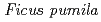 produced by ion beam irradiation with an improved ability to uptake and assimilate atmospheric nitrogen dioxide
Takahashi, Misa*; Kohama, S.*; Shigeto, Jun*; Hase, Yoshihiro; Tanaka, Atsushi; Morikawa, Hiromichi*
International Journal of Phytoremediation, 14(3), p.275 - 281, 2012/03
Times Cited Count:3 Percentile:9.31(Environmental Sciences)Production of novel mutants with a high ability to mitigate pollutants is important for phytoremediation. We investigated the use of ion beam irradiation to produce mutants of L. with an improved ability to mitigate atmospheric (NO ). More than 25,000 shoot explants were irradiated with ion beams, from which 263 independent plant lines were obtained. The plants were analyzed for NO uptake by fumigation with 1 ppm
  N-labeled NO, followed by mass spectrometric analysis. The mean NO uptake values of each lines differed over a 110-fold range. Propagation was attempted using cuttings from 44 lines showing the greatest NO uptake; in total, 15 lines were propagated. Two of the 15 lines showed a mean NO uptake 1.7- to 1.8-fold greater than that of the wild-type. This increase in NO uptake was heritable in both lines; their progenies showed a significantly greater ability to take up and assimilate NO than did the wild-type. RAPD analysis demonstrated DNA variation between the progeny plants and the wild type, suggesting that the progeny were true mutants. These mutants of
  may prove useful in mitigating atmospheric NO.
Nakajima, Kenji; Kawamura, Seiko; Kikuchi, Tatsuya; Nakamura, Mitsutaka; Kajimoto, Ryoichi; Inamura, Yasuhiro; Takahashi, Nobuaki; Aizawa, Kazuya; Suzuya, Kentaro; Shibata, Kaoru; et al.
Journal of the Physical Society of Japan, 80(Suppl.B), p.SB028_1 - SB028_6, 2011/05
Times Cited Count:125 Percentile:95.7(Physics, Multidisciplinary)AMATERAS is a cold-neutron disk-chopper spectrometer in MLF, J-PARC. The construction of main part of the spectrometer has been completed in spring of 2009. Soon after that, we have started the commissioning work on AMATERAS. The performance of AMATERAS has been examined by test experiments in the course of commissioning. In parallel to these works, we have started the user program on AMATERAS from December 2009 and we are getting scientific results from our spectrometer. In this presentation, we will report the current status of AMATERAS including the results of performance tests and some of examples of scientific outputs.
 -O ( = Mo or U) ternary compounds
Tokushima, Kazuyuki*; Tanaka, Kosuke; Kurosaki, Ken*; Gima, Hiromichi*; Muta, Hiroaki*; Uno, Masayoshi*; Yamanaka, Shinsuke*
Materials Research Society Symposium Proceedings, Vol.1215, p.151 - 156, 2010/10
The thermal diffusivities of CsMoO and CsUO using samples fabricated by hot press and SPS techniques were measured by a laser flash method in the range from room temperature to 823 K for CsMoO and to 900 K for CsUO. The thermal conductivities of these cesium ternary oxides were quite low compared with UO and MOX fuel. This is consistent with previous findings. These results would be useful for evaluating the thermal performance of MOX fuels at the high burn-up region in the fast reactors.
Agui, Akane; Sakurai, Hiroshi*; Tamura, Takuro*; Kurachi, Toshitaka*; Tanaka, Masahito*; Adachi, Hiromichi*; Kawata, Hiroshi*
Journal of Synchrotron Radiation, 17(3), p.321 - 324, 2010/05
Times Cited Count:16 Percentile:60.02(Instruments & Instrumentation)An application of magnetic Compton scattering as a new tool to measure a spin-specific magnetic hysteresis loop was introduced and demonstrated its validity. The applied magnetic field dependence of the integrated intensity of magnetic Compton scattering spectra was interpreted as the spin-specific hysteresis in this study.
 Maxim
MaximTakahashi, Misa*; Kohama, S.*; Kondo, Komei*; Hakata, Makoto*; Hase, Yoshihiro; Shikazono, Naoya; Tanaka, Atsushi; Morikawa, Hiromichi*
Plant Biotechnology, 22(1), p.63 - 67, 2005/03
no abstracts in English
Tanaka, Tadao; Sakamoto, Yoshiaki; Sawada, Hiroshi; Ogawa, Hiromichi
JAERI-Conf 2003-010, p.134 - 141, 2003/09
We have performed migration experiments of Np(V) and Am(III) for crushed granite, under the coexistent condition with humic acid substance. As for Np, the periodical concentration changes in the breakthrough curve and the migration velocity of Np passed through the column were not affected by the coexistence of the humic substance. As for Am, on the other hand, the periodical concentration changes in the breakthrough curve were affected by the humic substance concentration. The migration behavior of Am passed through the present column system could be expressed by a migration model taking account of the non-equilibrium state.
Ogawa, Hiromichi; Tanaka, Tadao; Mukai, Masayuki; Maeda, Toshikatsu; Munakata, Masahiro; Matsumoto, Junko; Bamba, Tsunetaka; Li, S.*; Wang, Z.*; Li, Z.*; et al.
Nihon Genshiryoku Gakkai Wabun Rombunshi, 2(3), p.332 - 335, 2003/09
The filed migration test using TRU nuclide was carried out as a cooperative research project between JAERI and CIRP (China Institute for Radiation Protection). This report introduced the outline of the filed migration test and described the outline of the special number of Field Test on Migration of TRU-nuclide and main results as a summary report.
Maeda, Toshikatsu; Tanaka, Tadao; Mukai, Masayuki; Ogawa, Hiromichi; Yamaguchi, Tetsuji; Munakata, Masahiro; Matsumoto, Junko; Kozai, Naofumi; Bamba, Tsunetaka; Fan, Z.*; et al.
Nihon Genshiryoku Gakkai Wabun Rombunshi, 2(3), p.336 - 341, 2003/09
no abstracts in English
Tanaka, Tadao; Mukai, Masayuki; Munakata, Masahiro; Maeda, Toshikatsu; Ogawa, Hiromichi; Wang, Z.*; Li, S.*; Yang, Y.*; Zhao, Y.*
Nihon Genshiryoku Gakkai Wabun Rombunshi, 2(3), p.350 - 360, 2003/09
Migration data of  Sr,
Sr, Np and
  Pu in natural aquifer were collected by a field test, which was performed in an aquifer at 30 m under ground surface of the field test site. Migration parameters for analysis of the results obtained the field test were measured by laboratory column tests and batch tests. Diffusion coefficient corresponding to water velocity was determined from the relationship between water velocity and diffusion length, which obtained from the column tests. Distribution coefficient was determined by considering confident ability of data, test conditions, and environmental conditions. One dimensional migration behavior of the radionuclides in aquifer, calculated by using the migration parameters obtained from the batch and column tests, agreed with the results obtained from the field test. It was confirmed that the migration behavior of alpha-nuclides could be evaluated by applying the conventional equation for evaluating the radionuclide migration and the migration parameters obtained from laboratory tests.
Mukai, Masayuki; Tanaka, Tadao; Maeda, Toshikatsu; Ogawa, Hiromichi; Matsumoto, Junko; Munakata, Masahiro; Zhao, Y.*; Guo, Z.*; Ni, S.*; Li, S.*
Nihon Genshiryoku Gakkai Wabun Rombunshi, 2(3), p.342 - 349, 2003/09
Evaluation of radionuclide migration in geologic media is of great importance in safety assessment for shallow land disposal specially for TRU nuclides because of inadequate data based on field test. As a cooperative research between JAERI and CIRP, a field test of radionuclide migration was conducted under natural condition using Sr-90, Np-237 and Pu-238 to obtain migration data of the radionuclides in actual aerated layer under natural rainfall condition. Values of input parameters to an existing evaluation equation of nuclide migration were determined on the basis of the results of laboratory experiments of batch and column methods and field investigation. Migration distribution of the radionuclides calculated with the determined values showed reasonable agreement with the measured distribution of the field test. This confirmed an applicability of the evaluation equation for radionuclide migration to actual aerated layer under natural condition.
Munakata, Masahiro; Kimura, Hideo; Tanaka, Tadao; Mukai, Masayuki; Maeda, Toshikatsu; Ogawa, Hiromichi
Nihon Genshiryoku Gakkai Wabun Rombunshi, 2(3), p.361 - 367, 2003/09
no abstracts in English
Np and  Am through loess media
Tanaka, Tadao; Mukai, Masayuki; Maeda, Toshikatsu; Matsumoto, Junko; Ogawa, Hiromichi; Li, Z.*; Wang, X.*; Fan, Z.*; Guo, L.*; Liu, C.*
Journal of Radioanalytical and Nuclear Chemistry, 256(2), p.205 - 211, 2003/05
Times Cited Count:3 Percentile:25.79(Chemistry, Analytical)Migration experiments of Np(V) and Am(III) have been performed using a column system, to investigate migration behavior of Np and Am through a column packed with loess, taken from Shanxi, China. Adsorption mechanisms of Np and Am on the loess were examined by a chemical extraction method. In the case of the Np, most of Np adsorbed on the influent edge of the column. The Np adsorbed on the loess was mainly controlled by surface complexation. However, the migration of Np in the loess media could be roughly evaluated by using the distribution coefficient. In the case of the Am, particulate Am species was formed in the influent solution and moved in the column. The Am adsorbed on the loess was controlled by irreversible reactions. The migration behavior of particulate Am in the loess media could be expressed by the filtration theory.
 -FeSi fabricated by ion beam sputter deposition method
Saito, Takeru; Yamamoto, Hiroyuki; Yamaguchi, Kenji; Nakanoya, Takamitsu; Hojo, Kiichi; Haraguchi, Masaharu*; Imamura, Motoyasu*; Matsubayashi, Nobuyuki*; Tanaka, Tomoaki*; Shimada, Hiromichi*
Nuclear Instruments and Methods in Physics Research B, 206, p.321 - 325, 2003/05
Times Cited Count:7 Percentile:46.83(Instruments & Instrumentation)no abstracts in English
Tanaka, Tadao; Mukai, Masayuki; Maeda, Toshikatsu; Matsumoto, Junko; Ogawa, Hiromichi; Munakata, Masahiro; Kimura, Hideo; Bamba, Tsunetaka; Fujine, Sachio
Genshiryoku eye, 49(2), p.76 - 79, 2003/02
no abstracts in English
Tanaka, Tadao; Mukai, Masayuki; Maeda, Toshikatsu; Munakata, Masahiro; Matsumoto, Junko; Ogawa, Hiromichi; Bamba, Tsunetaka*; Wang, Z.*; Yang, Y.*; Zhao, Y.*
Proceedings of International Symposium on Radioecology and Environmental Dosimetry, p.179 - 184, 2003/00
Migration behaviors of stable strontium element and radioactive nuclide strontium 90 in natural aquifer were studied by a field test, which was performed in the aquifer loess zone at 30 m under the ground surface of the field test site of China Institute for Radiation Protection. The migration behavior of stable strontium was a little different from that of Sr. The difference was evaluated by applying the distribution coefficient considering Sr and coexistent ion concentrations. Migration behavior of radionuclide in natural environment has been generally demonstrated on field tests without radioactive tracers and/or large-scale column tests with radioactive tracers. Such tests seem to be valuable to improve reliability of the migratory evaluation.
 Sr, Np, Pu and Am in loess media (Joint research)
Tanaka, Tadao; Mukai, Masayuki; Maeda, Toshikatsu; Matsumoto, Junko; Ogawa, Hiromichi; Li, S.*; Wang, Z.*; Wang, J.*; Guo, Z.*; Zhao, Y.*
JAERI-Research 2002-034, 20 Pages, 2002/12
 JAERI-Research-2002-034.pdf:1.1MB
Adsorption mechanisms and models of Sr(II), Np(V), Pu(IV) and Am(III) on the loess were investigated from their adsorption and desorption properties. The distribution coefficient of Sr and Np was 2 - 3 orders of magnitude smaller than that of Pu and Am. The adsorption of Sr and Np was mainly controlled by the ion exchange reaction. On the other hand, the adsorption of Pu and Am was mostly controlled by the selective chemical reactions with Fe and Mn oxyhydroxide/oxide and humic substances. On the basis of the experimental results, several types of adsorption models of the radionuclides, considering elemental concentrations, adsorption mechanisms and kinetics, were proposed for setting up the analytical systems of radionuclide migration in the loess media.
