



Initialising ...
Initialising ...
Initialising ...
Initialising ...
Initialising ...
Initialising ...
Initialising ...
 He spin filter at a pulsed neutron source
Okudaira, Takuya; Ueda, Yuki; Hiroi, Kosuke; Motokawa, Ryuhei; Inamura, Yasuhiro; Takata, Shinichi; Oku, Takayuki; Suzuki, Junichi*; Takahashi, Shingo*; Endo, Hitoshi*; et al.
Journal of Applied Crystallography, 54(2), p.548 - 556, 2021/04
Times Cited Count:2 Percentile:33.1(Chemistry, Multidisciplinary)Neutron polarization analysis (NPA) for small-angle neutron scattering (SANS) experiments using a pulsed neutron source was successfully achieved by applying a He spin filter as a spin analyzer for the scattered neutrons. The He spin filter covers a sufficient solid angle for performing SANS experiments, and the relaxation time of the He polarization is sufficient for continuous use over a few days, thus reaching the typical duration required for a complete set of SANS experiments. Although accurate evaluation of the incoherent neutron scattering, which is predominantly attributable to hydrogen atoms in samples, is practically difficult using calculations based on the sample elemental composition, the developed NPA approach with consideration of the influence of multiple neutron scattering enabled reliable decomposition of the SANS intensity distribution into the coherent and incoherent scattering components. To date, NPA has not been well established as a standard technique for SANS experiments at pulsed neutron sources. This work is anticipated to greatly contribute to the accurate determination of the coherent neutron scattering component for scatterers in various types of organic sample systems in SANS experiments at J-PARC.
 Si
Si without local inversion symmetry
Nakamura, Shota*; Hyodo, Kazushi*; Matsumoto, Yuji*; Haga, Yoshinori; Sato, Hitoshi*; Ueda, Shigenori*; Mimura, Kojiro*; Saiki, Katsuyoshi*; Iso, Kosei*; Yamashita, Minoru*; et al.
Journal of the Physical Society of Japan, 89(2), p.024705_1 - 024705_5, 2020/02
Times Cited Count:2 Percentile:22.16(Physics, Multidisciplinary)Magome, Hirokatsu; Okada, Yuji; Tomita, Kenji; Iida, Kazuhiro; Ando, Hitoshi; Yonekawa, Akihisa; Ueda, Haruyasu; Hanawa, Hiroshi; Kanno, Masaru; Sakuta, Yoshiyuki
JAEA-Technology 2015-025, 100 Pages, 2015/09
 JAEA-Technology-2015-025.pdf:78.32MB
In Japan Atomic Energy Agency, in order to solve the problem in the long-term operation of a light water reactor, preparation which does the irradiation experiment of light-water reactor fuel and material was advanced. JMTR stopped after the 165th operation cycle in August 2006, and is advancing renewal of the irradiation facility towards re-operation. The material irradiation test facility was installed from 2008 fiscal year to 2012 fiscal year in JMTR. The material irradiation test facility is used for IASCC study, and that consists of mainly three equipments. This report is described performance operating test of the water environmental control facilities for IASCC study carried out 2013 fiscal year.
Magome, Hirokatsu; Okada, Yuji; Hanawa, Hiroshi; Sakuta, Yoshiyuki; Kanno, Masaru; Iida, Kazuhiro; Ando, Hitoshi; Yonekawa, Akihisa; Ueda, Haruyasu; Shibata, Mitsunobu
JAEA-Technology 2014-023, 267 Pages, 2014/07
JAEA-Technology-2014-023-01.pdf:103.68MBJAEA-Technology-2014-023-02.pdf:71.92MB
In Japan Atomic Energy Agency, in order to solve the problem in the long-term operation of a light water reactor, preparation which does the irradiation experiment of light-water reactor fuel and material was advanced. JMTR stopped after the 165th operation cycle in August 2006, and is advancing renewal of the irradiation facility towards re-operation. The material irradiation test facility was installed from 2008 fiscal year to 2012 fiscal year in JMTR. This report summarizes manufacture and installation of the material irradiation test facility for IASCC research carried out from 2012 to 2014 in the follow-up report reported before (JAEA-Technology 2013-019).
Okada, Yuji; Magome, Hirokatsu; Hanawa, Hiroshi; Omi, Masao; Kanno, Masaru; Iida, Kazuhiro; Ando, Hitoshi; Shibata, Mitsunobu; Yonekawa, Akihisa; Ueda, Haruyasu
JAEA-Technology 2013-019, 236 Pages, 2013/10
JAEA-Technology-2013-019.pdf:45.07MB
In Japan Atomic Energy Agency, in order to solve the problem in the long-term operation of a light water reactor, preparation which does the irradiation experiment of light-water reactor fuel and material is advanced. JMTR stopped after the 165th operation cycle in August 2006, and is advancing renewal of the irradiation facility towards re-operation. This material irradiation test facility and power ramping test facility for doing the neutron irradiation test of the fuel and material for light water reactors is scheduled to be manufactured and installed between the 2008 fiscal year and the 2012 fiscal year. This report summarizes manufacture and installation of the material irradiation test facility for IASCC research carried out from the 2008 fiscal year to the 2010 fiscal year.
Yabashi, Makina*; Tanaka, Hitoshi*; Tanaka, Takashi*; Tomizawa, Hiromitsu*; Togashi, Tadashi*; Nagasono, Mitsuru*; Ishikawa, Tetsuya*; Harries, J.; Hikosaka, Yasumasa*; Hishikawa, Akiyoshi*; et al.
Journal of Physics B; Atomic, Molecular and Optical Physics, 46(16), p.164001_1 - 164001_19, 2013/08
Times Cited Count:71 Percentile:95.16(Optics) studied by photoemission and soft X-ray absorption spectroscopies
Utsumi, Yuki*; Sato, Hitoshi*; Kurihara, Hidenao*; Maso, Hiroyuki*; Hiraoka, Koichi*; Kojima, Kenichi*; Tobimatsu, Komei*; Okochi, Takuo*; Fujimori, Shinichi; Takeda, Yukiharu; et al.
Physical Review B, 84(11), p.115143_1 - 115143_7, 2011/09
Times Cited Count:11 Percentile:44.66(Materials Science, Multidisciplinary)We have studied conduction-band (CB) electronic states of a typical valence-transition compound YbInCu by means of temperature-dependent hard X-ray photoemission spectroscopy (HX-PES), soft X-ray absorption spectroscopy (XAS), and soft X-ray photoemission spectroscopy (SX-PES) of the valence band. We have described the valence transition in YbInCu in terms of the charge transfer from the CB to Yb 4 states.
Hasegawa, Makoto; Kondo, Hitoshi; Kamei, Gento; Hirano, Fumio; Mihara, Morihiro; Takahashi, Kuniaki; Funabashi, Hideyuki; Kawatsuma, Shinji; Ueda, Hiroyoshi*; Oi, Takao*; et al.
JAEA-Research 2011-003, 47 Pages, 2011/02
JAEA-Research-2011-003.pdf:3.99MB
In 2009, NUMO and JAEA set up a technical commission to investigate the reasonable TRU waste disposal following a cooperation agreement between these two organizations. In this report, the calculation result of radionuclide transport for a TRU waste geological disposal system was described, by using the TIGER code and the GoldSim code at identical terms. Comparing the calculation result, a big difference was not seen. Therefore, the reliability of both codes was able to be confirmed. Moreover, the influence on the disposal site design (Disposal capacity: 19,000 m) was examined when 10% of the amount of TRU waste increased. As a result, it was confirmed that the influence of the site design was very little based on the concept of the Second Progress Report on Research and Development for TRU Waste Disposal in Japan.
 and
and  cross sections of the
  C(
C( ,
, )
) O reaction at
 1.2 MeV using pulsed beams
Makii, Hiroyuki; Ueda, Hitoshi*; Temma, Yasuyuki*; Nagai, Yasuki*; Shima, Tatsushi*; Fujimoto, Shinya*; Segawa, Mariko; Mishima, Kenji*; Nishiyama, Jun*; Igashira, Masayuki*
AIP Conference Proceedings 1269, p.283 - 288, 2010/10
Times Cited Count:0 Percentile:0.02(Astronomy & Astrophysics)The C(,)O reaction cross section plays an important role in stellar evolution at the stage of helium-burning. However, the cross section at low energy still has a large uncertainty mainly due to the poor determination of the ratio of cross section to one. Hence, we have installed new system to make a precise measurement of the cross section. In this experiment, we used the high efficiency anti-Compton NaI(Tl) spectrometers with a large S/N ratio, an intense pulsed beams, and the monitoring system of target thickness. With use of the system we succeeded in removing a background due to neutron and could clearly detect the -ray from the C(,)O reaction with high statistics. We determined the and cross section down to  1.2 MeV, and thus obtained results are compared to recent theoretical calculations.
Abe, Hitoshi; Tashiro, Shinsuke; Ueda, Yoshinori*
Nihon Genshiryoku Gakkai Wabun Rombunshi, 9(1), p.82 - 95, 2010/03
A special committee of "Research on the analysis methods for accident consequence of nuclear fuel facilities (NFF)" was organized by the Atomic Energy Society of Japan under the entrustment of JAEA. The committee aims to research on the state-of-the-art of consequence analysis method for Probabilistic Safety Assessment (PSA) of NFF such as fuel reprocessing and fuel fabrication facilities. The objective is to obtain the useful information related to establishing quantitative performance objectives and to risk-informed regulation through qualifying issues needed to be resolved for applying PSA to NFF. The research activities of the committee were mainly focused on the analysis method of consequences for postulated accidents with potentially large consequence in NFF resulting in release of radio active material to the environment. In this technical report, the research results about basic experimental data and method for safety evaluation for fire and explosion incidents were summarized.
and cross sections of the C O reaction using pulsed beams
Makii, Hiroyuki; Nagai, Yasuki*; Shima, Tatsushi*; Segawa, Mariko; Mishima, Kenji*; Ueda, Hitoshi*; Igashira, Masayuki*; Osaki, Toshiro*
Physical Review C, 80(6), p.065802_1 - 065802_16, 2009/10
Times Cited Count:32 Percentile:83.95(Physics, Nuclear)We measured the -ray angular distribution from CO to the ground state of O using a pulsed beam at  and 1.4 MeV. True events of CO were discriminated from background events due to neutrons from
  C(
C( )O with a time-of-flight method. The obtained -ray spectrum with anti-Compton NaI(Tl) spectrometers showed a characteristic line shape from CO: the Doppler broadening and energy loss of particles in C targets. The astrophysical S factors for and ,
 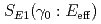 and
and 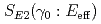 , derived from the present cross sections are in excellent agreement with the values derived by
  -matrix calculation of the
  -delayed spectrum of N, and by using the asymptotic normalization constant in the -matrix fit.
Murakawa, Hideki*; Ueda, Tadanobu*; Yoshida, Takehisa*; Sugimoto, Katsumi*; Asano, Hitoshi*; Takenaka, Nobuyuki*; Mochiki, Koichi*; Iikura, Hiroshi; Yasuda, Ryo; Matsubayashi, Masahito
Nuclear Instruments and Methods in Physics Research A, 605(1-2), p.127 - 130, 2009/06
Times Cited Count:24 Percentile:81.32(Instruments & Instrumentation) and cross sections of the C( O reaction at
  1.4 MeV using pulsed beams
Makii, Hiroyuki; Nagai, Yasuki; Mishima, Kenji*; Segawa, Mariko; Shima, Tatsushi*; Ueda, Hitoshi; Igashira, Masayuki*
AIP Conference Proceedings 1016, p.215 - 220, 2008/05
The C(O reaction plays an important role in stellar evolution at the stage of helium-burning. However, the cross section at low energy still has a large uncertainty mainly due to the poor determination of the  ratio. We have installed a new system to measure the -ray angular distribution of the C(O reaction to accurately determine the
  and
and  . In this experiment, we used high efficiency anti-Compton NaI(Tl) spectrometers to detect a -ray from the reaction with a large S/N ratio, intense pulsed beams to discriminate true events from neutron induced background with a time-of-flight method, and the monitoring system of target thickness. We succeeded in removing a background due to neutrons and could clearly detect the -ray from the C(O reaction with high statics.
Hayashida, Hitoshi; Kokaki, Nobuhisa; Ueda, Masashi; Isozaki, Tadashi; Ara, Kuniaki
JNC TN9400 98-001, 54 Pages, 1998/10
Based on the temperature dependence of the velocity of sound in sodium, an ultrasonic thermometer that measures the temperature of sodium non-intrusively is being developed. The principle of the device is based on the propagation time of an acoustic pulse wave, and the back calculation of the sodium temperature. As the part of the development a test was actually carried out in sodium pipe-flow in order to evaluate various aspects of realizing the ultrasonic wave thermometer. The results and conclusions to date are as follows: (1)Within the present test range, the ultrasonic wave thermometer appears relatively insensitive to flow velocity of sodium, pressure of the cover gas and the impurity concentration in sodium. The calculated error of the measured thermometry was in the experiment about 1  C, a smaller value than the expected 2.5C of the system. (2)The ultrasonic thermometer has only been used wherein the thermal expansion coefficient was known and with 200 C as the reference temperatures. For the entire temperature range tested the difference between this approach and a two-point calibration over a temperature range is only expected to be about 1 C. (3)By using the mean value of multiple ultrasonic wave transmit and receive measurements, a value whereby the ultrasonic propagation time was stabilized is obtained. (4)As acoustic coupling material between the ultrasonic transducer and piping, a copper plate was found to be more suitable than a specialized acoustic bonding material. A weight equivalent, area distributed force of 2.0kg/mm
 was used to press the test copper plate to the pipe. A slightly smaller force appears more than sufficient as well. (5)We found that mounting the ultrasonic transducer to the exterior surface of the pipe by a clamping method is sufficient such that no welding is needed. (6)The in-sodium test period was about 2 months. No noticeable change in measurement characteristics of the ...
Ueda, Masashi; Kondo, Hitoshi
PNC TN9410 92-258, 27 Pages, 1992/08
None

 and
and  of the C(, )O reaction obtained at E
 = 1.6 and 1.4 MeV
Makii, Hiroyuki; Nagai, Yasuki*; Shima, Tatsushi*; Segawa, Mariko; Ueda, Hitoshi*; Masaki, Tomohiro*; Mishima, Kenji*; Igashira, Masayuki*; Osaki, Toshiro*
no journal, ,
no abstracts in English
Segawa, Mariko; Nagai, Yasuki*; Masaki, Tomohiro*; Shima, Tatsushi*; Makii, Hiroyuki; Mishima, Kenji*; Ueda, Hitoshi*; Temma, Yasuyuki*; Igashira, Masayuki*; Osaki, Toshiro*; et al.
no journal, ,
no abstracts in English
Segawa, Mariko; Nagai, Yasuki*; Masaki, Tomohiro*; Temma, Yasuyuki*; Shima, Tatsushi*; Makii, Hiroyuki*; Mishima, Kenji*; Ueda, Hitoshi*; Nakayoshi, Akira*; Ota, Takeshi*; et al.
no journal, ,
 Re-Os pair is known as the most promising nuclear cosmochronometer with considerable potential. However, there remains non-trivial problems related to an excited neutron capture reaction of Os at a stellar temperature. Firstly, Os is produced and depleted by the slow process nucleosynthesis. Hence, it is necessary to obtain both the production and depletion rates of Os. Secondly, Os is depleted not only by its ground state neutron capture reaction but also by an excited state neutron capture reaction of Os in a stellar temperature. In the present study, we have measured the neutron capture reaction cross sections for
  Os, Os and
  Os accurately and neutron inelastic scattering reaction cross section for Os off the ground state of Os to its 9.75-keV first excited statein the neutron energy range from 10 to 100 keV. The measurements of the neutron capture reactions have been carried out by detecting a prompt -ray by means fan anti-Compton NaI(Tl) spectrometer. The (n, n') reaction cross section for Os has been measured with use of four
  Li-glass scintillation detectors. Based on these new capture cross sections, we reestimate on the basis of a careful reaction cross section calculation the correction factor F for the neutron capture on the 9.75-keV first excited state in Os as a function of stellar temperature, as required to derive the age of the galaxy within the Re-Os chronology.
Tamaki, Hitoshi; Yoshida, Kazuo; Ueda, Yoshinori*
no journal, ,
A risk-informed regulation will be applied to not only nuclear power plants but also nuclear fuel facilities in Japan. It is important for risk-informed regulation to assure the results of PSA. Component failure rates used in the frequency evaluation play an important role to assure the quality of PSA. Reprocessing plants are recognized as having higher risk than that of other nuclear fuel facilities. However, accident frequencies happened in reprocessing plants are evaluated almost using component failure rates estimated from operation experiences of nuclear power plants because those parameters estimated from experiences of reprocessing plants are limited. In order to improve the quality of results of accident frequencies in reprocessing plants, a project was launched in 2005 at JAEA. This project is consisted of two activities and is performed under entrustment from JNES. One is the estimation of component failure rates based on maintenance data from Tokai Reprocessing plant which has been operating since 1977 in Japan. The other is the preparation of component failure rates for frequency evaluation of accidents in reprocessing plants. This presentation will introduce the second activity.
Tamaki, Hitoshi; Yoshida, Kazuo; Ishida, Michihiko; Muramatsu, Ken; Ueda, Yoshinori*
no journal, ,
no abstracts in English
