



Initialising ...
Initialising ...
Initialising ...
Initialising ...
Initialising ...
Initialising ...
Initialising ...
Kwon, H.*; Sathiyamoorthi, P.*; Gangaraju, M. K.*; Zargaran, A.*; Wang, J.*; Heo, Y.-U.*; Harjo, S.; Gong, W.; Lee, B.-J.*; Kim, H. S.*
Acta Materialia, 248, p.118810_1 - 118810_12, 2023/04
Times Cited Count:15 Percentile:98.95(Materials Science, Multidisciplinary)Woo, W.*; Kim, Y. S.*; Chae, H. B.*; Lee, S. Y.*; Jeong, J. S.*; Lee, C. M.*; Won, J. W.*; Na, Y. S.*; Kawasaki, Takuro; Harjo, S.; et al.
Acta Materialia, 246, p.118699_1 - 118699_13, 2023/03
Times Cited Count:13 Percentile:98.47(Materials Science, Multidisciplinary) TaS
TaS with perpendicular magnetic anisotropy; Comparison with FeTiS
Shibata, Goro; Won, C.*; Kim, J.*; Nonaka, Yosuke*; Ikeda, Keisuke*; Wan, Y.*; Suzuki, Masahiro*; Koide, Tsuneharu*; Tanaka, Arata*; Cheong, S.-W.*; et al.
Photon Factory Activity Report 2022 (Internet), 2 Pages, 2023/00
no abstracts in English
Kim, S. B.*; Zhang, Y.*; Won, S. M.*; Bandodkar, A. J.*; Sekine, Yurina; Xue, Y.*; Koo, J.*; Harshman, S. W.*; Martin, J. A.*; Park, J. M.*; et al.
Small, 14(12), p.1703334_1 - 1703334_11, 2018/03
Times Cited Count:100 Percentile:95.69(Chemistry, Multidisciplinary)Yoon, S. W.*; Ahn, J.-W.*; Jeon, Y. M.*; Suzuki, Takahiro; Hahn, S. H.*; Ko, W. H.*; Lee, K. D.*; Chung, J. I.*; Nam, Y. U.*; Kim, J.*; et al.
Nuclear Fusion, 51(11), p.113009_1 - 113009_9, 2011/11
Times Cited Count:33 Percentile:78.95(Physics, Fluids & Plasmas)Typical ELMy H-mode discharges have been achieved on the KSTAR tokamak with the combined auxiliary heating of NBI and ECRH. The minimum external heating power required is about 1.1 MW at a line-averaged density higher than 1.4 10
10 m
m and a toroidal field of 2 T. There is a clear indication of the increase of the L-H threshold power at densities lower than
 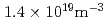 . The initial analysis of energy confinement time (
 ) predicted that was higher than the prediction of multi-machine scaling laws by a factor 1.4-1.6. However, when the contribution of fast ion confinement to the total energy was taken into account, better agreed with the scaling results. A clear increase of electron and ion temperature in the pedestal was observed in the H-mode phase but the core ion temperature did not change significantly. On the other hand, the toroidal rotation also increased over all radii in the H-mode phase. The measured ELM frequency was from 30-50 Hz and the drop of total energy appeared to be less than 5%. Between large ELM spikes, small/grassy ELMs were also identified when mixed heating of NBI and ECRH was applied.
 collisions at
  = 200 GeV
Adare, A.*; Afanasiev, S.*; Aidala, C.*; Ajitanand, N. N.*; Akiba, Y.*; Al-Bataineh, H.*; Alexander, J.*; Aoki, K.*; Aphecetche, L.*; Armendariz, R.*; et al.
Physical Review D, 84(1), p.012006_1 - 012006_18, 2011/07
Times Cited Count:29 Percentile:73.24(Astronomy & Astrophysics)We report on the event structure and double helicity asymmetry ( ) of jet production in longitudinally polarized collisions at = 200 GeV. Photons and charged particles were measured by the PHENIX experiment. Event structure was compared with the results from PYTHIA event generator. The production rate of reconstructed jets is satisfactorily reproduced with the next-to-leading-order perturbative QCD calculation. We measured = -0.0014
  0.0037 at the lowest
  bin and -0.0181 0.0282 at the highest bin. The measured is compared with the predictions that assume various
  distributions.
collisions at = 200 and 62.4 GeVAdare, A.*; Afanasiev, S.*; Aidala, C.*; Ajitanand, N. N.*; Akiba, Yasuyuki*; Al-Bataineh, H.*; Alexander, J.*; Aoki, Kazuya*; Aphecetche, L.*; Armendariz, R.*; et al.
Physical Review C, 83(6), p.064903_1 - 064903_29, 2011/06
Times Cited Count:184 Percentile:99.45(Physics, Nuclear)Transverse momentum distributions and yields for  , and
, and  in collisions at = 200 and 62.4 GeV at midrapidity are measured by the PHENIX experiment at the RHIC. We present the inverse slope parameter, mean transverse momentum, and yield per unit rapidity at each energy, and compare them to other measurements at different collisions. We also present the scaling properties such as
  and
and  scaling and discuss the mechanism of the particle production in collisions. The measured spectra are compared to next-to-leading order perturbative QCD calculations.
 and Au+Au collisions at
  = 200 GeV
Adare, A.*; Afanasiev, S.*; Aidala, C.*; Ajitanand, N. N.*; Akiba, Yasuyuki*; Al-Bataineh, H.*; Alexander, J.*; Aoki, Kazuya*; Aphecetche, L.*; Aramaki, Y.*; et al.
Physical Review C, 83(4), p.044912_1 - 044912_16, 2011/04
Times Cited Count:9 Percentile:49.6(Physics, Nuclear)Measurements of electrons from the decay of open-heavy-flavor mesons have shown that the yields are suppressed in Au+Au collisions compared to expectations from binary-scaled collisions. Here we extend these studies to two particle correlations where one particle is an electron from the decay of a heavy flavor meson and the other is a charged hadron from either the decay of the heavy meson or from jet fragmentation. These measurements provide more detailed information about the interaction between heavy quarks and the quark-gluon matter. We find the away-side-jet shape and yield to be modified in Au+Au collisions compared to collisions.
 + collisions at = 200 GeV and scaling properties of hadron production
Adare, A.*; Afanasiev, S.*; Aidala, C.*; Ajitanand, N. N.*; Akiba, Y.*; Al-Bataineh, H.*; Alexander, J.*; Aoki, K.*; Aphecetche, L.*; Armendariz, R.*; et al.
Physical Review D, 83(5), p.052004_1 - 052004_26, 2011/03
Times Cited Count:177 Percentile:98.48(Astronomy & Astrophysics)The PHENIX experiment at RHIC has measured the invariant differential cross section for production of  ,
,  ,
,  and
and  mesons in collisions at = 200 GeV. The spectral shapes of all hadron transverse momentum distributions are well described by a Tsallis distribution functional form with only two parameters,
  and
and  , determining the high
  and characterizing the low regions for the spectra, respectively. The integrated invariant cross sections calculated from the fitted distributions are found to be consistent with existing measurements and with statistical model predictions.
Bae, Y. S.*; Park, Y. M.*; Kim, J. S.*; Han, W. S.*; Kwak, S. W.*; Chang, Y. B.*; Park, H. T.*; Song, N. H.*; Chang, D. H.*; Jeong, S. H.*; et al.
Proceedings of 23rd IAEA Fusion Energy Conference (FEC 2010) (CD-ROM), 9 Pages, 2011/03
The neutral beam injection (NBI) system is designed to provide the ion heating and current drive for the high performance operation and long pulse operation of the Korean Superconducting Tokamak Advanced Research (KSTAR). The KSTAR NBI consists of two beam lines. Each beam line contains three ion sources of which one ion source has been designed to deliver more than 2.5 MW of deuterium neutral beam power with maximum 120-keV beam energy. Consequently, the final goal of the KSTAR NBI system aims to inject more than 14 MW of deuterium beam power with the two beam lines. According to the planned NBI system, the first NBI system is to demonstrate the beam injection from one ion source into the KSTAR tokamak plasma in 2010 campaign including the system commissioning of each components and subsystems. In this paper, the construction and the commissioning of the first NBI system with one ion source is presented.
Yang, H. L.*; Kim, Y. S.*; Park, Y. M.*; Bae, Y. S.*; Kim, H. K.*; Kim, K. M.*; Lee, K. S.*; Kim, H. T.*; Bang, E. N.*; Joung, M.*; et al.
Proceedings of 23rd IAEA Fusion Energy Conference (FEC 2010) (CD-ROM), 8 Pages, 2011/03
Because the 2010 operation of Korea Superconducting Tokamak Advanced Research (KSTAR) mainly aims to achieve strongly elongated and diverted plasma, all the necessary hardware systems to provide an essential circumstance for the plasma shaping were newly installed and upgraded in 2010. In this paper, general configuration of the upgraded systems described earlier will be outlined. Moreover, several key performances and test results of the systems will be also reported in summary.
Bae, Y. S.*; Na, Y. S.*; Oh, Y. K.*; Kwon, M.*; Bak, J. S.*; Lee, G. S.*; Jeong, J. H.*; Park, S. I.*; Cho, M. H.*; Namkung, W.*; et al.
Fusion Science and Technology, 52(2), p.321 - 333, 2007/08
Times Cited Count:23 Percentile:81.67(Nuclear Science & Technology)An 84-GHz, 500-kW gyrotron system have been installed at KSTAR, and the initial test of the gyrotron has been carried out with 20  sec-pulse and an output RF power of 500 kW. The launcher system having with a highly flexible steering mirror was fabricated and would inject 500-kW rf power into the KSTAR plasma. KSTAR will employ 170-GHz EC current drive (CD) in ITER-relevant experiments such as the suppression of the neoclassical tearing modes and the creation of an electron internal transport barrier. A JAEA 170-GHz, 1-MW gyrotron on loan in accordance with a Korea-Japan fusion collaboration agreement, and it will be used for the 170-GHz, 1-MW ECCD system in 2010. This paper describes the current status of the installation and initial conditioning tests of the 84-GHz gyrotron system as well as the development plan of the 170-GHz ECH and CD system. Also, this paper discusses the CD efficiency and the steering range of the second-harmonic X-mode injection.
