



Initialising ...
Initialising ...
Initialising ...
Initialising ...
Initialising ...
Initialising ...
Initialising ...
Yamaguchi, Yuji; Meigo, Shinichiro; Yamazaki, Takayuki*
Proceedings of 21st Annual Meeting of Particle Accelerator Society of Japan (Internet), p.239 - 243, 2024/10
Fringe field of a secondary-particle capture solenoid magnet with three coils has been experimentally investigated placed at muon science facility in materials and life science experimental facility (MLF), J-PARC. To clarify relationship between the fringe field and excitation current of each coil and interference of fields by the coils, proton beam position changes in vertical direction were measured for 125(= 5 ) combinations of excitation currents using a multi-wire profile monitor located in front of the final target of MLF. The measured position changes show that the field by the most upstream coil is non-linear with its current while the fields by other coils are linear and that the field can be enhanced by excitation of multiple coils. The non-linearity of the filed by the most upstream coil has been introduced to the proton beam orbit correction, which has been demonstrated.
Yamaguchi, Takayuki*; Koura, Hiroyuki; Litvinov, Yu. A.*; Wang, M.*
Progress in Particle and Nuclear Physics, 120, p.103882_1 - 103882_98, 2021/09
Times Cited Count:52 Percentile:84.06(Physics, Nuclear)Nagae, Daisuke*; Abe, Yasushi*; Okada, Shunsuke*; Omika, Shuichiro*; Wakayama, Kiyoshi*; Hosoi, Shun*; Suzuki, Shinji*; Moriguchi, Tetsuro*; Amano, Masamichi*; Kamioka, Daiki*; et al.
Nuclear Instruments and Methods in Physics Research A, 986, p.164713_1 - 164713_7, 2021/01
Times Cited Count:9 Percentile:71.33(Instruments & Instrumentation)Abe, Mitsushi*; Bae, S.*; Beer, G.*; Bunce, G.*; Choi, H.*; Choi, S.*; Chung, M.*; da Silva, W.*; Eidelman, S.*; Finger, M.*; et al.
Progress of Theoretical and Experimental Physics (Internet), 2019(5), p.053C02_1 - 053C02_22, 2019/05
Times Cited Count:161 Percentile:99.30(Physics, Multidisciplinary)This paper introduces a new approach to measure the muon magnetic moment anomaly 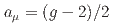 and the muon electric dipole moment (EDM)
  at the J-PARC muon facility. The goal of our experiment is to measure
  and using an independent method with a factor of 10 lower muon momentum, and a factor of 20 smaller diameter storage-ring solenoid compared with previous and ongoing muon g-2 experiments with unprecedented quality of the storage magnetic field. Additional significant differences from the present experimental method include a factor of 1000 smaller transverse emittance of the muon beam (reaccelerated thermal muon beam), its efficient vertical injection into the solenoid, and tracking each decay positron from muon decay to obtain its momentum vector. The precision goal for is a statistical uncertainty of 450 parts per billion (ppb), similar to the present experimental uncertainty, and a systematic uncertainty less than 70 ppb. The goal for EDM is a sensitivity of
  e
e cm.
cm.
Hiraka, Haruhiro*; Yamaguchi, Yasuo*; Maruyama, Ryuji; Oku, Takayuki; Ino, Takashi*
Hamon, 28(3), p.144 - 149, 2018/08
no abstracts in English
 Ge in the normal state
Nakatani, Yasuhiro*; Aratani, Hidekazu*; Fujiwara, Hidenori*; Mori, Takeo*; Tsuruta, Atsushi*; Tachibana, Shoichi*; Yamaguchi, Takashi*; Kiss, Takayuki*; Yamasaki, Atsushi*; Yasui, Akira*; et al.
Physical Review B, 97(11), p.115160_1 - 115160_7, 2018/03
Times Cited Count:5 Percentile:22.25(Materials Science, Multidisciplinary)Tanaka, Taiki*; Narikiyo, Yoshihiro*; Morita, Kosuke*; Fujita, Kunihiro*; Kaji, Daiya*; Morimoto, Koji*; Yamaki, Sayaka*; Wakabayashi, Yasuo*; Tanaka, Kengo*; Takeyama, Mirei*; et al.
Journal of the Physical Society of Japan, 87(1), p.014201_1 - 014201_9, 2018/01
Times Cited Count:23 Percentile:75.95(Physics, Multidisciplinary)Excitation functions of quasielastic scattering cross sections for the  Ca +
Ca +  Pb,
Pb,  Ti + Pb, and Ca +
  Cm reactions were successfully measured by using the gas-filled recoil-ion separator GARIS. Fusion barrier distributions were extracted from these data, and compared with the coupled-channels calculations. It was found that the peak energies of the barrier distributions for the Ca + Pb and Ti + Pb systems coincide with those of the 2n evaporation channel cross sections for the systems, while that of the Ca + Cm is located slightly below the 4n evaporation ones. This results provide us helpful information to predict the optimum beam energy to synthesize superheavy nuclei.
Ca + Cm 
 Lv
Lv at RIKEN-GARIS
Kaji, Daiya*; Morita, Kosuke*; Morimoto, Koji*; Haba, Hiromitsu*; Asai, Masato; Fujita, Kunihiro*; Gan, Z.*; Geissel, H.*; Hasebe, Hiroo*; Hofmann, S.*; et al.
Journal of the Physical Society of Japan, 86(3), p.034201_1 - 034201_7, 2017/03
Times Cited Count:32 Percentile:82.52(Physics, Multidisciplinary)The fusion reaction of Ca + Cm Lv was studied using the gas-filled recoil-ion separator GARIS at RIKEN. A total of seven  and spontaneous-fission decay chains were observed, which would originate from the reaction products of the element 116,
  Lv and
  Lv. Decay properties observed in the chains are in good agreement with the previously published ones. However, one of the chains showed a discrepancy, indicating the new spontaneous-fission branch in
  Cn or the production of the new isotope
  Lv.
Lv.
GeNakatani, Yasuhiro*; Fujiwara, Hidenori*; Aratani, Hidekazu*; Mori, Takeo*; Tachibana, Shoichi*; Yamaguchi, Takashi*; Kiss, Takayuki*; Yamasaki, Atsushi*; Yasui, Akira*; Yamagami, Hiroshi*; et al.
Journal of Electron Spectroscopy and Related Phenomena, 220, p.50 - 53, 2017/01
Times Cited Count:2 Percentile:15.23(Spectroscopy)We report the soft X-ray angle-resolved photoemission study for LaNiGe to reveal the electronic structures derived from non-4 bands of the heavy fermion compound CeNiGe. The photoemission spectra recorded at the La M
 absorption edges clearly show the enhancement of the La 5
 components in the valence band spectra. The circular dichroism of photoemission spectra reveals the band-dependent dichroic response due to the orbital symmetry.
Noda, Yohei*; Koizumi, Satoshi*; Masui, Tomomi*; Mashita, Ryo*; Kishimoto, Hiromichi*; Yamaguchi, Daisuke; Kumada, Takayuki; Takata, Shinichi; Oishi, Kazuki*; Suzuki, Junichi*
Journal of Applied Crystallography, 49(6), p.2036 - 2045, 2016/12
Times Cited Count:20 Percentile:76.98(Chemistry, Multidisciplinary); Soft X-ray absorption, magnetic circular dichroism, and angle-resolved photoemission spectroscopiesSaito, Yuji; Fujiwara, Hidenori*; Yamaguchi, Takashi*; Nakatani, Yasuhiro*; Mori, Takeo*; Fuchimoto, Hiroto*; Kiss, Takayuki*; Yasui, Akira*; Miyawaki, Jun*; Imada, Shin*; et al.
Journal of the Physical Society of Japan, 85(11), p.114713_1 - 114713_7, 2016/11
Times Cited Count:16 Percentile:66.83(Physics, Multidisciplinary)We report on the electronic structures of ferromagnetic CeAgSb using soft X-ray absorption (XAS), magnetic circular dichroism (XMCD), and angle-resolved photoemission (ARPES) spectroscopies. The Ce  XAS spectra show very small satellite structures, reflecting a strongly localized character of the Ce 4
 electrons. The linear dichroism effects in the Ce XAS spectra demonstrate the ground-state Ce 4 symmetry of
 , the spatial distribution of which is directed along the
  -axis. Nevertheless, ARPES spectra at the Ce 3-4 resonance show the momentum dependence of the intensity ratio between Ce 4
 and 4
and 4 peaks in a part of the Brillouin zone, suggesting the non negligible momentum-dependent hybridization effect between the Ce 4 and the conduction electrons. This is associated with the moderate mass enhancement in CeAgSb.
Hase, Takayuki*; Otagaki, Tatsuya*; Yamaguchi, Masatake; Ikeo, Naoko*; Mukai, Toshiji*
Acta Materialia, 104, p.283 - 294, 2016/02
Times Cited Count:54 Percentile:89.65(Materials Science, Multidisciplinary)We measured the impact toughness of three alloys (Mg, Mg-0.3 at.% Ca-0.6 at.% Zn, and Mg-0.3 at.% Ca-0.6 at.% Al) by the impact three-point bending test. The plastic deformability and impact toughness were higher in the ternary alloys than in pure Mg. The generalized stacking fault energy and grain boundary cohesive energy were estimated by first-principles calculations for Mg, binary Mg-Ca, ternary Mg-Ca-Zn, and ternary Mg-Ca-Al alloys. The calculation results agreed with the trend in the experimental results. We suggest that addition of Ca along with Zn or Al reduced plastic anisotropy and strengthened the grain boundaries, leading to higher in impact toughness of Mg alloys.
 Spp. by ion beam breeding
Yamaguchi, Erika*; Miyatani, Masanori*; Kawai, Takayuki*; Atsumi, Hirohisa*; Hase, Yoshihiro
JAEA-Review 2015-022, JAEA Takasaki Annual Report 2014, P. 111, 2016/02
no abstracts in English
 O
O thin films on Si (100) by ion beam sputter deposition
Mao, W.*; Fujita, Masaya*; Chikada, Takumi*; Yamaguchi, Kenji; Suzuki, Akihiro*; Terai, Takayuki*; Matsuzaki, Hiroyuki*
Surface & Coatings Technology, 283, p.241 - 246, 2015/12
Times Cited Count:3 Percentile:12.82(Materials Science, Coatings & Films)Single-phase nanocrystalline thin films of ErO (440) has been first prepared using Si (100) substrates by ion beam sputter deposition at 973 K at a pressure of  10
10 Pa and
  -
- annealing at 1023 K at a pressure of
  10
10 Pa. Er silicides formed during the deposition are eliminated via the annealing, which results in the single phase and the smooth surface of the ErO thin films. The epitaxial relationship between Si (100) and ErO (110) is clarified by X-ray diffraction and reflection high energy electron diffraction.
O (001) surface; A DFT studyMao, W.*; Chikada, Takumi*; Shimura, Kenichiro*; Suzuki, Akihiro*; Yamaguchi, Kenji; Terai, Takayuki*
Journal of Nuclear Materials, 443(1-3), p.555 - 561, 2013/11
Times Cited Count:4 Percentile:30.44(Materials Science, Multidisciplinary)In this work,  calculations based on density functional theory (DFT) and generalized gradient approximation were performed to investigate the structural and electronic properties of the cubic ErO
 (001) surface and H adsorption processes on this surface. Several stable adsorption sites were identified, and at the most energetically favorable adsorption sites it was found that H bonds with O atoms at the cubic ErO (001) surface with an adsorption energy of 295.68 kJ mol
 at coverage 1/8 ML, which was inclined to decrease with the increase of H coverage (
 1/4 ML). In addition, the calculations revealed that the dissociative H atom configurations have adsorption energies that are at least 152.64 kJ mol greater than the H molecule configurations on the surface. These results are discussed in regard of the hydrogen isotope permeation behavior in the tritium permeation barrier in a fusion reactor.
Mao, W.*; Chikada, Takumi*; Suzuki, Akihiro*; Terai, Takayuki*; Yamaguchi, Kenji
Journal of Plasma and Fusion Research SERIES, Vol.10, p.27 - 32, 2013/02
A tritium permeation barrier (TPB) is strongly required in fusion blankets for the reduction of loss of fuel and radiological hazard. However, the precise tritium permeation mechanism through the TPB coatings has not been clarified yet, because of their complicated crystal structures. To understand the microscopic mechanism, we have not only prepared and characterized nanostructured ceramic ErO thin films, but also studied the energetics and mobility of hydrogen atom in cubic bulk ErO using ab initio density-functional calculations. The estimated diffusion activation energy (
 ) of interstitial H is somewhat higher than the diffusion energy barrier observed experimentally at 873 K. It is then considered that diffusion and permeation of hydrogen and its isotopes through the ErO coatings are likely to be dominated by the grain boundary rather than by the grain.
 113 of the 113th element
Morita, Kosuke*; Morimoto, Koji*; Kaji, Daiya*; Haba, Hiromitsu*; Ozeki, Kazutaka*; Kudo, Yuki*; Sumita, Takayuki*; Wakabayashi, Yasuo*; Yoneda, Akira*; Tanaka, Kengo*; et al.
Journal of the Physical Society of Japan, 81(10), p.103201_1 - 103201_4, 2012/10
Times Cited Count:179 Percentile:97.24(Physics, Multidisciplinary)An isotope of the 113th element, 113, was produced in a nuclear reaction with a  Zn beam on a
  Bi target. We observed six consecutive decays following the implantation of a heavy particle in nearly the same position in the semiconductor detector, in extremely low background condition. The fifth and sixth decays are fully consistent with the sequential decays of
  Db and
  Lr both in decay energies and decay times. This indicates that the present decay chain consisted of 113,
  Rg (Z = 111),
  Mt (Z = 109),
  Bh (Z = 107), Db (Z = 105), and Lr (Z = 103) with firm connections. This result, together with previously reported results from 2004 and 2007, conclusively leads the unambiguous production and identification of the isotope 113, of the 113th element.
 -ray camera
Takeda, Shinichiro*; Ichinohe, Yuto*; Hagino, Koichi*; Odaka, Hirokazu*; Yuasa, Takayuki*; Ishikawa, Shinnosuke*; Fukuyama, Taro*; Saito, Shinya*; Sato, Tamotsu*; Sato, Goro*; et al.
Physics Procedia, 37, p.859 - 866, 2012/10
Times Cited Count:26 Percentile:98.51(Physics, Applied)By using new Compton camera consisting of silicon double-sided strip detector (Si-DSD) and CdTe-DSD developed for the ASTRO-H mission, an experiment was conducted to study its feasibility for advanced hotspot monitoring. In addition to hotspot imaging already provided by commercial imaging systems, the identification of the variety of radioisotopes is realized thanks to the good energy resolution given by the semiconductor detectors. Three radioisotopes of  Ba (356 keV),
  Na (511 keV) and
  Cs (662 keV) were individually imaged by applying event selection in the energy window and the -ray images was correctly overlapped by an optical picture. The detection efficiency of 1.68
 10
10 (effective area: 1.710 cm
 ) and angular resolution of 3.8
 were obtained by stacking five detector modules for 662 keV -ray. The higher detection efficiency required in a specific use can be achieved by stacking more detector modules.
Imaizumi, Tomomi; Miyauchi, Masaru; Ito, Masayasu; Watahiki, Shunsuke; Nagata, Hiroshi; Hanakawa, Hiroki; Naka, Michihiro; Kawamata, Kazuo; Yamaura, Takayuki; Ide, Hiroshi; et al.
JAEA-Technology 2011-031, 123 Pages, 2012/01
 JAEA-Technology-2011-031.pdf:16.08MB
The number of research reactors in the world is decreasing because of their aging. However, the planning to introduce the nuclear power plants is increasing in Asian countries. In these Asian countries, the key issue is the human resource development for operation and management of nuclear power plants after constructed them, and also the necessity of research reactor, which is used for lifetime extension of LWRs, progress of the science and technology, expansion of industry use, human resources training and so on, is increasing. From above backgrounds, the Neutron Irradiation and Testing Reactor Center began to discuss basic concept of a multipurpose low-power research reactor for education and training, etc. This design study is expected to contribute not only to design tool improvement and human resources development in the Neutron Irradiation and Testing Reactor Center but also to maintain and upgrade the technology on research reactors in nuclear power-related companies. This report treats the activities of the working group from July 2010 to June 2011 on the multipurpose low-power research reactor in the Neutron Irradiation and Testing Reactor Center and nuclear power-related companies.
 Hs and
  Hs
HsSato, Nozomi; Haba, Hiromitsu*; Ichikawa, Takatoshi*; Kaji, Daiya*; Kudo, Yuki*; Morimoto, Koji*; Morita, Kosuke*; Ozeki, Kazutaka*; Sumita, Takayuki*; Yoneda, Akira*; et al.
Journal of the Physical Society of Japan, 80(9), p.094201_1 - 094201_7, 2011/09
Times Cited Count:16 Percentile:65.60(Physics, Multidisciplinary)Decay properties of Hs and Hs produced in the  Pb(
Pb( Fe,
Fe,  ) [
) [ =1, 2] reactions were studied using a gas-filled recoil ion separator at the linear accelerator facility of RIKEN. A total of 6 decay chains were assigned to Hs. Cross sections for the Hs production in the Pb(Fe,
 ) and
) and  Pb(Fe,
 ) reactions were measured to be
  pb and
  pb, respectively. The isotope Hs decayed with a half-life of
  ms by -particle emission and spontaneous fission. The -particle energy of Hs was observed at 10.61
 0.04 and 10.800.08 MeV. The spontaneous fission branch of Hs was found to be
  .
.
