



Initialising ...
Initialising ...
Initialising ...
Initialising ...
Initialising ...
Initialising ...
Initialising ...
Liu, P.-F.*; Li, X.*; Li, J.*; Zhu, J.*; Tong, Z.*; Kofu, Maiko*; Nirei, Masami; Xu, J.*; Yin, W.*; Wang, F.*; et al.
National Science Review, 11(12), p.nwae216_1 - nwae216_10, 2024/12
Times Cited Count:12 Percentile:91.22(Multidisciplinary Sciences)Zhu, M.*; Romerio, V.*; Steiger, N.*; Nabi, S. D.*; Murai, Naoki; Kawamura, Seiko; Povarov, K. Y.*; Skourski, Y.*; Sibille, R.*; Keller, L.*; et al.
Physical Review Letters, 133(18), p.186704_1 - 186704_6, 2024/11
Times Cited Count:7 Percentile:88.92(Physics, Multidisciplinary) -
- transitions
Yang, Q.*; Yang, X.*; Wang, Y.*; Fei, Y.*; Li, F.*; Zheng, H.*; Li, K.*; Han, Y.*; Hattori, Takanori; Zhu, P.*; et al.
Nature Communications (Internet), 15, p.7778_1 - 7778_9, 2024/09
Times Cited Count:9 Percentile:88.46(Multidisciplinary Sciences)Luminescent materials that simultaneously embody bright singlet and triplet excitons hold great potential in optoelectronics, signage, and information encryption. However, achieving high-performance white-light emission is severely hampered by their inherent unbalanced contribution of fluorescence and phosphorescence. Herein, we address this challenge by pressure treatment engineering via hydrogen bonding cooperativity effect to realize the mixture of n-- transitions, where the triplet state emission was boosted from 7% to 40% in isophthalic acid (IPA). A superior white-light emission based on hybrid fluorescence and phosphorescence was harvested in pressure-treated IPA, and the photoluminescence quantum yield was increased to 75% from the initial 19% (blue-light emission). In-situ high-pressure IR spectra, X ray diffraction, and neutron diffraction reveal continuous strengthening of the hydrogen bonds with the increase of pressure. Furthermore, this enhanced hydrogen bond is retained down to the ambient conditions after pressure treatment, awarding the targeted IPA efficient intersystem crossing for balanced singlet/triplet excitons population and resulting in efficient white-light emission. This work not only proposes a route for brightening triplet states in organic small molecule, but also regulates the ratio of singlet and triplet excitons to construct high-performance white-light emission.
Ying, H.*; Yang, X.*; He, H.*; Yan, A.*; An, K.*; Ke, Y.*; Wu, Z.*; Tang, S.*; Zhang, Z.*; Dong, H.*; et al.
Scripta Materialia, 250, p.116181_1 - 116181_7, 2024/09
Times Cited Count:1 Percentile:41.92(Nanoscience & Nanotechnology)Ma, Y.*; Naeem, M.*; Zhu, L.*; He, H.*; Sun, X.*; Yang, Z.*; He, F.*; Harjo, S.; Kawasaki, Takuro; Wang, X.-L.*
Acta Materialia, 270, p.119822_1 - 119822_13, 2024/05
Times Cited Count:9 Percentile:95.42(Materials Science, Multidisciplinary) Cl via
  and
and  decay
decayTripathi, V.*; Bhattacharya, S.*; Rubino, E.*; Benetti, C.*; Perello, J. F.*; Tabor, S. L.*; Liddick, S. N.*; Bender, P. C.*; Carpenter, M. P.*; Carroll, J. J.*; et al.
Physical Review C, 109(4), p.044320_1 - 044320_15, 2024/04
Times Cited Count:0 Percentile:0.00(Physics, Nuclear)no abstracts in English
 -MgAgSb
Li, J.*; Li, X.*; Zhang, Y.*; Zhu, J.*; Zhao, E.*; Kofu, Maiko; Nakajima, Kenji; Avdeev, M.*; Liu, P.-F.*; Sui, J.*; et al.
Applied Physics Reviews (Internet), 11(1), p.011406_1 - 011406_8, 2024/03
Times Cited Count:7 Percentile:91.57(Physics, Applied) SnSe
SnSe
Ren, Q.*; Gupta, M. K.*; Jin, M.*; Ding, J.*; Wu, J.*; Chen, Z.*; Lin, S.*; Fabelo, O.*; Rodriguez-Velamazan, J. A.*; Kofu, Maiko; et al.
Nature Materials, 22(8), p.999 - 1006, 2023/08
Times Cited Count:76 Percentile:99.20(Chemistry, Physical) decay of exotic P and S isotopes with neutron number near 28Tripathi, V.*; Bhattacharya, S.*; Rubino, E.*; Benetti, C.*; Perello, J. F.*; Tabor, S. L.*; Liddick, S. N.*; Bender, P. C.*; Carpenter, M. P.*; Carroll, J. J.*; et al.
Physical Review C, 106(6), p.064314_1 - 064314_14, 2022/12
Times Cited Count:4 Percentile:53.47(Physics, Nuclear)no abstracts in English
Zhang, W. Q.*; Yamaguchi, Toshio*; Fang, C. H.*; Yoshida, Koji*; Zhou, Y. Q.*; Zhu, F. Y.*; Machida, Shinichi*; Hattori, Takanori; Li, W.*
Journal of Molecular Liquids, 348, p.118080_1 - 118080_11, 2022/02
Times Cited Count:3 Percentile:15.57(Chemistry, Physical)The ion hydration and association and hydrogen-bonded water structure in an aqueous 3 mol/kg RbCl solution were investigated at 298 K/0.1 MPa, 298 K/1 GPa, 523 K/1 GPa, and 523 K/4 GPa by neutron diffraction combined with EPSR methods. The second hydration layer of Rb and Cl
 becomes evident under elevated pressure and temperature conditions. The average oxygen coordination number of Rb (Cl) in the first hydration layer increases from 6.3 (5.9) ambient pressure to 8.9 (9.1) at 4 GPa, while decreasing coordination distance from 0.290 nm (0.322 nm) to 0.288 nm (0.314 nm). The orientation of the water dipole in the first solvation shell of Rb and a central water molecule is sensitive to pressure, but that in the first solvation shell of Cl does not change very much. The number of contact-ion pairs Rb-Cl decreases with elevated temperature and increases with elevated pressure. Water molecules are closely packed, and the tetrahedral hydrogen-bonded network of water molecules no longer exists in extreme conditions.
Naeem, M.*; Zhou, H.*; He, H.*; Harjo, S.; Kawasaki, Takuro; Lan, S.*; Wu, Z.*; Zhu, Y.*; Wang, X.-L.*
Applied Physics Letters, 119(13), p.131901_1 - 131901_7, 2021/09
Times Cited Count:20 Percentile:78.00(Physics, Applied) states
Wang, G.-J.*; Meng, L.*; Xiao, L.-Y.*; Oka, Makoto; Zhu, S.-L.*
European Physical Journal C, 81(2), p.188_1 - 188_12, 2021/02
Times Cited Count:39 Percentile:90.93(Physics, Particles & Fields)The mass spectrum and strong decays of the S-wave states are studied in the compact tetraquark scenario with the quark model. The model consists of the Coulomb, the linear confinement, and the hyperfine interactions. We calculate their decay amplitudes into the  channels using the quark interchange method. The mass and decay width of the
 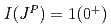 state are
  MeV and
  MeV, respectively, which indicates that it might be a good candidate for the recently observed
  state. We also obtain an isospin partner state
 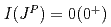 with
with  MeV and
  MeV, respectively. Future experimental search for
  will be very helpful.
 particles triggered strong interaction with LaFeO
 framework for total and preferential CO oxidation
Zheng, Y.*; Xiao, H.*; Li, K.*; Wang, Y.*; Li, Y.*; Wei, Y.*; Zhu, X.*; Li, H.-W.*; Matsumura, Daiju; Guo, B.*; et al.
ACS Applied Materials & Interfaces, 12(37), p.42274 - 42284, 2020/09
Times Cited Count:26 Percentile:71.09(Nanoscience & Nanotechnology) (Sb
(Sb Bi
Bi )
) Te
TeYe, M.*; Xu, T.*; Li, G.*; Qiao, S.*; Takeda, Yukiharu; Saito, Yuji; Zhu, S.-Y.*; Nurmamat, M.*; Sumida, Kazuki*; Ishida, Yukiaki*; et al.
Physical Review B, 99(14), p.144413_1 - 144413_7, 2019/04
Times Cited Count:15 Percentile:56.82(Materials Science, Multidisciplinary) Co
Co Sn
Sn
Cheung, Y. W.*; Zhang, J. Z.*; Zhu, J. Y.*; Yu, W. C.*; Hu, Y. J.*; Wang, D. G.*; Otomo, Yuka*; Iwasa, Kazuaki*; Kaneko, Koji; Imai, Masaki*; et al.
Physical Review B, 93(24), p.241112_1 - 241112_5, 2016/06
Times Cited Count:17 Percentile:57.73(Materials Science, Multidisciplinary)TeYe, M.*; Li, W.*; Zhu, S.-Y.*; Takeda, Yukiharu; Saito, Yuji; Wang, J.*; Pan, H.*; Nurmamat, M.*; Sumida, Kazuki*; Ji, F.*; et al.
Nature Communications (Internet), 6, p.8913_1 - 8913_7, 2015/11
Times Cited Count:60 Percentile:90.36(Multidisciplinary Sciences)Magnetically doped topological insulators are predicted to exhibit exotic phenomena including the quantized anomalous Hall effect and a dissipationless transport, which facilitate the development of low-power-consumption devices using electron spins. The realization of the quantized anomalous Hall effect is so far restricted to the Cr-doped (Sb,Bi)Te system at extremely low temperature; however, the microscopic origin of its ferromagnetism is poorly understood. Here we present an element-resolved study for Cr-doped (Sb,Bi)Te using X-ray magnetic circular dichroism to unambiguously show that the long-range magnetic order is mediated by the p-hole carriers of the host lattice, and the interaction between the Sb(Te) p and Cr d states is crucial.
Sumida, Kazuki*; Shirai, Kaito*; Zhu, S.-Y.*; Taniguchi, Masaki*; Ye, M.*; Ueda, Shigenori*; Takeda, Yukiharu; Saito, Yuji; Aseguinolaza, I. R.*; Barandiar n, J. M.*; et al.
Physical Review B, 91(13), p.134417_1 - 134417_6, 2015/04
Times Cited Count:6 Percentile:26.22(Materials Science, Multidisciplinary)Fe N (x = 0, 3, 4) films grown by molecular beam epitaxy
Ito, Keita*; Sanai, Tatsunori*; Yasutomi, Yoko*; Zhu, S.-Y.*; Toko, Kaoru*; Takeda, Yukiharu; Saito, Yuji; Kimura, Akio*; Suemasu, Takashi*
Journal of Applied Physics, 115(17), p.17C712_1 - 17C712_3, 2014/05
Times Cited Count:21 Percentile:61.29(Physics, Applied)Deng, Z.*; Zhao, K.*; Gu, B.; Han, W.*; Zhu, J. L.*; Wang, X. C.*; Li, X.*; Liu, Q. Q.*; Yu, R. C.*; Goko, Tatsuo*; et al.
Physical Review B, 88(8), p.081203_1 - 081203_5, 2013/08
Times Cited Count:76 Percentile:91.63(Materials Science, Multidisciplinary) Se
SeYe, M.*; Kuroda, Kenta*; Takeda, Yukiharu; Saito, Yuji; Okamoto, Kazuaki*; Zhu, S.-Y.*; Shirai, Kaito*; Miyamoto, Koji*; Arita, Masashi*; Nakatake, Masashi*; et al.
Journal of Physics; Condensed Matter, 25(23), p.232201_1 - 232201_5, 2013/06
Times Cited Count:12 Percentile:46.86(Physics, Condensed Matter)no abstracts in English

