



Initialising ...
Initialising ...
Initialising ...
Initialising ...
Initialising ...
Initialising ...
Initialising ...
Shimizu, Yusuke*; Fujita, Takaaki*; Arimoto, Hideki*; Nakano, Tomohide; Hoshino, Kazuo; Hayashi, Nobuhiko
Plasma and Fusion Research (Internet), 10(Sp.2), p.3403062_1 - 3403062_4, 2015/07
Garcia, J.*; Hayashi, Nobuhiko; Baiocchi, B.*; Giruzzi, G.*; Honda, Mitsuru; Ide, Shunsuke; Maget, P.*; Narita, Emi*; Schneider, M.*; Urano, Hajime; et al.
Nuclear Fusion, 54(9), p.093010_1 - 093010_13, 2014/09
Times Cited Count:42 Percentile:86.39(Physics, Fluids & Plasmas)Garcia, J.*; Hayashi, Nobuhiko; Giruzzi, G.*; Schneider, M.*; Joffrin, E.*; Ide, Shunsuke; Sakamoto, Yoshiteru; Suzuki, Takahiro; Urano, Hajime; JT-60 Team; et al.
Europhysics Conference Abstracts (Internet), 38F, p.P1.029_1 - P1.029_4, 2014/06
Ikeda, Yoshitaka; NBI Heating Group; NCT Design Team
Journal of the Korean Physical Society, 49, p.S43 - S47, 2006/12
There are two type of NBI systems on JT-60U. One is the positive ion-based NBI (P-NBI) to inject the beam energy of 80-85 kV. The other is the negative ion-based NBI (N-NBI) at the beam energy more than 350 keV. Recently the pulse duration of NBI system was required to extend up to 30 sec so as to study long pulse plasmas. The four P-NBI units, which tangentially inject neutral beam to plasma, were modified to extend the pulse duration up to 30 sec with 2 MW/unit at  85 keV. The seven P-NBI units, each of which perpendicularly injects for 10 sec, were conducted to operate in series for the total pulse duration of 30 sec. The ion source of the N-NBI unit was also modified to reduce the heat load of the grid for 30 sec operation. The pulse duration was extended up to 25 sec, 1 MW at the beam energy of 350keV. In the next step, further pulse extension of NBI up to 100 sec is planned for the modified JT-60U with superconducting coils (so called NCT). This paper reports the recent progress of the NBI system on JT-60U and the design study of the upgraded NBI system for NCT.
 -mode plasmas in JT-60U tokamak
Urano, Hajime; Takizuka, Tomonori; Takenaga, Hidenobu; Oyama, Naoyuki; Miura, Yukitoshi; Kamada, Yutaka
Nuclear Fusion, 46(8), p.781 - 787, 2006/08
Times Cited Count:23 Percentile:58.57(Physics, Fluids & Plasmas)The degradation of energy confinement with increased toroidal beta  was shown by the non-dimensional analysis in JT-60U. The dependence of the energy confinement on was examined by both the JT-60U ELMy
  -mode confinement database and the dedicated experiment on a single scan while
  and
and  were kept fixed as well as the other magnetic geometrical parameters. In both cases, the degradation of energy confinement with increasing was observed, satisfying the relation of
 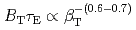 . This dependence is a little weaker than that predicted by the IPB98(y,2) scaling. The fusion power production rate was estimated to increase in proportion to
  .
.
Ikeda, Yoshitaka; Umeda, Naotaka; Akino, Noboru; Ebisawa, Noboru; Grisham, L. R.*; Hanada, Masaya; Honda, Atsushi; Inoue, Takashi; Kawai, Mikito; Kazawa, Minoru; et al.
Nuclear Fusion, 46(6), p.S211 - S219, 2006/06
Times Cited Count:62 Percentile:86.96(Physics, Fluids & Plasmas)Recently, the extension of the pulse duration up to 30 sec has been intended to study quasi-steady state plasma on JT-60U N-NBI system. The most serious issue is to reduce the heat load on the grids for long pulse operation. Two modifications have been proposed to reduce the heat load. One is to suppress the beam spread which may be caused by beamlet-beamlet interaction in the multi-aperture grid due to the space charge force. Thin plates were attached on the extraction grid to modify the local electric field. The plate thickness was optimized to steer the beamlet deflection. The other is to reduce the stripping loss, where the electron of the negative ion beam is stripped and accelerated in the ion source and then collides with the grids. The ion source was modified to reduce the pressure in the accelerator column to suppress the beam-ion stripping loss. Up to now, long pulse injection of 17 sec for 1.6 MW and 25 sec for 1 MW has been obtained by one ion source with these modifications.
Ishimoto, Yuki; Goto, Yoshitaka*; Arai, Takashi; Masaki, Kei; Miya, Naoyuki; Oyama, Naoyuki; Asakura, Nobuyuki
Journal of Nuclear Materials, 350(3), p.301 - 309, 2006/05
Times Cited Count:22 Percentile:79.97(Materials Science, Multidisciplinary)Thermal properties of the redeposition layer on the inner plate of the W-shaped divertor of JT-60U have been measured with laser flash method for the first time so as to estimate transient heat loads onto the divertor. Measurement of a redeposition layer sample of more than 200 m thick showed following results: (1) the bulk density of the redeposition layer is about half of that of carbon fiber composite material; (2) the specific heat of the layer is roughly equal to that of the isotropic graphite; (3) the thermal conductivity of the redeposition layer is two orders of magnitude smaller than that of the carbon fiber composite. The difference between the divertor heat loads and the loss of the plasma stored energy becomes smaller taking account of thermal properties of the redeposition layer on the inner divertor, whereas estimated heat loads due to the ELMs is still larger than the loss. This is probably caused by the poloidal distribution of the thermal properties and heat flux asymmetry inherent in the device.
Kamiya, Kensaku; Urano, Hajime; Koide, Yoshihiko; Takizuka, Tomonori; Oyama, Naoyuki; Kamada, Yutaka; JT-60 Team
Plasma Physics and Controlled Fusion, 48(5A), p.A131 - A139, 2006/05
Times Cited Count:22 Percentile:57.37(Physics, Fluids & Plasmas)Effects of plasma rotation and ripple loss on the Type-I ELMs have systematically studied in the JT-60U tokamak, scanning combinations of NBI at the three kinds of plasma volumes. New findings on the Type-I ELMs confirm to be smaller ELM energy loss per pedestal stored energy, DWELM/Wped, and faster ELM frequency, fELM, in the counter-NBI than co-NBI, keeping the power of ELM, PELM, per heating power crossing the separatrix, PSEP, constant. Balanced-NBI case is also intermediate between co- and counter-NBI. In addition, the product of PELM/PSEP decreases according to increase in the plasma volume, suggesting an increase in the inter-ELM transport due mainly to an enhancement in the ripple loss of fast ion.
Urano, Hajime; Kamiya, Kensaku; Koide, Yoshihiko; Takizuka, Tomonori; Oyama, Naoyuki; Kamada, Yutaka; JT-60 Team
Plasma Physics and Controlled Fusion, 48(5A), p.A193 - A199, 2006/05
Times Cited Count:10 Percentile:33.11(Physics, Fluids & Plasmas)The characteristics of the H-mode pedestal structure were investigated by conducting the power scans for a variation of the toroidal momentum sources at different toroidal field ripple in JT-60U. It was found that the pedestal pressure is increased by reduced loss power of fast ions, independently of toroidal rotation. However, the energy confinement is improved with the CO-directed toroidal momentum source at H-mode plasmas with small ripple loss.
Sakamoto, Yoshiteru; Ide, Shunsuke; Yoshida, Maiko; Koide, Yoshihiko; Fujita, Takaaki; Takenaga, Hidenobu; Kamada, Yutaka
Plasma Physics and Controlled Fusion, 48(5A), p.A63 - A70, 2006/05
Times Cited Count:36 Percentile:72.83(Physics, Fluids & Plasmas)no abstracts in English
Hayashi, Nobuhiko; Takizuka, Tomonori; Sakamoto, Yoshiteru; Fujita, Takaaki; Kamada, Yutaka; Ide, Shunsuke; Koide, Yoshihiko
Plasma Physics and Controlled Fusion, 48(5A), p.A55 - A61, 2006/05
Times Cited Count:7 Percentile:23.78(Physics, Fluids & Plasmas)no abstracts in English
La Haye, R. J.*; Prater, R.*; Buttery, R. J.*; Hayashi, Nobuhiko; Isayama, Akihiko; Maraschek, M. E.*; Urso, L.*; Zohm, H.*
Nuclear Fusion, 46(4), p.451 - 461, 2006/04
Times Cited Count:163 Percentile:97.45(Physics, Fluids & Plasmas)no abstracts in English
Takeishi, Toshiharu*; Katayama, Kazunari*; Nishikawa, Masabumi*; Masaki, Kei; Miya, Naoyuki
Journal of Nuclear Materials, 349(3), p.327 - 338, 2006/03
Times Cited Count:6 Percentile:40.23(Materials Science, Multidisciplinary)no abstracts in English
Fujita, Takaaki; JT-60 Team
Nuclear Fusion, 46(3), p.S3 - S12, 2006/03
Times Cited Count:8 Percentile:26.99(Physics, Fluids & Plasmas)no abstracts in English
Kikuchi, Mitsuru; Tamai, Hiroshi; Matsukawa, Makoto; Fujita, Takaaki; Takase, Yuichi*; Sakurai, Shinji; Kizu, Kaname; Tsuchiya, Katsuhiko; Kurita, Genichi; Morioka, Atsuhiko; et al.
Nuclear Fusion, 46(3), p.S29 - S38, 2006/03
Times Cited Count:13 Percentile:40.56(Physics, Fluids & Plasmas)The National Centralized Tokamak (NCT) facility program is a domestic research program for advanced tokamak research to succeed JT-60U incorporating Japanese university accomplishments. The mission of NCT is to establish high beta steady-state operation for DEMO and to contribute to ITER. The machine flexibility and mobility is pursued in aspect ratio and shape controllability, feedback control of resistive wall modes, wide current and pressure profile control capability for the demonstration of the high-b steady state.
Umeda, Naotaka; Ikeda, Yoshitaka; Hanada, Masaya; Inoue, Takashi; Kawai, Mikito; Kazawa, Minoru; Komata, Masao; Mogaki, Kazuhiko; Oga, Tokumichi
Review of Scientific Instruments, 77(3), p.03A529_1 - 03A529_3, 2006/03
Times Cited Count:7 Percentile:36.84(Instruments & Instrumentation)no abstracts in English
Kikuchi, Mitsuru; Nishio, Satoshi; Kurita, Genichi; Tsuzuki, Kazuhiro; Bakhtiari, M.*; Kawashima, Hisato; Takenaga, Hidenobu; Kusama, Yoshinori; Tobita, Kenji
Fusion Engineering and Design, 81(8-14), p.1589 - 1598, 2006/02
Times Cited Count:4 Percentile:29.72(Nuclear Science & Technology)Blanket-plasma interaction is important for plasma performance enhancement and reliability of first-wall/ blanket. Typical examples are harminization of wall stabilization and reduction of EM force during current quench, error field effect by ferritic steel, neutral-wall interaction under wall saturation, etc. JAERI reactor studies, JT-60U and JFT-2M results on this topics will be described.
Isobe, Kanetsugu; Nakamura, Hirofumi; Kaminaga, Atsushi; Tsuzuki, Kazuhiro; Higashijima, Satoru; Nishi, Masataka; Kobayashi, Yasunori*; Konishi, Satoshi*
Fusion Engineering and Design, 81(1-7), p.827 - 832, 2006/02
Times Cited Count:11 Percentile:58.92(Nuclear Science & Technology)Exhaust gas from JT-60U during experimental operation has been measured with Gas Chromatography (GC), and the gas exhaust characteristic from JT-60U on plasma discharge conditions has been investigated during the JT-60U experimental campaign in 2003-2004. During experimental operation of JT-60U, hydrogen isotope concentration strongly depended on the type of discharges such as high performance, long pulse and so on. On the other hand, impurity species, such as helium, hydrocarbon and carbon oxide, were detected during plasma discharges occasionally. During the experimental operation, plasma disruption remarkably tended to produce high concentration impurities. Glow discharge and Taylor discharge for wall conditioning also produced impurities. In the case of normal plasma, impurity was detected and high performance plasma, such as high  plasma, tended to produce high concentration impurities. This result indicated that impurities concentration might be higher in the case of normal plasma in ITER, because of its high performance.
Hayashi, Takao; Ochiai, Kentaro; Masaki, Kei; Goto, Yoshitaka*; Kutsukake, Chuzo; Arai, Takashi; Nishitani, Takeo; Miya, Naoyuki
Journal of Nuclear Materials, 349(1-2), p.6 - 16, 2006/02
Times Cited Count:10 Percentile:55.89(Materials Science, Multidisciplinary)Deuterium concentrations and depth profiles in plasma-facing graphite tiles used in the divertor of JT-60U were investigated by NRA. The highest deuterium concentration of D/ C of 0.053 was found in the outer dome wing tile, where the deuterium accumulated probably through the deuterium-carbon co-deposition. In the outer and inner divertor target tiles, the D/C data were lower than 0.006. Additionally, the maximum (H+D)/C in the dome top tile was estimated to be 0.023 from the results of NRA and SIMS. OFMC simulation showed energetic deuterons caused by NBI were implanted into the dome region with high heat flux. Furthermore, the surface temperature and conditions such as deposition and erosion significantly influenced the accumulation process of deuterium. The deuterium depth profile, SEM observation and OFMC simulation indicated the deuterium was considered to accumulate through three processes: the deuterium-carbon co-deposition, the implantation of energetic deuterons and the deuterium diffusion into the bulk.
Ushigome, Masahiro*; Ide, Shunsuke; Ito, Satoshi*; Jotaki, Eriko*; Mitarai, Osamu*; Shiraiwa, Shunichi*; Suzuki, Takahiro; Takase, Yuichi*; Tanaka, Shigetoshi*; Fujita, Takaaki; et al.
Nuclear Fusion, 46(2), p.207 - 213, 2006/02
Times Cited Count:12 Percentile:38.16(Physics, Fluids & Plasmas)This papaer studies on tokamak plasma start-up completely without central solenoid (CS). On the JT-60 tokamak it is demonstrated that a completely CS-less Ip start-up to 100 kA was achieved even without any null-point by Electron cyclotron range of frequencies (ECRF) and outer PF coil current swing only. Necessary conditions (the EC power, the toroidal field etc.) were clarified. Moreover, it was succeded to maintain Ip = 260kA for 1 sec without CS by NB only. In addition Ip ramp-up by EC and NB only (without LHCD) from 215 to 310kA was achieved. In a high confinement reversed shear discharge, a result suggesting bootstrap over drive was obtained.
