



Initialising ...
Initialising ...
Initialising ...
Initialising ...
Initialising ...
Initialising ...
Initialising ...
 -wave
 baryons
Su, N.*; Chen, H.-X.*; Gubler, P.; 保坂 淳
Physical Review D, 113(1), p.016005_1 - 016005_7, 2026/01
被引用回数:1 パーセンタイル:67.85(Astronomy & Astrophysics)Using the QCD sum rule method, we investigate the mass splitting for the spin-orbit partner states of the  baryon assuming that it is a -wave excitation with
 . This study is an extension of a previous work, in which the masses of these states were estimated with uncertainties too large to extract the reliable mass splitting. In the present study, by directly formulating a sum rule for the mass splitting, we obtain an improved prediction,
 MeV. This result provides a more quantitative insight into the spectrum of -wave baryons and serves as a useful reference for future experiments.
from QCD sum rulesSu, N.*; Chen, H.-X.*; Gubler, P.; 保坂 淳
Proceedings of Science (Internet), 500, p.076_1 - 076_6, 2026/01
We investigate the recently observed baryon using QCD sum rules. By constructing P-wave baryon currents and performing spin projection and parity projection, we obtain the masses of the  and
 states as
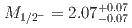 GeV and
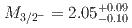 GeV, in good agreement with experiment. This suggests that is likely to be a negative parity P-wave excited state, though its spin remains undetermined and requires further study of its decay properties.
from QCD sum rulesSu, N.*; Chen, H.-X.*; Gubler, P.; 保坂 淳
Nuclear and Particle Physics Proceedings, 347, p.2 - 5, 2024/12
We investigate the recently observed baryon using QCD sum rules. By constructing P-wave baryon currents and performing spin projection and parity projection, we obtain the masses of the and states as GeV and GeV, in good agreement with experiment. This suggests that is likely to be a negative parity P-wave excited state, though its spin remains undetermined and requires further study of its decay properties.
from QCD sum rulesSu, N.*; Chen, H.-X.*; Gubler, P.; 保坂 淳
Physical Review D, 110(3), p.034007_1 - 034007_9, 2024/08
被引用回数:9 パーセンタイル:70.13(Astronomy & Astrophysics)We study the recently observed baryon in quantum chromodynamics (QCD) sum rules. We construct the P-wave baryon currents with a covariant derivative, and perform spin projection to obtain the currents with total spin 1/2 and 3/2. We then apply the parity-projected QCD sum rules to separate the contributions of the positive and negative parity states. We extract the masses of and states to be GeV and GeV. Both results are in good agreement with the experimental result. Therefore, it is likely that the is a negative parity state, which is interpreted as a P-wave excited state in the quark model. However, its spin is not determined in the present analysis, which can be done by detailed study on its decay properties.
