



Initialising ...
Initialising ...
Initialising ...
Initialising ...
Initialising ...
Initialising ...
Initialising ...
 -wave
-wave  baryons
Su, N.*; Chen, H.-X.*; Gubler, P.; 保坂 淳
Physical Review D, 113(1), p.016005_1 - 016005_7, 2026/01
被引用回数:1Using the QCD sum rule method, we investigate the mass splitting for the spin-orbit partner states of the  baryon assuming that it is a -wave excitation with
  . This study is an extension of a previous work, in which the masses of these states were estimated with uncertainties too large to extract the reliable mass splitting. In the present study, by directly formulating a sum rule for the mass splitting, we obtain an improved prediction,
  MeV. This result provides a more quantitative insight into the spectrum of -wave baryons and serves as a useful reference for future experiments.
石川 貴嗣*; 保坂 淳; Gubler, P.; 佐甲 博之; 谷田 聖; 他33名*
Proceedings of Science (Internet), 500, p.225_1 - 225_5, 2026/01
We plan to measure cross sections for pion-induced phi-meson production on the proton at the high-intensity high-momentum secondary-particle beamline at J-PARC under the E95 physics program to study nucleon resonances and a possible hidden-strangeness pentaquark baryon in the phi-nucleon channel, which are expected to appear in the s-channel intermediate state of the reaction. The pentaquark baryon is a candidate for the origin of the unresolved bump that observed in the differential cross section at forward angles for photoproduction of phi mesons on the proton. We use several incident negative-pion momenta ranging from 1.6 to 2.4 GeV/c and detect positive and negative kaon pairs from the phi-meson decays utilizing the existing spectrometer with large acceptance. In this contribution, we will give a brief introduction of this E95 physics program.
from QCD sum rulesSu, N.*; Chen, H.-X.*; Gubler, P.; 保坂 淳
Proceedings of Science (Internet), 500, p.076_1 - 076_6, 2026/01
We investigate the recently observed baryon using QCD sum rules. By constructing P-wave baryon currents and performing spin projection and parity projection, we obtain the masses of the  and
and  states as
 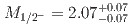 GeV and
 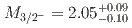 GeV, in good agreement with experiment. This suggests that is likely to be a negative parity P-wave excited state, though its spin remains undetermined and requires further study of its decay properties.
Ou-Yang, Z.-X.*; Gubler, P.; 岡 眞*; Wang, G.-J.*; Wu, J.-J.*
Physical Review D, 112(11), p.114034_1 - 114034_13, 2025/12
被引用回数:0 パーセンタイル:0.00(Astronomy & Astrophysics)We propose an extension of the QCD sum rules, termed the resonance sum rules, to access resonance poles in the complex energy plane. By strategically introducing a contour in the complex plane and conformal mapping, the method intends to reach resonance poles on the second Riemann sheet. To validate this approach, we apply resonance sum rules to the square-well potential model, for which the pole locations are known. The analysis demonstrates a successful extraction of the pole positions and residues for both the S-wave and P-wave resonances. The results are in good agreement with the analytic solutions, with discrepancies within 5% for the pole positions and 20% for the residues. This framework provides a basis for future applications to realistic hadronic resonances, promising new insights into spectral properties of QCD.
 meson spectrum through kaons in proton-nucleus reactions
Balassa, G.*; 青木 和也*; Gubler, P.; Lee, S. H.*; 佐甲 博之; Wolf, G.*
Progress of Theoretical and Experimental Physics (Internet), 2025(11), p.113C01_1 - 113C01_20, 2025/11
被引用回数:0 パーセンタイル:0.00(Physics, Multidisciplinary)Exploring the mass modifications of mesons in nuclei provides insights into the nature of strongly interacting matter. Specifically, meson mass shifts can be related to the in-medium modification of the strange quark condensate. Therefore, the partial restoration of chiral symmetry can be studied by observing the mass shifts through the decay channels  , and
, and  . In this paper, we examine the possibility of observing the meson mass modifications of the mesons in 30 GeV proton-nucleus (C, Cu, Pb) collisions, to be studied at the J-PARC E88 experiment, through the kaonic decay channel, with the off-shell Budapest Boltzmann-Uehling-Uhlenbeck (BuBUU) transport model. By applying different mean fields to the kaons, we examine their effects on the invariant mass spectra.
mesons at finite density using a transport approach in the 12 GeV pA reactions市川 真也; Gubler, P.; 成木 恵; KEK-PS E325 Collaboration*; 他25名*
Progress of Theoretical and Experimental Physics (Internet), 2025(9), p.093D01_1 - 093D01_21, 2025/08
被引用回数:1 パーセンタイル:58.26(Physics, Multidisciplinary)The hadron spectrum at finite density is an important observable for exploring the origin of hadron masses. In the KEK-PS E325 experiment, the di-electron decays of mesons inside and outside nuclei were measured using 12 GeV pA reactions. In the previous analysis, a significant excess was observed on the low-mass side of the meson peak in the data for slow-moving mesons ( =
= 
 /
/
 1.25) with the Cu target, and in-medium vector meson spectral modification was verified. We newly employed the PHSD transport approach to take into account the time evolution of spatial density distribution of the target nuclei. Consistent with the previous analysis, a significant excess was observed in the present analysis as well. It was found that incorporating momentum dependence into the spectral modification leads to better agreement with the experimental results. For the slow-moving mesons with the Cu target, the newly obtained modification parameters are consistent with those from the previous analysis within the uncertainties.
Kim, H.*; Gubler, P.; 佐々木 千尋*
Physics Letters B, 866, p.139577_1 - 139577_4, 2025/07
被引用回数:1 パーセンタイル:67.88(Astronomy & Astrophysics)We present a novel approach for investigating the spin structure of hadrons based on the two-point function in quantum field theory. In a rotating frame, we derive two independent expressions of the two-point function and identify their equivalence, which allows for a complete decomposition of the total spin of a composite system into the angular momenta of its constituent particles. Applying this approach to the proton, we analyze its spin structure in the massless quark limit. Our results indicate that the quark spin contribution accounts for approximately 27% of the total proton spin at a low-energy scale, significantly deviating from the prediction of the non-relativistic quark model.
市川 真也; Gubler, P.; 成木 恵; 四日市 悟*
Journal of Subatomic Particles and Cosmology (Internet), 3, p.100018_1 - 100018_5, 2025/06
It is important to measure the hadron spectrum at finite density to explore the origin of hadron masses. At the KEK-PS E325 experiment, mesons inside and outside nuclei were measured by using 12GeV pA reactions and significant spectral modification was observed. In order to accurately estimate the density that the mesons felt during the reaction, a PHSD transport calculation of the respective reaction is currently ongoing. In this paper, PHSD and the current status of its implementation are reported.
江島 廉*; Gubler, P.; 佐々木 千尋*; 志垣 賢太*
Physical Review C, 111(5), p.055201_1 - 055201_12, 2025/05
被引用回数:2 パーセンタイル:85.20(Physics, Nuclear)The degeneracy of chiral partners is an ideal signal for measuring the restoration of the spontaneously broken chiral symmetry in QCD. In this work, we investigate the observability of the -f(1420) degeneracy in the J-PARC E16 experiment, which measures di-electrons emitted from 30 GeV pA collisions. We for this purpose make use of an effective Lagrangian approach, which naturally incorporates the broken charge-conjugation symmetry in nuclear matter and the ensuing anomaly-induced mixing between vector and axial-vector mesons, to compute the spectral function relevant for the experimental measurement. The real-time dynamics of the pA collision is obtained from a transport simulation. Including experimental background and resolution effects on top of that, we find that a signal of the -f(1420) mixing can be observed around 2.5  with the Run2 statistics planned for the J-PARC E16 experiment with an ideal mixing strength.
mesons in proton-nucleus reactions from a transport approachGubler, P.; 市川 真也; Song, T.*; Bratkovskaya, E.*
Physical Review C, 111(3), p.034908_1 - 034908_12, 2025/03
被引用回数:4 パーセンタイル:95.19(Physics, Nuclear)Production and in-medium modification of hidden strange mesons are studied in proton-nucleus reactions: p+C, p+Cu, and p+Pb at 12 GeV/c, partially measured by the KEK E325 Collaboration via the dilepton decay mode. This work is based on the off-shell microscopic parton-hadron-string dynamics transport approach, and especially makes it possible to simulate in-medium off-shell dynamics of the meson in the reactions studied. Different in-medium scenarios for the modification of the meson spectral function in nuclear matter are investigated: (i) dropping pole mass, (ii) collisional broadening, and (iii) simultaneous dropping pole mass and collisional broadening. Even though the meson production in p+A reactions occurs only at densities around or below normal nuclear matter density  , we find visible modifications of the generated dilepton spectra for the in-medium scenarios compared to the vacuum distribution.
 correlation function
Abreu, L. M.*; Gubler, P.; Khemchandani, K. P.*; Mart nez Torres, A.*; 保坂 淳
Physics Letters B, 860, p.139175_1 - 139175_7, 2025/01
被引用回数:6 パーセンタイル:85.62(Astronomy & Astrophysics)The femtoscopic correlation function is studied within a hadronic effective Lagrangian approach with coupled channels, based on hidden local symmetry. The results are compared with the data recently reported by the ALICE collaboration. We find that the correlation function has very different features for the system in the spin 1/2 and 3/2 configurations, with the spin-averaged combination matching well with the experimental data. A strong attraction, leading to the formation of a bound state or a very prominent cusp is found in the spin 3/2 case. The correlation function for spin 1/2, on the other hand, is strongly impacted by the negative parity  *(1895) nucleon resonance.
from QCD sum rulesSu, N.*; Chen, H.-X.*; Gubler, P.; 保坂 淳
Nuclear and Particle Physics Proceedings, 347, p.2 - 5, 2024/12
We investigate the recently observed baryon using QCD sum rules. By constructing P-wave baryon currents and performing spin projection and parity projection, we obtain the masses of the and states as GeV and GeV, in good agreement with experiment. This suggests that is likely to be a negative parity P-wave excited state, though its spin remains undetermined and requires further study of its decay properties.
,  ,
,  and
and  mesons through their angular-dependent two-body decay modes
Park, I. W.*; 佐甲 博之; 青木 和也*; Gubler, P.; Lee, S. H.*
Journal of Subatomic Particles and Cosmology (Internet), 1-2, p.100014_1 - 100014_11, 2024/11
The mass shift a spin-1 particle moving in the nuclear medium will depend on its polarization direction. To study polarization-independent mass shifts in the medium, we explore methods to isolate each polarization direction of spin-1 mesons through the angular-dependent two-body decay modes. Specifically, we study ,  ,
,  , and
, and  (
( ) decays. Concerning and mesons, since both particles have vacuum widths smaller than 100 MeV, they are ideal candidates for experimentally measuring chiral partners. The simultaneous observation of mass shifts of these chiral partners would provide valuable insights into the contribution of chiral symmetry breaking to the generation of hadron masses.
meson production in nuclear matter and the correlation functionGubler, P.
Journal of Subatomic Particles and Cosmology (Internet), 1-2, p.100007_1 - 100007_4, 2024/11
We first review results of transport simulations of 12 GeV pA reactions to study the meson in nuclear matter, especially focusing on the production mechanism of the meson in such reactions and on the generated dilepton spectrum. Next, we discuss a recent study calculating the correlation function, making use of a hadronic effective Lagrangian approach with coupled channels and comparing the result with the recent measurement of the same quantity by the ALICE collaboration.
from QCD sum rulesSu, N.*; Chen, H.-X.*; Gubler, P.; 保坂 淳
Physical Review D, 110(3), p.034007_1 - 034007_9, 2024/08
被引用回数:5 パーセンタイル:34.34(Astronomy & Astrophysics)We study the recently observed baryon in quantum chromodynamics (QCD) sum rules. We construct the P-wave baryon currents with a covariant derivative, and perform spin projection to obtain the currents with total spin 1/2 and 3/2. We then apply the parity-projected QCD sum rules to separate the contributions of the positive and negative parity states. We extract the masses of and states to be GeV and GeV. Both results are in good agreement with the experimental result. Therefore, it is likely that the is a negative parity state, which is interpreted as a P-wave excited state in the quark model. However, its spin is not determined in the present analysis, which can be done by detailed study on its decay properties.
and mesons through their angular-dependent decay modesPark, I. W.*; 佐甲 博之; 青木 和也*; Gubler, P.; Lee, S. H.*
Physical Review D, 109(11), p.114042_1 - 114042_10, 2024/06
被引用回数:0 パーセンタイル:0.00(Astronomy & Astrophysics)Observing the mass shifts of chiral partners will provide invaluable insight into the role of chiral symmetry breaking in the generation of hadron masses. Because both the and mesons have vacuum widths smaller than 100 MeV, they are ideal candidates for realizing mass shift measurements. On the other hand, the different momentum dependence of the longitudinal and transverse modes smear the peak positions. In this work, we analyze the angular dependence of the two-body decays of both the and . It is found that the longitudinal and transverse modes of the can be isolated by observing the pseudoscalar decay in either the forward or perpendicular directions, respectively. For the decaying into a vector meson and a pseudoscalar meson, one can accomplish the same goal by further observing the polarization of the vector meson through its angular dependence on the two pseudoscalar meson decay.
Kumar, A.*; Yang, D.-L.*; Gubler, P.
Physical Review D, 109(5), p.054038_1 - 054038_16, 2024/03
被引用回数:21 パーセンタイル:96.18(Astronomy & Astrophysics)Starting with the polarization dependent Wigner function of vector mesons, we derive an expression for the 00-component ( ) of spin density matrix in terms of the second order gradients of the vector meson distribution functions. We further apply a thermal model to analyze the transverse momentum and the azimuthal angle dependence of for and
  mesons resulting from distribution gradients in Au-Au collisions with
  GeV at midrapidity. Our results for the transverse momentum dependence indicate that the deviations of from 1/3 as the signal for spin alignment are greatly enhanced at large transverse momenta and have a strong centrality dependence while analysis of the azimuthal angle
  dependence suggest that such deviations have a
  structure with opposite sign for and . Our finding may be considered as a baseline for probing spin-alignment mechanisms beyond hydrodynamic gradients.
meson in nuclear matter from theory and experimental dataGubler, P.; Bratkovskaya, E.*; 市川 真也; Song, T.*
EPJ Web of Conferences, 291, p.04003_1 - 04003_4, 2024/02
核物質における中間子の性質変化に関する最近の理論的及び実験的な研究を総括し、今後の展望について議論する。われわれの研究の最近の結果についても紹介する。
meson through dilepton and kaon decaysPark, I. W.*; 佐甲 博之; 青木 和也*; Gubler, P.; Lee, S. H.*
Physical Review D, 107(7), p.074033_1 - 074033_9, 2023/04
被引用回数:12 パーセンタイル:75.70(Astronomy & Astrophysics)Angular distributions of meson decay amplitudes of  and
and  channels are computed using both specific interaction Lagrangians and simple arguments relying on angular momentum conservation. Based on the obtained results, we assess methods to experimentally disentangle the longitudinal and transverse polarization modes of the meson and discuss advantages and disadvantages of employing either the leptonic or hadronic decay modes for this task.
meson properties in nuclear matter from dilepton spectra in a transport approachGubler, P.; Bratkovskaya, E.*; Song, T.*
EPJ Web of Conferences, 274, p.07015_1 - 07015_6, 2022/12
There is presently no consensus on how the meson mass and width will change once it is put in a dense environment such as nuclear matter. While many theoretical works exist, connecting them with experimental measurements remains non-trivial task, as the meson in nuclear matter is usually produced in relatively high-energy pA (p: proton, A: nucleus) reactions, which are generally non-equilibrium processes. In this presentation I will report on an ongoing project, attempting to simulate pA reactions in which the meson is produced in nuclei, making use of a transport approach. Results of simulations of 12 GeV/30 GeV p+C and p+Cu reactions will be presented and comparisons between obtained dilepton spectra and experimental data of the E325 experiment at KEK will be made. Furthermore, predictions for the ongoing J-PARC E16 experiment for both dilepton and spectra will be given and discussed.
