



Initialising ...
Initialising ...
Initialising ...
Initialising ...
Initialising ...
Initialising ...
Initialising ...
和田 裕貴; 柴本 泰照; 日引 俊詞*
International Journal of Heat and Mass Transfer, 249, p.127219_1 - 127219_16, 2025/10
被引用回数:0Two saturated boiling heat transfer correlations for downward flows in vertical circular pipes depending on wall superheat or wall heat flux as input parameters were developed based on a heat transfer experimental database. Owing to the absence of heat transfer correlations specifically developed for downward flows, existing heat transfer correlations for different flow directions were evaluated to determine their applicability to predicting the downward flow heat transfer coefficient. The results revealed that even the most accurate correlation showed a mean absolute percentage error (MAPE) of 66.5%, highlighting the need for improving predictive performance. In response, the downward flow heat transfer correlation was modeled by integrating a nucleate boiling heat transfer term and a forced convection heat transfer term. The Dong-Hibiki correlation, a two-component, two-phase heat transfer correlation for downward flows, was adopted for the forced convection heat transfer term. The Forster-Zuber correlation, developed as a wall superheat function, and the Cooper correlation, developed as a wall heat flux function, were used for the nucleate boiling term to develop the heat transfer correlations where either wall superheat or wall heat flux is known. Notably, the Dong-Hibiki correlation has been validated over a wide range of experimental conditions. A correction factor was applied to the nucleate boiling term to address errors caused by applying Foster-Zuber and Cooper correlations to downward flows. The two developed correlations achieved an MAPE value of approximately 20%, representing an improvement of roughly 40% over existing correlations of heat transfer coefficients.
和田 裕貴; 柴本 泰照; 日引 俊*
International Journal of Heat and Mass Transfer, 239, p.126598_1 - 126598_18, 2025/04
被引用回数:3 パーセンタイル:21.83(Thermodynamics)This study reviewed the saturated boiling heat transfer research in downward flows. A database of downward flow heat transfer experiments was created using experimental studies. Saturated boiling heat transfer correlations in internal flows were collected, and no downward flow-specific heat transfer correlations were identified. The applicability of heat transfer correlations to downward flow heat transfer experiments was evaluated, and no correlation could predict the heat transfer coefficients accurately for all experimental databases. However, correlations that could predict heat transfer coefficients reasonably well were determined for each channel size. Cooper's correlation [Int. Chem. Eng. Symp. Ser. 86 (1984) 785-792] had a mean absolute percentage error (MAPE) of 11.7% for mini-channels and Kim and Mudawar's correlation [Int. J. Heat Mass Transf. 64 (2013) 1239-1256] had an MAPE of 66.5% for macro-channels. Furthermore, because the advection direction between the liquid-phase and the generated bubbles differed depending on the liquid-phase velocity in downward flows, we evaluated the prediction performance of the heat transfer coefficient for the liquid-phase velocity. For some experimental data, the prediction performance of the existing correlation for downward flow heat transfer worsened as the advection velocity of the bubbles decreased. This result is one of the issues to be addressed in the future development of heat transfer correlations.
岡垣 百合亜; 日引 俊詞*; 柴本 泰照
JAEA-Review 2024-047, 58 Pages, 2025/02
 JAEA-Review-2024-047.pdf:2.22MB
加圧水型原子炉(PWR)の事故シナリオでは、非常用炉心冷却系(ECCS)からの注水(ECC注水)により、低温及び高温の冷却材の混合が不十分な場合、温度成層が形成され、加圧熱衝撃(PTS)が引き起こされる可能性がある。その結果、原子炉圧力容器(RPV)の健全性に影響を与えることが想定されている。そのため、PTSは原子炉の安全性において重要な研究課題であり、原子炉の運転可能期間を決定するRPVの健全性評価に関連してPTS解析は不可欠である。PTS解析は、熱水力解析及び構造解析の連成解析により実施される。特に、熱水力学的側面からのアプローチでは、RPV壁面の温度勾配を予測するために、ダウンカマ(DC)の過渡温度分布に関するデータが必要とされる。したがって、将来的には信頼性の高い数値流体力学(CFD)解析が重要な役割を果たすことが期待されている。本研究では、ROCOM、TOPFLOW、UPTF及びLSTFで行われたPTSに関する実験を対象とした単相流及び二相流CFD解析について、2010年以降に発表された論文を基に、PTS解析に最も影響を及ぼす乱流モデルの観点からレビューを行った。
茂木 孝介; 柴本 泰照; 日引 俊詞*
International Journal of Heat and Mass Transfer, 237, p.126406_1 - 126406_15, 2025/02
被引用回数:1 パーセンタイル:36.85(Thermodynamics)We performed Reynolds-averaged Navier-Stokes (RANS) simulations of a single-phase turbulent opposing flow mixed convection in a heated vertical circular tube. Previous research has indicated that the Launder-Sharma  model (hereafter the LS model), one of the most popular RANS turbulence models, overestimates experimental heat transfer coefficients for opposing flows. Although the RANS models have been widely applied to opposing flows in various systems, the mechanism and conditions under which the predictive performance of the LS models fail remain unclear. This study aims to understand the model characteristics and their applicability under various mixed convection conditions. This article investigates the LS model, the LS model with the Yap correction, and the
  model. The LS model remarkably over predicts the Nusselt number and the friction coefficient under highly buoyant conditions. The error for the Nusselt number was more than 90% for
 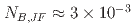 , where
  is a controlling parameter. The conditions under which the prediction of the LS model fails are linked to those under which reverse flow occurs near the heated wall. The reverse flow condition is given by
  . This condition could be used where the LS model cannot be applied. The LS model with Yap correction and model can predict experimental data successfully from forced convection to mixed convection conditions
  . For natural convection-dominant conditions
 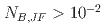 , the LS model with the Yap correction was numerically unstable and could not obtain a converged numerical solution; however, the model stably reproduced the experimental data. By optimizing the model constants included in the Yap correction, the stability and accuracy of the calculation can be improved under highly buoyant opposing flow conditions.
孫 昊旻; 日引 俊*
International Journal of Heat and Mass Transfer, 237, p.126445_1 - 126445_14, 2025/02
被引用回数:2 パーセンタイル:36.85(Thermodynamics)Various bubbles exist in two-phase flows. A practical approach is classifying the bubbles into two groups based on their drag coefficients. Two-group two-fluid model can potentially provide the most accurate analysis of two-phase flows. Two-group drift-flux model should be established as a constitutive equation to simplify the two-group two-fluid model for its practical use. The drift-flux model for large square channels has seldom been investigated, even though such channels exist in various engineering systems. This study developed the two-group drift-flux model for large square channels based on experimental databases.
佐藤 聡; 日引 俊*; 池田 遼; 柴本 泰照
Progress in Nuclear Energy, 180, p.105593_1 - 105593_11, 2025/02
被引用回数:0 パーセンタイル:0.00(Nuclear Science & Technology)加圧水型原子炉(PWR)の冷却材喪失事故では、ダウンカマーに流入するコールドレグに注入された緊急炉心冷却(ECC)水の流れにより、原子炉圧力容器(RPV)内壁に加圧熱衝撃(PTS)が発生するリスクがある。PTSは、ECC水によるダウンカマー壁の急冷によって発生し、ECC水の温度、壁面へのジェットの衝突位置と速度、壁面上の液膜の速度、液膜の厚さ、下降流の広がりなどに強く影響される。したがって、コールドレグからダウンカマーに流出するECC水の流れは、PTS事象に強く影響する可能性がある。この流動現象を理解するために、円管からの自由流出に関する研究をレビューした。流動条件の分類、流動条件間の遷移条件、端部深さ比、円管内の流れの自由表面形状、管から流出するナッペの形状に関する実験結果は、ほぼ一致した形で得られている。これに対し、コールドレグからダウンカマーへの流れを考慮する場合、自由空間ではなく狭い隙間への流れ、円管出口の角の丸みの存在、炉心からコールドレグへ流れる蒸気流の影響など、特殊な状況での流れ場を扱う必要がある。しかし、これらの要因を考慮した先行研究は少ないため、今後蓄積すべき知見としてまとめた。
茂木 孝介; 柴本 泰照; 日引 俊詞*; 塚本 直史*; 金子 順一*
JAEA-Review 2024-039, 45 Pages, 2024/09
JAEA-Review-2024-039.pdf:2.23MB
既往研究において様々な対向複合対流の熱伝達相関式が提案されているが、それらは様々な試験装置、流路形状、試験流体、熱流動パラメータの範囲で実施された実験結果に基づいている。従って、使用に際してその適用範囲や外挿性を踏まえた上でどの相関式を選択すべきかを整理しておくことは重要である。本稿では既存の対向複合対流の熱伝達相関式についてレビューした。また、複数の既往実験データと各相関式との比較を行い、相関式の予測性能を評価した。その結果、Jackson and Fewster相関式、Churchill相関式、Swanson and Catton (IJHMT)相関式は、全ての実験データを精度良く予測可能であった。さらに、代表長さに水力等価直径を用いることにより流路形状の違いに関わらず相関式が適用可能であり、支配パラメータの無次元化により試験流体によらず相関式が適用可能であることを確認した。
松本 俊慶; 日引 俊*; 丸山 結
International Journal of Energy Research, 2024(1), p.9748588_1 - 9748588_18, 2024/08
被引用回数:0 パーセンタイル:0.00(Energy & Fuels)ウェットキャビティ戦略(格納容器内への事前注水方策)の有効性を評価するために、圧力容器から放出される溶融物条件の不確かさを考慮した確率論的な評価手法を構築した。第1段階では、MELCORコードにより溶融物条件を求めた。炉心溶融進展に関係する5つの不確かさパラメータが選択された。インプットパラメータのセットはラテン超方格サンプリングにより発生された。第2段階ではJASMINEコードにより溶融物挙動が解析された。JASMINE解析のパラメータの確率分布はMELCOR解析の結果から決定された。初期水位は0.5、1.0、2.0mに設定された。デブリの高さが冷却性判定のために基準と比較された。一連の計算の結果としてデブリの冷却確率が取得された。さらにMELCOR-JASMINEを組み合わせた解析手法の成立性と技術的な課題について議論された。
孫 昊旻; 功刀 資彰*; 横峯 健彦*; Shen, X.*; 日引 俊*
Experimental Thermal and Fluid Science, 154, p.111171_1 - 111171_24, 2024/05
被引用回数:3 パーセンタイル:64.78(Thermodynamics)Taking the importance of gas-liquid two-phase flows in large square channels for advanced nuclear reactors, such as ESBWR, we experimented with upward cap-bubbly flows in a large square channel. Local void fractions, axial gas velocities, and interfacial area concentrations for two bubble-size groups were measured at three axial locations. Based on the database, cap-bubbly flow characteristics in a large square channel were understood. The existing drift-flux and interfacial area concentration correlations were validated. The void fraction covariances were obtained and used to validate their existing correlations.
岡垣 百合亜; 日引 俊詞*; 柴本 泰照
International Journal of Energy Research, 2024, p.5114542_1 - 5114542_37, 2024/04
被引用回数:0 パーセンタイル:0.00(Energy & Fuels)In pressurized water reactor accident scenarios, the injection of water from the ECCS (ECC injection) might induce a PTS, affecting the RPV integrity. Therefore, PTS is a vital research issue in reactor safety, and its analysis is essential for evaluating the integrity of RPVs, which determines the reactor life. The PTS analysis comprises a coupled analysis between thermal-hydraulic and structural analysis. The thermal-hydraulic approach is particularly crucial, and reliable Computational Fluid Dynamics (CFD) simulations should play a vital role in the future because predicting the temperature gradient of the RPV wall requires data on the transient temperature distribution of the downcomer. Since one-dimensional codes cannot predict the complex three-dimensional flow features during ECC injection, PTS is one reactor safety issue where CFD can benefit from complement evaluations with thermal-hydraulic system analysis codes. This study reviewed the code validation efforts for turbulence models most affecting PTS analysis based on papers published since 2010 on single- and two-phase flow CFD analysis for the experiment on PTS performed in the ROCOM, TOPFLOW, UPTF, and LSTF. The results revealed that in single-phase flow CFD analysis, where knowledge and experience are sufficient, various turbulence models have been considered, and many analyses using LES have been reported. For two-phase flow analysis of air-water conditions, interface capturing/tracking methods were used in addition to two-fluid models. The standard k- and SST k-
 models were still in the validated phase, and various turbulence models have yet to be fully validated. In the two-phase flow analysis of steam-water conditions, many studies have used two-fluid models and RANS, and NEPTUNE_CFD, in particular, has been reported to show excellent prediction performance based on years of accumulated validation.
廣瀬 意育; 安部 諭; 石垣 将宏*; 柴本 泰照; 日引 俊*
Progress in Nuclear Energy, 169, p.105085_1 - 105085_13, 2024/04
被引用回数:0 パーセンタイル:0.00(Nuclear Science & Technology)Immersed boundary methods (IBMs) have been developed as complementary methods for computational fluid dynamics (CFD). They allow a flow simulation in a mock-up model that includes complex-shaped inner structures and/or boundaries with a non-body conformal mesh. Such a model might force us to create a complicated body-fitted mesh with a high cost in the conventional CFD (CCFD) approach. We focus on the Brinkman penalization (BP) method and its extended version, which we call here the extended Brinkman penalization method (EBP), among the different types of IBMs, aiming to apply them to the phenomena that occur during severe accidents in a nuclear reactor containment vessel and explore the possibility that the methods can partially replace the CCFD. In this paper, as a preliminary step to validate the applicability of these methods, we measure the jet flow rectified by a grating-type structure used for the validation of numerical techniques and apply them to simulate the behavior of an upward jet rectified by a horizontally placed grating-type structure modeled as an immersed body. This type of structure is generally used in reactor buildings, and it is crucial to evaluate their influence on gaseous flows because the behaviors of hydrogen produced during severe accidents may be influenced by them. The structure is selected as our subject because it has moderate complexity, enabling us to examine the effects of the IBMs and compare them with CCFD. We investigate whether these methods can reproduce a result of corresponding CCFD in which the grating is modeled as body-conformal mesh and show that the former can produce the latter with equivalent accuracy. All these results are also compared with the experimental data on the flow velocity distributions downstream of the grating measured using particle image velocimetry.
廣瀬 意育; 柴本 泰照; 日引 俊*
Progress in Nuclear Energy, 168, p.105027_1 - 105027_17, 2024/03
被引用回数:3 パーセンタイル:43.92(Nuclear Science & Technology)This study reviewed the literature that measured critical heat flux (CHF) for downward flow in round pipes and arranged the proposed correlations. Each correlation shows relatively good prediction accuracy for experimental data from their literature, but the accuracies sometimes decrease for experimental data from other literature. No correlation accurately predicts all the experimental data of the literature, indicating an issue in extrapolating existing correlations. Therefore, we developed a correlation that can accurately predict the experimental data of the collected literature. First, we used a neural network to select the essential dimensionless quantities that comprise the correlation. Then, we regarded the prediction accuracy when all candidate dimensionless quantities extracted from the literature were used for the input variables of the network as the achievable limit prediction accuracy and searched for the minimum combination of dimensionless quantities required to achieve it. The results showed that only the dimensionless mass flux and the ratio of the heating length to the channel diameter are the essential parameters to achieve it. We developed a correlation equation using these two dimensionless quantities and achieved 17.6% of the average prediction accuracy. This result considerably improved existing correlation equations with 25%-40% average prediction accuracy for the same experimental data.
茂木 孝介; 柴本 泰照; 日引 俊詞*; 塚本 直史*; 金子 順一*
International Journal of Energy Research, 2024, p.6029412_1 - 6029412_22, 2024/01
被引用回数:1 パーセンタイル:51.66(Energy & Fuels)自然対流熱伝達と強制対流熱伝達が共存する流れを複合対流と呼ぶ。特に強制対流が下降流の場合をopposing flow複合対流と呼ぶ。既往研究において様々な単相opposing flow複合対流の熱伝達相関式が提案されているが、それらは様々な試験装置流路形状、作動流体、熱流動パラメータの範囲で実施された実験結果に基づいている。無次元支配因子の定義や実験的に確認された適用範囲も相関式ごとに異なるため、使用に際してその適用範囲や外挿性を踏まえた上でどの相関式を選択すべきかを整理しておくことは重要である。本稿では既存のopposing flow複合対流の熱伝達相関式と、熱水力システムコードに実装されている単相流壁面熱伝達相関式についてレビューした。また、複数の既往実験データと各相関式との比較を行い、相関式の予測性能を評価した。その結果、Jackson and Fewster相関式、Churchill相関式、Swanson and Catton (IJHMT)相関式は全ての実験データを精度よく予測可能であった。また、乱流複合対流では等温・等熱流束の熱的境界条件による熱伝達率への影響は顕著ではなく、既存の相関式は熱伝達率予測に適用可能であった。さらに、代表長さに水力学相当直径を用いることにより試験装置流路形状の違いに関わらず相関式が適用可能であり、支配パラメータの無次元化により作動流体によらず相関式が適用可能であることを確認した。幅広い無次元数範囲に対して相関式の外挿性を調査した所、Jackson and Fewster相関式、Churchill相関式、Aicher and Martin相関式は自然対流熱伝達、強制対流熱伝達への優れた外挿性を有しており、実験で妥当性が確認されたパラメータ範囲を超えて相関式が適用できることを示した。
孫 昊旻; 功刀 資彰*; 横峯 健彦*; Shen, X.*; 日引 俊*
International Journal of Heat and Mass Transfer, 211, p.124214_1 - 124214_17, 2023/09
被引用回数:4 パーセンタイル:37.98(Thermodynamics)An experiment for upward bubbly flows was conducted in a large square channel. The local void fraction, axial gas velocity, axial liquid velocity, interfacial area concentration, and Sauter mean diameter were measured at three axial locations. Based on the measurement data, the flow characteristics through flow development were investigated. The drift-flux parameters were directly determined from the local measurement data through their definitions. It was found that the distribution parameters and the void fractions could be fairly reproduced by the existing correlations for large circular pipes. Furthermore, the interfacial area concentrations could be predicted by existing correlations with reasonable accuracy.
岡垣 百合亜; 柴本 泰照; 和田 裕貴; 安部 諭; 日引 俊詞*
Journal of Nuclear Science and Technology, 60(8), p.955 - 968, 2023/08
被引用回数:3 パーセンタイル:59.85(Nuclear Science & Technology)Pool scrubbing is an important filtering process that prevents radioactive aerosols from entering the environment in the event of severe accidents in a nuclear reactor. In this process of transporting aerosol particles using bubbles, bubble hydrodynamics plays a crucial role in modeling pool scrubbing and significantly affects particle removal in a bubble. The pool scrubbing code based on Lumped Parameter (LP) approach includes the particle removal model, and its hydrodynamic parameters are determined based on simple assumptions. We aim to apply the three-dimensional Computer Fluid Dynamics (CFD) approach to understand the detailed bubble interaction. This study validated the applicability of the CFD simulation to bubble hydrodynamics at the flow transition from a globule to a swarm region, which is critical in the stand-alone pool scrubbing code-SPARC-90. Two types of solvers based on the Volume Of Fluid (VOF) and the Simple Coupled Volume Of Fluid with Level Set (S-CLSVOF) methods were used to capture the gas-liquid interface in the CFD simulation. We used the experimental data for validation. As a result, the VOF and S-CLSVOF methods accurately predicted the bubble size and void fraction distributions. In addition, we confirmed that the bubble rise velocity of the S-CLSVOF method almost agreed with the experimental results.
Han, X.*; Shen, X.*; 山本 俊弘*; 中島 健*; 孫 昊旻; 日引 俊*
International Journal of Heat and Mass Transfer, 178, p.121637_1 - 121637_24, 2021/10
被引用回数:20 パーセンタイル:76.84(Thermodynamics)This paper studies the flow regimes, their transitions and the drift-flux correlations in upward gas-liquid two-phase flows in vertical rod bundle flow channels. The flows are classified into 5 flow regimes, namely, bubbly, finely dispersed bubbly, cap-bubbly, churn and annular flows according to their different flow characteristics. Transition criteria between the flow regimes are proposed mechanistically. Those criteria can correctly predict 83% of the existing experimental observation of the flow regime. The drift-flux correlations for the distribution parameter and the drift velocity are also improved. The void fractions predicted by those correlations are compared with the existing experimental data, showing satisfactory agreement with mean relative error of 8%.
 6 rod bundle
Han, X.*; Shen, X.*; 山本 俊弘*; 中島 健*; 孫 昊旻; 日引 俊*
International Journal of Heat and Mass Transfer, 144, p.118696_1 - 118696_19, 2019/12
被引用回数:24 パーセンタイル:73.38(Thermodynamics)This paper presents a database of local flow parameters for upward adiabatic air-water two-phase flows in a vertical 66 rod bundle flow channel. The local void fraction, interfacial area concentration (IAC), bubble diameter and bubble velocity vector were measured by using a four-sensor optical probe. Based on an existing state-of-the-art four-sensor probe methodology with the characteristic to count small bubbles, IAC in this study was derived more reliably than those in the existing studies. In addition, bubble velocity vector could be measured by the methodology. Based on this database, flow characteristics were investigated. The area-averaged void fraction and IAC were compared with the predictions from the drift-flux model and the IAC correlations, respectively. The applicability of those to the rod bundle flow channel was evaluated.
Xiao, Y.*; Shen, X.*; 三輪 修一郎*; 孫 昊旻; 日引 俊*
混相流シンポジウム2018講演論文集(インターネット), 2 Pages, 2018/08
ロッドバンドル体系における二流体モデルの構成式の高度化を図るために、66ロッドバンドル体系における上昇気液二相流実験を実施した。ボイド率や界面積濃度等の局所流動パラメータを2針式光プローブで計測した。計測した断面平均ボイド率と界面積濃度の結果と、既存ドリフトフラックスモデルや界面積濃度相関式から予測した結果と比較した。
Shen, X.*; Schlegel, J. P.*; 日引 俊*; 中村 秀夫
Nuclear Engineering and Design, 333, p.87 - 98, 2018/07
被引用回数:12 パーセンタイル:30.29(Nuclear Science & Technology)Two phase flows in large-diameter channels are important to efficiently and safely transfer mass and energy in a wide variety of applications including nuclear power plants. Two-phase flows in vertical large-diameter channels, however, show much more complex multi-dimensional nature than those in small diameter channels. Various constitutive equations are required to mathematically close the model to predict two-phase flows with two-fluid model. Validations of the constitutive equations require extensive experiment effort. This paper summarizes the recent experimental studies on two-phase flows in vertical large-diameter channels, which includes measuring technique and available databases. Then, a comprehensive review of constitutive equations is provided covering flow regime transition criteria, drift-flux correlations, interfacial area concentration correlations and one- and two-group interfacial area transport equation(s), with discussions on typical characteristics of large-diameter channel flows. Recent 1D numerical simulations of large-diameter channel flows is reviewed too. Finally, future research directions are suggested.
Shen, X.*; 孫 昊旻; Deng, B.*; 日引 俊*; 中村 秀夫
International Journal of Heat and Fluid Flow, 67(Part A), p.168 - 184, 2017/10
被引用回数:17 パーセンタイル:58.92(Thermodynamics)主に4センサープローブを用いて、鉛直大口径正方形管内における上昇気泡流に関する実験的研究を実施した。流れ方向3断面における、局所界面積濃度、ボイド率、3次元気泡速度、気泡径を計測した。界面積輸送方程式やその中の気泡合体分裂モデルは、二相流における界面積濃度の予測に多用されてきたものの、主に円管や小口径管の二相流実験から構築されており、大口径正方形管に対する適応性の検証がされていない。そこで本研究では、大口径正方形管で取得したデータベースを用いて、既存の1次元1グループ界面積輸送方程式の気泡合体分裂モデルの大口径正方形管への適応性を評価した。最良のモデルに基づく予測と実験結果との誤差は25%であることを示した。
