



Initialising ...
Initialising ...
Initialising ...
Initialising ...
Initialising ...
Initialising ...
Initialising ...

Sato, Katsuya; Tejima, Kohei*; Onodera, Takefumi; Narumi, Issei
JAEA-Review 2012-046, JAEA Takasaki Annual Report 2011, P. 103, 2013/01
 USDA110 generated by ion-beam irradiation
Takeda, Kiyoko; Tejima, Kohei*; Sato, Katsuya; Narumi, Issei; Yokoyama, Tadashi*
JAEA-Review 2012-046, JAEA Takasaki Annual Report 2011, P. 107, 2013/01

Nunoshiba, Tatsuo*; Hirasawa, Yukei*; Yamauchi, Ayako*; Sato, Katsuya; Tejima, Kohei*; Onodera, Takefumi; Narumi, Issei
JAEA-Review 2012-046, JAEA Takasaki Annual Report 2011, P. 111, 2013/01
 -sterilization of biofertilizer's carrier on bacterial inoculants survival
Tejima, Kohei*; Yokoyama, Tadashi*; Sato, Katsuya; Takeda, Kiyoko; Narumi, Issei
JAEA-Review 2012-046, JAEA Takasaki Annual Report 2011, P. 112, 2013/01
RecFOR proteins in homologous recombinationSato, Katsuya; Kikuchi, Masahiro; Ishaque, A. M.*; Oba, Hirofumi*; Yamada, Mitsugu; Tejima, Kohei; Onodera, Takefumi; Narumi, Issei
DNA Repair, 11(4), p.410 - 418, 2012/04
Times Cited Count:24 Percentile:59.83(Genetics & Heredity)In an effort to gain insights into the role of  RecFOR proteins in homologous recombination, we generated
  ,
,  and
and  disruptant strains and characterized the disruption effects. Disruption of resulted in severe reduction of the transformation efficiency. On the other hand, the disruptant strain was the most sensitive phenotype to rays, UV irradiation and mitomycin C among the three disruptants. In the disruptant strain, the intracellular level of the LexA1 protein did not decrease following irradiation. These results demonstrate that the RecF protein plays a crucial role in the homologous recombination repair process by facilitating RecA activation. Thus, the RecF and RecR proteins are involved in the RecA activation and the stability of incoming DNA, respectively, during RecA-mediated homologous recombination processes that initiated the ESDSA pathway in .
-sterilization of carrier materials made with different types of soils on the shelf life of biofertilizer containing strain USDA110Tejima, Kohei; Sato, Katsuya; Takeda, Kiyoko; Yokoyama, Tadashi*; Narumi, Issei
Radioisotopes, 61(4), p.161 - 171, 2012/04
A biofertilizer is a substance that holds beneficial microorganisms for plant growth in a carrier material. To demonstrate the effect of -sterilization, the survival of the was monitored to assess the shelf life of biofertilizers. As biofertilizer carriers, five kinds of typical Japanese soil-based materials were used. Following the sterilization of carrier materials by -irradiation or autoclaving, 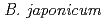 was inoculated into each material. The biofertilizer was stored for 12 months at 4
 C or 30C. After storage, viable inoculants in the biofertilizer were enumerated. Results indicated that inoculant density after storage was greater than the initial density in biofertilizers made from sterilized carriers, whereas it decreased significantly in biofertilizers made from non-sterilized carriers. -sterilization was superior to autoclave sterilization in enhancing inoculant survival in some cases.
Sato, Katsuya; Tejima, Kohei; Onodera, Takefumi; Narumi, Issei
JAEA-Review 2011-043, JAEA Takasaki Annual Report 2010, P. 106, 2012/01
USDA 110 obtained by ion-beam microbial mutation-breeding technologyTakeda, Kiyoko; Tejima, Kohei; Sato, Katsuya; Narumi, Issei; Yokoyama, Tadashi*
JAEA-Review 2011-043, JAEA Takasaki Annual Report 2010, P. 110, 2012/01
-sterilized carriersTejima, Kohei; Yokoyama, Tadashi*; Sato, Katsuya; Narumi, Issei
JAEA-Review 2011-043, JAEA Takasaki Annual Report 2010, P. 114, 2012/01
Tejima, Kohei; Sato, Katsuya; Narumi, Issei
Tsuchi To Biseibutsu, 65(1), p.78 - 82, 2011/04
Along with world population growth, production increase and stable supply of food as well as global environment conservation are critical issues. Decrease in agricultural productivity and increase in food consumption in recent years are a grave situation in Japan because of Japan's low self-sufficiency in food. The spread of biological resources that possess environmental resistance and new functionality is necessary to make possible production increase and stable supply of food as well as global environment conservation. Since mutation breeding can contribute to spread biological resources, Quantum Beam Science Directorate, JAEA, has engaged in R&D on ion beam mutation breeding using the cyclotron at TIARA. This article presents an overview of the current state of plant mutation breeding technology using ion beam and its expansive application to microbial mutation breeding.
-sterilization of biofertilizer's carrier on the density of rhizobial inoculantsTejima, Kohei; Narumi, Issei
FNCA Biofertilizer Newsletter, (9), P. 3, 2011/03
The inoculants survival in the biofertilizer could be affected by the physical and chemical properties of carrier materials and by the competition with native microbes in the carrier. -irradiation is expected to sterilize the carrier materials without changes in physical and chemical properties. In an effort to demonstrate the effect of -sterilization, the survivals of inoculants were monitored to assess the shelf life of biofertilizer. As results, the inoculants density after 6-month storage was greater than the initial density in biofertilizers made from sterilized carriers, while that was significantly decreased in biofertilizers made from non-sterilized carriers. -sterilization was superior to autoclave-sterilization in enhancing the survival of inoculants.
USDA 110 into a high temperature tolerant strain in terms of ion-beam microbial mutation-breeding technologyTakeda, Kiyoko*; Tejima, Kohei; Sato, Katsuya; Narumi, Issei; Yokoyama, Tadashi*
JAEA-Review 2010-065, JAEA Takasaki Annual Report 2009, P. 75, 2011/01
Sato, Katsuya; Tejima, Kohei; Narumi, Issei
JAEA-Review 2010-065, JAEA Takasaki Annual Report 2009, P. 80, 2011/01
-sterilization of carrier materials on the shelf life of biofertilizerTejima, Kohei; Yokoyama, Tadashi*; Sato, Katsuya; Narumi, Issei
JAEA-Review 2010-065, JAEA Takasaki Annual Report 2009, P. 83, 2011/01
no abstracts in English
Takeda, Kiyoko*; Tejima, Kohei; Sato, Katsuya; Narumi, Issei; Yokoyama, Tadashi*
no journal, ,
no abstracts in English
-irradiation of biofertilizer's carrier in bacterial inoculants survivalTejima, Kohei; Yokoyama, Tadashi*; Sato, Katsuya; Narumi, Issei
no journal, ,
Biofertilizer is a substance that holds beneficial microorganism for plant growth (e.g.  ) in the carrier such as peat, perlite, charcoal and soil. To use biofertilizer more efficiently, it is necessary to keep the amount of viable inoculants in the biofertilizer for a definite period of time. The inoculants survival in the biofertilizer could be affected by the physical and chemical properties of carrier materials and by the competition with native microorganisms in the carrier. -irradiation is expected to sterilize the carrier materials without changes in physical and chemical properties. In an effort to demonstrate the advantage of -sterilization, the survivals of inoculants were monitored to assess the shelf life of biofertilizer.
USDA110 into a high temperature tolerant strain in terms of ion-beam microbial mutation-breeding technologyTakeda, Kiyoko*; Tejima, Kohei; Sato, Katsuya; Narumi, Issei; Yokoyama, Tadashi*
no journal, ,
no abstracts in English
Sato, Katsuya; Kikuchi, Masahiro; Oba, Hirofumi*; Yamada, Mitsugu; Tejima, Kohei; Onodera, Takefumi; Narumi, Issei
no journal, ,
In an effort to gain an insight into the role of the RecFOR in DNA repair through homologous recombination in , we generated a RecFOR disruptant strains and characterized the disruption effects. The RecF disruptant strain exhibited sensitivity to DNA-damaging agents, suggesting that RecF has a crucial role in DNA repair. This result indicates that RecF takes an important role in the RecA activation in the homologous recombination process with DNA damage. While, the recombination assay revealed that RecR is essential for the process of homologous intermolecular recombination, suggesting that RecR is important factor in the homologous recombination process without DNA damage. The importance of RecF and RecR in the homologous recombination processes is reversed due to the existence of DNA damage. Therefore, will use the different homologous recombination processes through the RecFOR or RecOR, respectively.
Yokoyama, Tadashi*; Takeda, Kiyoko*; Tejima, Kohei; Sato, Katsuya; Narumi, Issei
no journal, ,
no abstracts in English
Sato, Katsuya; Tejima, Kohei; Narumi, Issei
no journal, ,
no abstracts in English
